Documented
A feature’s presence or identity is directly supported by an architectural record or historical photograph.
Independent, descendant-led interpretation
The store is gone. The evidence is not.
A photograph made in 1925 still shows the connected Hoher Weg and Martiniplan buildings after Paul Reichenbach’s 1910–1913 rebuilding. The working model beside it is a modern interpretation, not the building returned.
The photograph and the model
The museum photograph shows the exterior that stood in Halberstadt. This working model (2026) sets the two connected buildings into one spatial view. It is plausible and proportional, not surveyed, metrically verified or finished as a visitor experience.
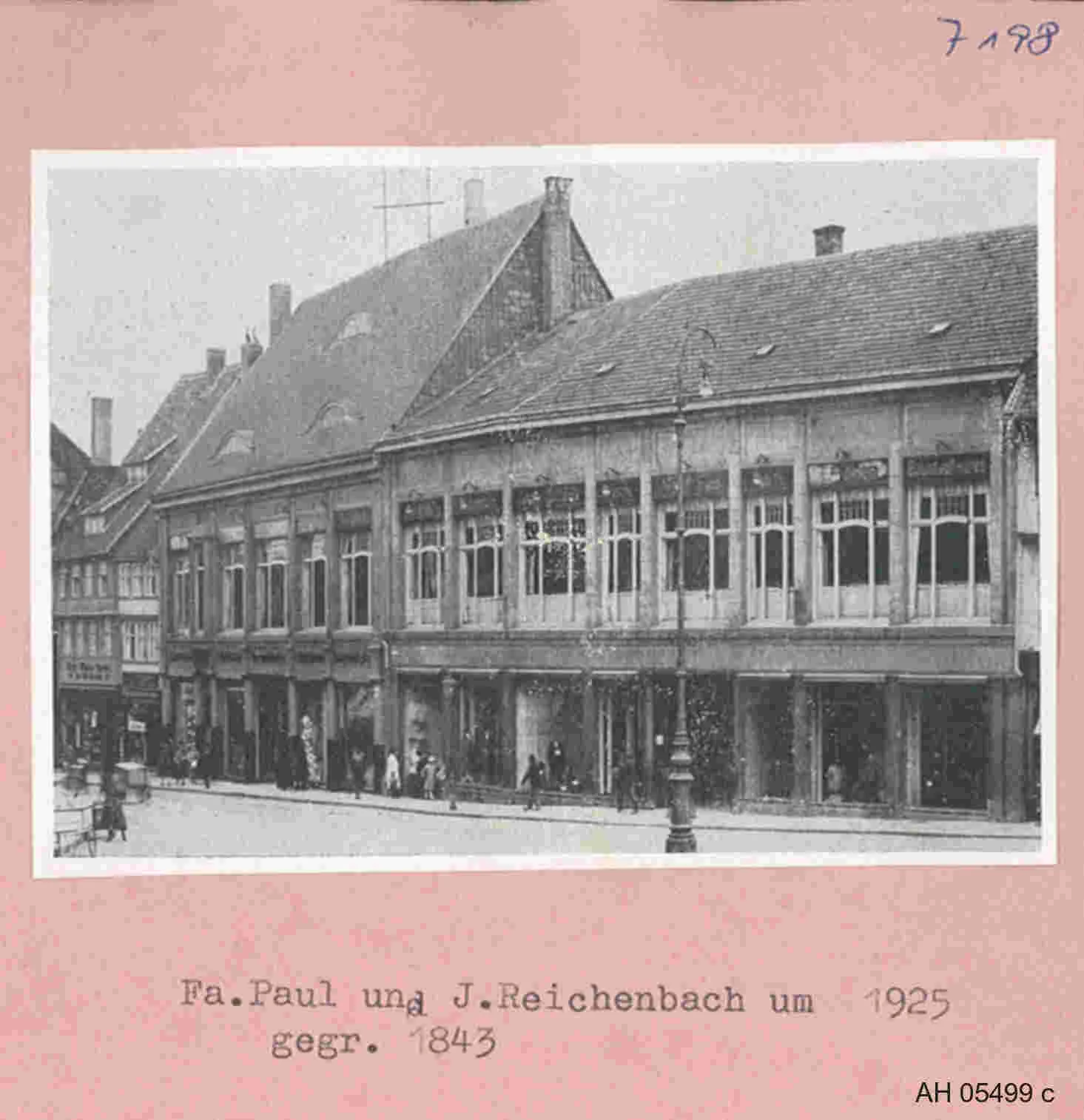
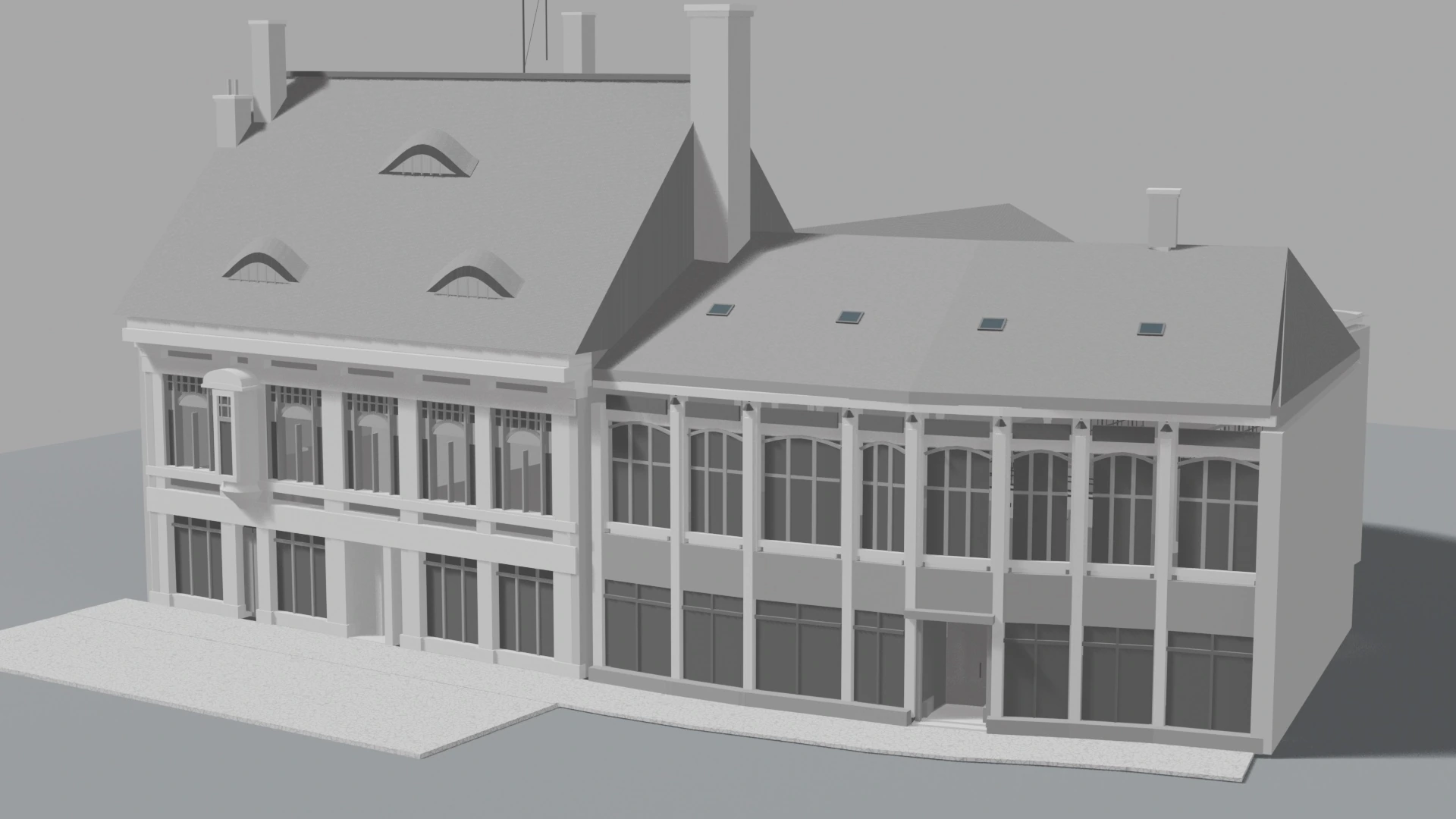
Evidence boundary. The reconstruction is an interpretive working model: plausible and proportional, not surveyed or metrically verified. The museum photograph, model render and proposed public concepts on this page have different evidentiary status. Appearance here does not imply institutional sponsorship or endorsement; reuse terms for the historical photograph remain with the holding institution.
Working-model film · 90 seconds
Working 3D research model, 2026 — interpretive reconstruction, not a historical photograph. Updated exterior, wooden entrance and statue views; colors and unseen geometry remain provisional. Music: 'Remembrance,' Jeffrey Ryan Smoots (BMI), licensed via Pond5. Historical photographs: Städtisches Museum Halberstadt (AH F 05499c, AH F DS 0099) and the Reichenbach Family Archive.
Audio-described transcript · EnglishThe shop in the city
Founded in 1843, J. Reichenbach was part of Halberstadt’s everyday economy. The firm advertised 1,500 winter coats in 1902 and described a large trade in men’s, boys’ and occupational clothing in 1931.
Under Nazi rule the firm was removed from family control. Surviving records make commercial succession visible by 1938, but do not establish every legal step. Halberstadt’s old town was largely destroyed on 8 April 1945, and the building did not survive.
The photograph, building files, advertisements and family objects constrain the working model. Where they fall silent, the model stays marked as interpretation.
How confidence is recorded
The method makes uncertainty inspectable instead of smoothing it away. Unknown or unresolved areas remain marked as such, and independent professional review is still required.
A feature’s presence or identity is directly supported by an architectural record or historical photograph.
Evidence constrains position, proportion or relationship, but does not provide measured geometry.
A feature is needed for structural, circulation or weather logic and remains compatible with the record.
A historically plausible reconstruction fills a gap and remains explicitly provisional.
Proposed museum interaction · not built. A future visitor interface could move between a neutral view and an evidence-confidence view while preserving these classifications.
What might be made later
These ideas are not existing products, funded work or institutional commitments. Any one of them would require review before its form or scope could be decided.
Proposed · not built
01A visitor could move through the model while switching on the evidence status of each feature.
Proposed · not built
02A screen could place the 1925 photograph, other sources and the interpretation side by side.
Proposed · not built
03At the historical address, a later study could ask whether the lost frontage can be placed responsibly against the present street.
Proposed · not built
04Students could compare what the photographs show with what the model has had to infer.
What the model could help visitors ask
A reviewed reconstruction could place Jewish commercial life, Nazi dispossession and the destruction of Halberstadt’s old town around one documented address.
Its use would depend on keeping the questions visible: what a photograph establishes, what a plan constrains and what the model has had to infer.
Distinguish documented evidence from plausible reconstruction.
Trace Jewish commercial life and Nazi dispossession through primary sources.
Explain how responsible reconstruction records uncertainty rather than concealing it.
How to read this page
The Reichenbach Family Archive is independent and descendant-led. It labels each kind of image so interpretation is not mistaken for evidence and access is not mistaken for a reuse license.
Before anything is built
Phase 0 is an invitation to check the sources, seek the missing building files and decide whether any public work should follow.
Compare v11.12 with the photographs and architectural record.
Seek access to Stadtarchiv Halberstadt files 2/2485 and 2/2486.
Write down corrections, unresolved geometry and evidence gaps.
Only then decide whether any public form should be scoped and costed.
No production commitment at this stage
This first review does not assume an existing partner, secured funding or a predetermined public format. Later work would address additional records, model calibration, professional production, public testing and long-term preservation.
The historical record
The shop page presents the building, interiors, advertisements, surviving objects, property records and the documented history of dispossession.