Where they lived, worked, and wrote

The streets that still hold their names

This modern photograph shows Martiniplan and Hoher Weg after wartime bombing destroyed the Reichenbach building. A visitor photographed the rebuilt streets where the family’s store once stood. The view locates the quarter today, but it does not preserve the historic shop footprint by itself.RB-PHO-0053

The family’s streets

Hoher Weg and Martiniplan

Hoher Weg and Martiniplan held the Halberstadt store. Breite Straße held Jeanette’s shop in Wernigerode. At the Carlton Hotel in St. Moritz, Dolf sat down on 26 November 1938 and wrote to Mutti.

This is the map room: the ground beneath the family story. Enter the Shops room for the department store and its objects, or follow the family through the lives that moved between these addresses.

The places the records name

From the Harz to refuge abroad

Letters, civil records, photographs and family memory place the Reichenbachs in these towns and streets. These are the towns and streets the papers name. They do not invent the roads between them.

This room follows locations rather than retelling every life or every commercial record: Family carries the family narrative, and Shops carries the exhibition of the Halberstadt businesses.

Halberstadt · Commercial center

Hoher Weg 27 / Martiniplan 10

The two adjoining premises were remade between 1910 and 1913 as the J. Reichenbach department store. The building was destroyed in the bombing of Halberstadt in 1945; its modern replacement now stands within a streetscape transformed by the war and reconstruction.

The Shops room holds the building’s full commercial history and object exhibition. Here, the record stays with its changing place in the city.

Municipal photographs show the façade, the adjoining block and the streets around it. Their source records remain linked with each image.

Search the Städtisches Museum Halberstadt finding aid for AH_F_DS_0099 and AH_F_05499c

Halberstadt’s ruined center after the bombing of 8 April 1945, with the damaged Martinikirche at right. The exact date and camera position are unrecorded.Open source record RB-SCAN-040

8 April 1945 · destruction and absence

The commercial center after the bombing

The City of Halberstadt records that incendiary bombs reduced the city center and large parts of the old town to rubble on 8 April 1945. The family’s department-store building at Hoher Weg 27 and Martiniplan 10 was among the structures lost.

This family-held print looks across the ruined center toward the damaged Martinikirche. It shows the physical destruction that later remade the family’s commercial quarter, though not every ruin in the frame belonged to the Reichenbach property. The exact camera position and date of the photograph remain open questions.

City of Halberstadt: history and destruction of the center

Family addresses

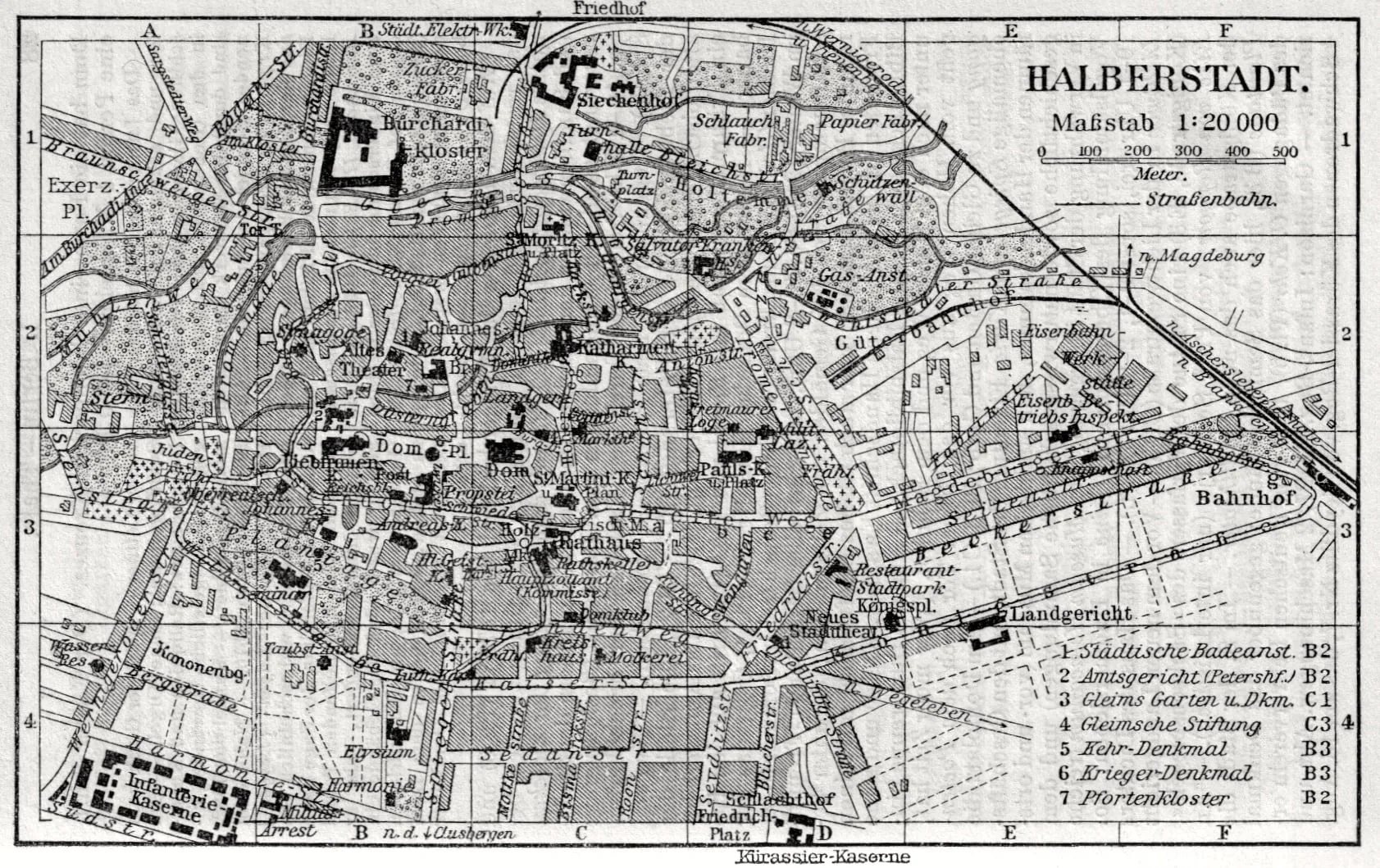
Three Halberstadt records on a 1912 plan

This public-domain city plan is contemporary with Paul’s Martiniplan years and the rebuilding of the family store. The numbered overlays identify documented street corridors; changes in numbering and wartime destruction prevent them from proving exact surviving building footprints.

Black-and-white 1912 city plan of Halberstadt showing the historic street network123
Halberstadt city plan from Meyers Reisebücher, Harz, 21st edition, 1912. Open the public-domain source map EXT-MAP-HALBERSTADT-1912
  1. 1

    1909–1913

    Martiniplan 19/21

    Paul’s address in the Halberstadt Alpine Club rolls during the years in which the neighboring commercial property was being remade.

  2. 2

    1930–1932

    Moltkestraße 46

    Paul’s address in Ruth’s 1930 marriage record and the 1931/32 Alpine Club membership roll. The street is now Rudolf-Breitscheid-Straße.

  3. 3

    1935

    Sedanstraße 52

    Paul’s final recorded home and the place of his death on 20 November 1935. The street is now Thomas-Müntzer-Straße.

Schwerin · family and marriage

Goldine Marcuse’s city

Goldine Marcuse was born in Schwerin on 8 February 1850. She married Adolf Reichenbach there on 27 July 1872, joining a Schwerin Marcuse household to the Reichenbach family in Halberstadt.

The family Ahnentafel names her parents as the merchant Louis Marcuse and Johanna Cohn. Paul’s Halberstadt birth record independently names Goldine and Adolf as his parents.

Read Goldine’s biography and evidence note →

Wernigerode · Breite Straße 7

The same family, in another Harz town

Salomon Gustav Reichenbach, son of Jacob and Helene and brother of Adolf, established his household in Wernigerode with Jeanette Rosenbaum. A 1938 photograph records Jeanette’s J. Reichenbach name above the display windows. Daniel’s present-day photograph returns to the same number, where a shop still opens to the street and four Stolpersteine outside name Jeanette, Fritz, Martha and Werner Reichenbach.

Follow the complete Wernigerode branch, its records and images →

The 1938 storefront is an external-source research image. The present-day exterior is Daniel Reichenbach’s family research photograph; the individual Stolperstein photographs are published under CC BY-SA 4.0 with the photographer’s credit and source links.

The J. Reichenbach storefront at Breite Straße 7, Wernigerode, photographed in 1938.Open source record WERN-1938
This modern photograph shows the Wernigerode building where Jeanette and Fritz Reichenbach kept the family shop. Four Stolpersteine now lie outside the surviving shopfront. The building connects the address to the street today, but its present appearance is not proof of the 1930s interior.RB-PHO-0054

Four names at one address

The Stolpersteine

Each photograph opens with its maker, source, and license.

The stone records Jeanette Reichenbach’s deportation to Theresienstadt and her death there on 25 October 1942. The stone lies outside the Wernigerode house where Jeanette kept the shop. It names her deportation and death, but it does not preserve the half-room and rent recorded in her Berlin papers.Open source record RB-EXT-CC-0003
The stone records Fritz Reichenbach’s arrest, imprisonment in Buchenwald and death there on 22 November 1938. The stone was laid outside the Wernigerode house where Fritz had lived and kept the shop. It is a public memorial, not the camp file that records the details of his imprisonment and death.Open source record RB-EXT-CC-0002
This photograph shows the Stolperstein laid for Martha Reichenbach at Breite Straße 7 on 14 April 2009. Its inscription reads “tot 1944 bei Bombenangriff.” The Gestapo and Berlin deportation file instead places her in the 33rd Osttransport of 3 March 1943, classed for Auschwitz; the stone is a local memorial inscription, not evidence of her last hour or registration on arrival.Open source record RB-EXT-CC-0004
This modern memorial stone lies outside the Wernigerode home of Werner Reichenbach’s family. The inscription names his flight in 1939 and survival in Brazil. It marks those facts in public space, but it does not tell the later life he built there.Open source record RB-EXT-CC-0005

St. Moritz · 26 November 1938

The Carlton Hotel

The hotel’s letterhead and the St. Moritz dateline place Dolf at the Swiss threshold of exile. From here he asked his mother to hold her head high and look forward to the family being together again.

Read the letter, transcription and English translation →

This historical photograph shows the Carlton Hotel in St. Moritz sometime between 1918 and 1937. Dolf wrote to his mother from this hotel on 26 November 1938. The picture places the building before us, but it does not show Dolf or the room in which he wrote.Open source record RB-EXT-PD-0007

The wider landscape

Jewish Halberstadt and remembrance

The family’s addresses belonged to a larger civic and Jewish geography, from Judenstraße and the synagogue quarter to the Stolpersteine in Wernigerode.

Judenstraße, the center of Jewish settlement in Halberstadt from the Middle Ages. The photograph lets us locate a street at the center of Jewish life in the city. It does not identify a Reichenbach home or shop.RB-PHO-0048
This photograph shows the surviving vestibule wall of the synagogue inaugurated in 1712. Visitors now stand beside a fragment left after desecration and demolition. The wall preserves part of the building, but not the sanctuary or the life once held inside it.RB-PHO-0043
These four memorial stones name Fritz, Jeanette, Martha and Werner Reichenbach outside their Wernigerode home. The inscriptions bring the household together at the address where they lived and worked. They are modern memorial texts and do not replace the separate records for each life.RB-PHO-0059

Domplatz · remembrance in the civic center

Names returned to the city

Beside Halberstadt Cathedral, memorial stones carry names and dates of Jewish residents persecuted and murdered under National Socialism. Family photographs from the 2022 return preserve both the setting and the act of looking for Reichenbach names.

Each photograph opens to its source, treatment note and a complete translation or an explicit reading note where the visible inscription consists only of names and dates.

The Stones of Remembrance beside Halberstadt Cathedral. The memorial names the Jews taken from the city, among them Kurt Reichenbach, Paula Wollenberg and Hans Wollenberg. It does not record what happened to them after Warsaw.RB-PHO-0042
This photograph shows names and life dates cut into Halberstadt’s Stones of Remembrance. The artist and city placed individual people back into public view. The frame records the installation, but it is not a complete legible inventory of every stone.RB-PHO-0018
Kurt Reichenbach among Halberstadt’s memorial names. Daniel photographed the name during the family’s return to Halberstadt. The stone marks Kurt’s removal from the city; it does not add a fate after Warsaw.RB-PHO-0023
This modern memorial stands beside Halberstadt Cathedral for the town’s persecuted and murdered Jews. Residents and visitors encounter the names in the center of the city. The photograph records the memorial in place, but not every inscription closely enough to read.RB-PHO-0008

Klein Quenstedter Straße · photographed and recorded

The Reichenbach stones

The family’s photographs preserve four named stones—Adolf, Paul, Salomon Gustav and Miriam Mathilde—and one further stone that cannot yet be identified responsibly. Select any photograph for its complete record, transcription, translation and related historical views.

Daniel and Paul J. Reichenbach · Halberstadt

Walking the family cemetery

Rabbi Daniel Dolph Reichenbach and his father, Paul J. Reichenbach, made this visit together during the family’s return to Halberstadt. The brief film keeps the cemetery’s own sound: footsteps, wind and birdsong.

The family record now names eighteen Reichenbach burials across two Halberstadt Jewish cemeteries. Some exact relationships remain unresolved, but the span of those graves—from 1833 to 1936—makes the larger fact unmistakable. The Reichenbachs were not passing through Halberstadt. Generations lived, worked, married, raised children and died there.

A walk through the Jewish cemetery at Klein Quenstedter Straße during Daniel and Paul J. Reichenbach’s return to Halberstadt. Family video · 27 May 2022

Visual and audio description: Daniel walks past Adolf and Goldine Reichenbach’s grave, visible on the right at the beginning, and continues among the overgrown rows of stones. Long grass moves around the graves while birdsong fills the cemetery.

About this film

A walk through the Jewish cemetery at Klein Quenstedter Straße during Daniel and Paul J. Reichenbach’s return to Halberstadt.

Archive reference
RB-VID-0007
Date
27 May 2022
Evidence
Family-held modern video
Source
Family video recorded 27 May 2022 and exported from the family Photos library album “Friedhof Halberstadt”; archival MOV and a 720p H.264 web derivative preserved by the Reichenbach Family Archive.
Credit
Reichenbach Family Archive
License or permission
Family-owned video; cleared for publication by the archive owner.
Media treatment
The source HDR MOV and a 720p H.264 derivative are preserved in the canonical archive. A compact mobile-friendly derivative is published here; its sequence and original sound are unchanged.
Text and translation
No spoken narration or visible running text requires translation. The original cemetery sound is preserved.
This photograph shows the German face of Adolf Reichenbach’s gravestone in its present condition. The stone gives 5 Tevet 5661, corresponding to 26 December 1900, while the cemetery register records 27 December. Both dates remain visible because the photograph cannot decide which record is correct.RB-PHO-0298
This photograph shows the Hebrew face of Paul Reichenbach’s gravestone after it was cleaned. Daniel’s family visit made the letters easier to see without replacing the stone’s weathered surface. The image records the cleaned condition, but not every stage of the inscription’s earlier wear.RB-PHO-0299
This photograph shows the gravestone of Salomon Gustav Reichenbach. Mourners placed the stone for the man whose household and business carried the family into Wernigerode. It secures his burial and identity, but does not tell the full history of the branch.RB-PHO-0300
This gravestone belongs to Moritz Reichenbach, the merchant connected with Quedlinburg and recorded in Hebrew family evidence as Moshe HaLevi. Mourners placed the stone in the Halberstadt cemetery beside his wife’s plot. It identifies this household, but their relationship to the principal Jacob–Adolf–Paul line remains unresolved.RB-PHO-0078
This photograph shows the Hebrew gravestone of Miriam Mathilde Reichenbach née Loewenthal. The inscription names her husband as Moshe HaLevi, whom the cemetery register identifies as Moritz Reichenbach in the adjoining plot. It establishes that household and date, but their relationship to the principal family line remains unresolved.RB-PHO-0301
This companion photograph shows the German face of Miriam Mathilde Reichenbach’s gravestone. The inscription gives the same Hebrew date as the adjoining face and names her in German. It confirms the two sides belong to one stone, but it does not resolve the household’s wider family connection.RB-PHO-0323

Miriam · Mathilde

A Hebrew name, a civil name, one woman

The stone and cemetery register identify her as Miriam Mathilde Reichenbach, née Loewenthal, wife of R. Moshe HaLevi Reichenbach. The adjoining register entry records the same husband under his civil name, Moritz Reichenbach, a merchant connected with Quedlinburg; the register also records their child Paul, who died in 1904.

The Hebrew face and the German face both give 4 Tevet 5689, corresponding to 17 December 1928 and exactly matching the cemetery register. Read Miriam Mathilde’s sourced biography → Read Moritz · Moshe HaLevi’s sourced biography →

Hebrew transcription

פ״נהאשה החשובה מ׳תמרים מאטהילדעאשת ר׳ משה הלוי רייכענבאךהלכה לעולמה ד׳ טבת תרפ״טאשה צנועה וכשרהעטרת בעלה ובניהחסד וגמלה לחיים ולמתיםביתה פתוחה לענייםוזכרה הטוב לברכהתנצב״ה

Full English translation

Here is buriedThe important woman, Mrs.Miriam MathildeWife of R. Moshe HaLevi ReichenbachShe passed away on the 4th of Tevet 5689A modest and righteous woman,Crown of her husband and her children.[She performed] kindness and charity for the living and the dead.Her house was open to the poor.May her good memory be for a blessing.May her soul be bound in the bond of life.

Institutional cemetery register · 18 burials

Names preserved beyond the photographed stones

A register supplied by Jutta Dick of the Moses Mendelssohn Akademie records Reichenbach burials in two Halberstadt Jewish cemeteries. A name in the register proves a burial; it does not by itself prove how that person fits into this family.

Halberstadt Jewish cemetery

Am Berge

The older Halberstadt Jewish cemetery. The register preserves four Reichenbach burials here, but does not identify their surviving stones.

  1. Abraham Reichenbach

    1780 — 6 February 1833

    Stone not identified

    Merchant.

  2. Täubchen Reichenbach, née Grank

    1788 — 14 November 1861

    Stone not identified

  3. Isaak Reichenbach

    1814 — 17 November 1872

    Stone not identified

  4. David Otto Reichenbach

    1851 — 20 August 1857

    Stone not identified

    A child whom the family genealogy records as a son of Jacob and Helene.

Halberstadt Jewish cemetery

Klein Quenstedter Straße

The later cemetery photographed by the family. The register supplies names and plots even when a stone has not yet been matched to a photograph.

  1. Adolf Reichenbach

    26/27 December 1900

    A 19

    Paul’s father. The stone gives 5 Tevet 5661, corresponding to 26 December; the cemetery register records 27 December.

  2. Helene Reichenbach, née Heynemann-Löwenheyn

    1 October 1903 in the register

    F 5

    Jacob’s wife; another family source gives 12 October, so both dates remain preserved.

  3. Paul Reichenbach

    died 18 October 1904

    D 2

    A child of the Quedlinburg merchant Moritz Reichenbach; not Paul Reichenbach (1876–1935).

  4. Georg Reichenbach

    died 31 October 1909

    G 15

  5. Goldine Reichenbach, née Marcuse

    died 12 October 1913

    A 20

    Adolf’s wife and Paul’s mother.

  6. Amalie Helft, née Reichenbach

    died 4 January 1915

    F 20

  7. Fanny Reichenbach

    died 10 September 1915

    K 7

    Recorded as unmarried.

  8. Lina Reichenbach, née Asch

    died 14 December 1918

    II 9

  9. Ludwig Reichenbach

    died 7 May 1920

    II 10

  10. VIII 3

    Jacob and Helene’s son, Adolf’s brother and the documented link to the Wernigerode branch.

  11. Miriam Mathilde Reichenbach, née Loewenthal

    4 Tevet 5689 · 17 December 1928

    VIII 5

    Her Hebrew stone names her as the wife of R. Moshe HaLevi Reichenbach, the Moritz Reichenbach recorded in the adjoining plot. The household’s relationship to the principal family line remains unresolved.

  12. Betty Hirsch, née Reichenbach

    died 16 September 1929

    VII 8

  13. Paul Reichenbach

    20 October 1876 — 20 November 1935

    XXIV 19

    The Halberstadt merchant, civic participant and father of Ruth and Dolf.

  14. VIII 6

    A Quedlinburg merchant, husband of Miriam Mathilde and father of the child Paul; his plot adjoins hers.

Recorded stone · identity still open

A monument that cannot yet be matched responsibly

This additional photograph preserves a stone among the family’s cemetery images whose name, date and relationship cannot yet be read securely. It belongs in the archive without being forced into the family tree.

This Hebrew-inscribed stone appears among the family’s cemetery photographs. Someone visiting the Halberstadt cemetery photographed it, but the surviving image does not allow a responsible reading of the name or date. Its presence in the group suggests attention, not a proven Reichenbach identity.RB-PHO-0011

Through this family

The cemetery is a family archive

Eighteen people named Reichenbach are recorded across two Jewish cemeteries in Halberstadt. The register does not prove that every person belongs to the same branch, but the concentration of names shows a family presence extending beyond the few lives most fully documented here.

Paul was already pursuing that history in 1935. In a surviving letter he planned to visit the cemetery at Gröbzig to learn how many Reichenbachs were buried there. Descendants now repeat his work in Halberstadt: reading stones, testing relationships and refusing to turn an old surname into a claim the evidence cannot support.

Sources and evidence: Halberstadt Jewish cemetery register supplied by Dr. Jutta Dick · Paul’s 1935 genealogy letter

Return through research · Halberstadt

Two stones, two acts of care

These family videos record Daniel caring for two Reichenbach gravestones in Halberstadt: his great-grandfather Paul’s, and his great-great-grandfather Adolf’s, a few steps away.

Paul Reichenbach · Halberstadt

Cleaning Paul’s gravestone

Rabbi Daniel Dolph Reichenbach cleans the Hebrew face of Paul Reichenbach’s gravestone. Family video · 27 May 2022

Visual description: Daniel kneels beside Paul’s gravestone and gently clears its weathered surface by hand.

Paul’s Hebrew inscription names him Yaakov son of Avraham.

Adolf Reichenbach · Halberstadt

Cleaning Adolf’s gravestone

Rabbi Daniel Dolph Reichenbach cleans the Hebrew face of Adolf Reichenbach’s gravestone. Family video · 2022

Visual description: wearing a red kippah, Daniel works across the Hebrew face of Adolf’s gravestone so that its inscription can be read again.

Adolf Reichenbach was Paul’s father and the family’s Halberstadt merchant. His stone carries his name in both languages: Adolph Reichenbach on the German face, Baruch Achiezer on the Hebrew.

This photograph shows the Hebrew face of Adolf Reichenbach’s gravestone in Halberstadt. Mourners named him Baruch Achiezer and praised his integrity and good works. The stone preserves his name and death date, but weathering prevents a letter-perfect reading of every line.RB-PHO-0090

Hebrew · normalized reconstruction

פ״נ

האיש היקר ר׳ ברוך אחיעזר

המכונה אדולף רייכענבאך

איש צדיק אשר הלך בתום

גדול בעצה ובמעשה ידיו

ישר אמריו רב פעלים ומטיב לבריות

בוכים אנו בעמדנו פה ולבנו נשבר

שים רחמיך ביד מנחיל נחלה רבה

נפטר ביום ד׳ ה׳ טבת שנת תרס״א לפ״ק

תנצב״ה

The stone is weathered. This normalized Hebrew reconstruction follows the preserved reading and is not presented as a letter-perfect diplomatic transcription.

English translation

Here lies Baruch Achiezer, known as Adolf Reichenbach.

A righteous man who walked with integrity; great in counsel and in the work of his hands, upright in speech, performing much good, and beneficial to others.

We weep as we stand here, our hearts broken. Place Your compassion into the hand of the One who grants abundant inheritance.

He passed away on Wednesday, the 5th of Tevet, in the year 5661, according to the minor reckoning — 26 December 1900.

May his soul be bound in the bond of life.