Halberstadt · a name above the glass
Hoher Weg 27 · Martiniplan 10
The clothing house · founded 1843
A family business remade beneath glass
For nearly a century this family sold clothes in two Harz towns. Hoher Weg 27 and Martiniplan 10 were a German house: court purveyor, glass roof, a name on the hanger. Then the name was taken.
The firm kept 1843 as its founding year. It began with Jacob Reichenbach, then passed through his widow and sons before later generations divided the work between J. Reichenbach and Paul’s women’s-clothing house.
Between 1910 and 1913, Hoher Weg 27 and neighboring Martiniplan 10 were rebuilt into a unified department store by Gebrüder Reinecke. Two tall selling floors, a curved staircase and a glass roof over the former courtyard created the Lichthof pictured in the firm’s advertising stamps.
Later generations noticed that they lived on a street whose name translates the Halberstadt one. The American address is not published.
The building file · 1913 and 2004
The façade is known through the building record.
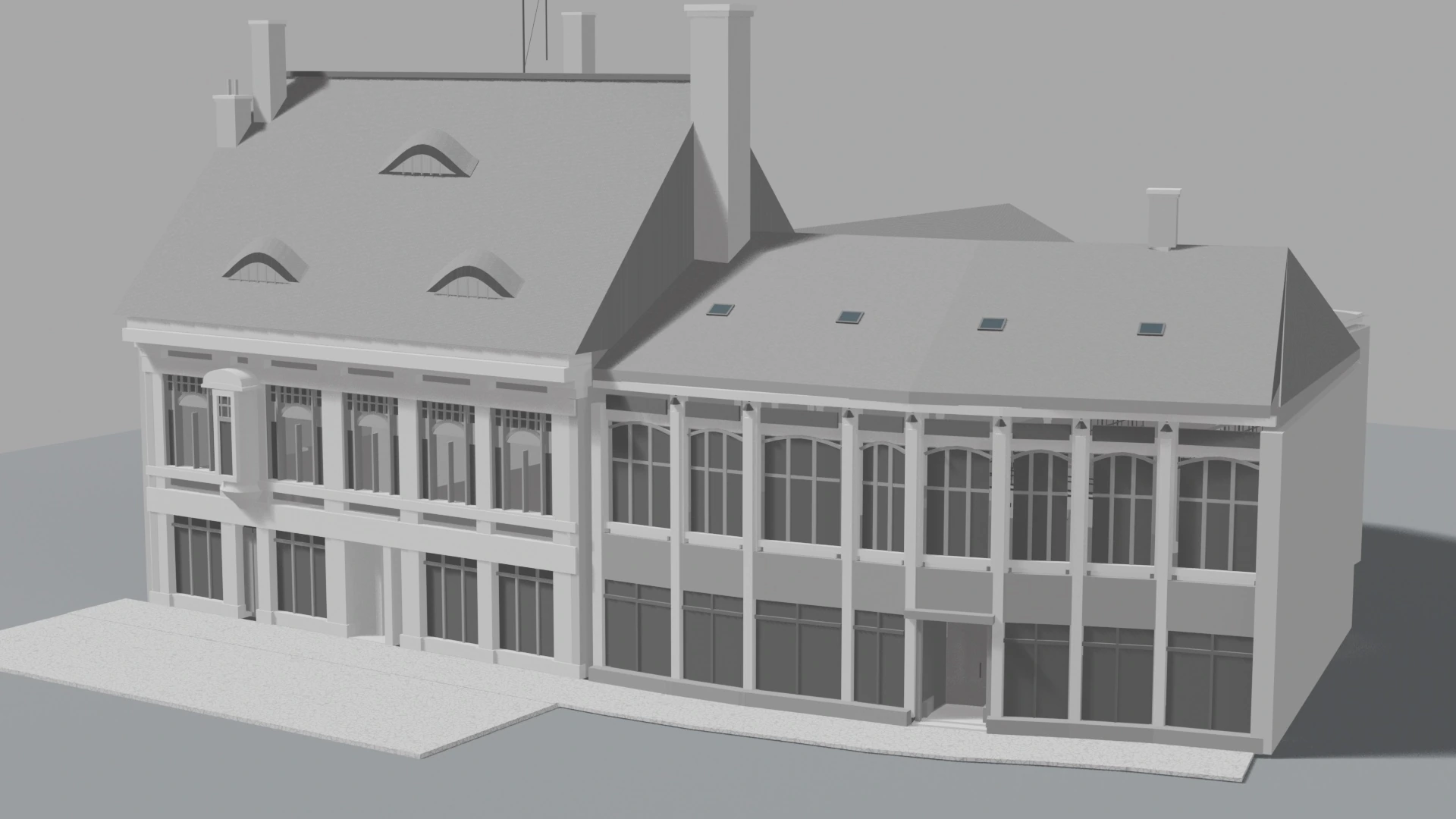
Lüdemann and Kröger’s published 2004 plate reconstructs the connected plan and street elevations from Halberstadt’s municipal building files, whose drawings span November 1910 through December 1913. It is a scholarly reconstruction, not an original 1913 measured drawing. The archive’s separate AI façade image is an interpretive presentation; it is not a scan or facsimile.
A scholarly reconstruction
One plate reconnects Hoher Weg and Martiniplan.
Monika Lüdemann’s study places the connected ground plan above the Hoher Weg and Martiniplan elevations. The plate credits the reconstruction to Lüdemann and the drawing to Nicola Kröger, and the following page cites Stadtarchiv Halberstadt, Stadtbauamt 2/2485 and 2/2486.
The plate should be read as a transparent secondary reconstruction from those files. Exact dimensions and linework still belong to the original municipal drawings.
AI reconstruction · interpretive, not an original scan
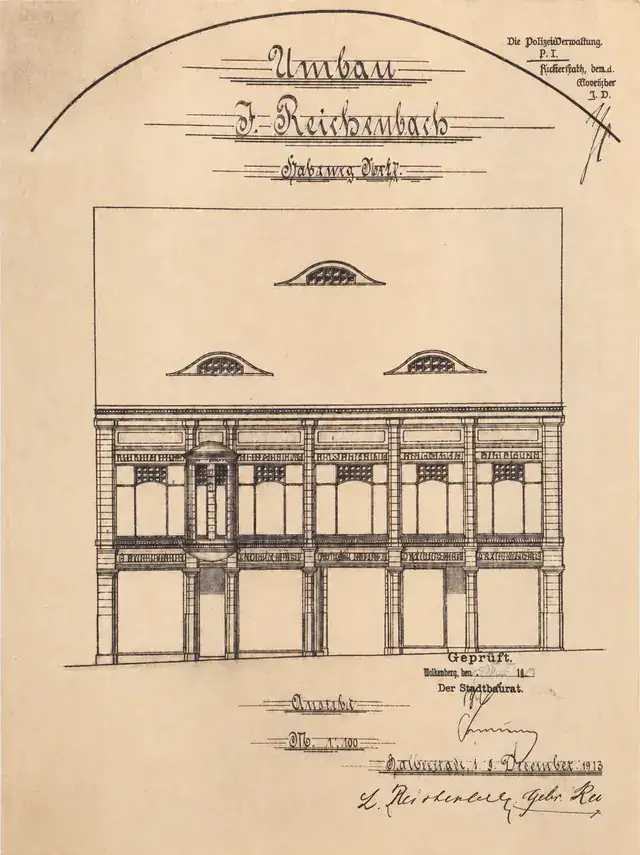 Reconstruction and provenance · 2 viewsAI reconstruction of the J. Reichenbach façade drawing and provenance viewThe labeled 2026 interpretation is followed by the museum display that identifies Stadtbauamt files 2/2485 and 2/2486. Exact details must be checked against the original document.Open all views
Select any view for a larger image, source and archive details.
Inside the Lichthof · 1925–1930
The plans become a working sales floor.
The surviving interior view runs from the curved staircase through counters and stocked wall shelving to the rear of the store. Its upper balustrade makes the two selling levels read as one room.
Three museum copies preserve the same scene. Their mounts, crops and catalogue notes show how the photograph was preserved and described over time.
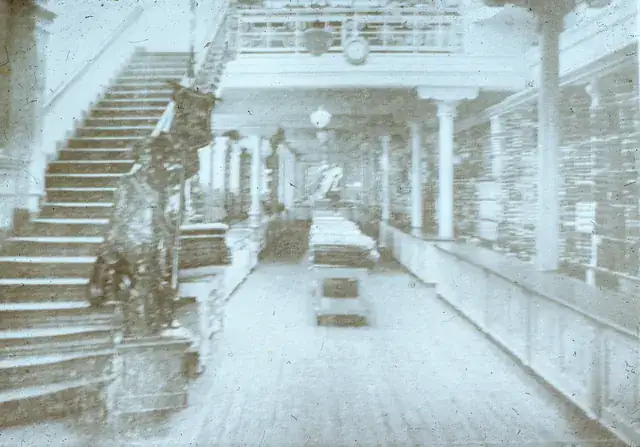 Municipal photograph group · 3 viewsInside Kaufhaus ReichenbachA direct slide and two mounted prints preserve the same sales-floor photograph and its catalogue history.Open all views
Select any view for a larger image, source and archive details.
The whole building
The façade survives in several records.
The family-held night photograph records the tall glazed wall and illuminated displays, but its surviving frame does not show the complete building. Four daytime municipal photographs supply the missing façade, block and street context; an open-use 1909 photograph shows Hoher Weg as a retail street before the Reichenbach rebuild.
Sources: Städtisches Museum Halberstadt; Sigurd Curman / DigitaltMuseum / Wikimedia Commons. Each object record states whether the image is store evidence or street context.
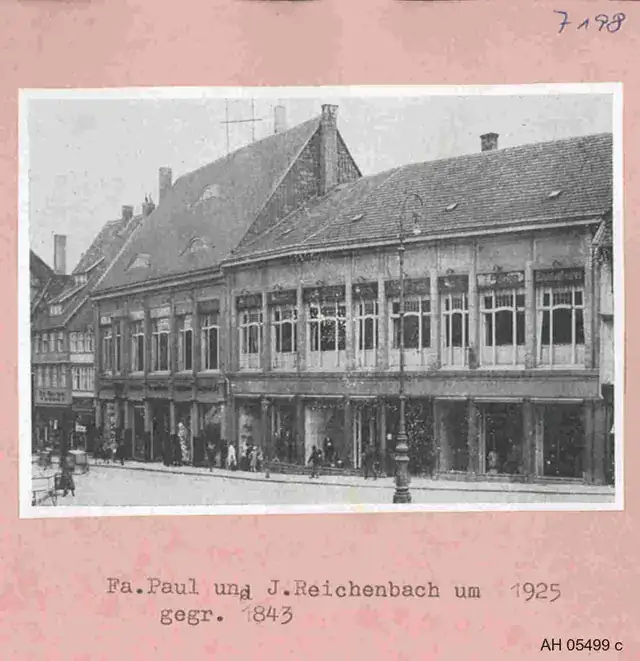 Daytime photograph group · 5 viewsThe façade and its streetFour municipal views document the commercial block. Sigurd Curman’s 1909 photograph is contextual, not a view of Hoher Weg 27.Open the five street views
Select any view for a larger image, source and archive details.
The commercial block after dark · c. 1935
The windows changed the street at night.
The direct slide identifies Kaufhaus Reichenbach within Martiniplan 10, 9 and 8, opposite No. 11. Its long row of illuminated windows shows the store as part of a larger nighttime retail environment rather than an isolated façade.
A mounted print of the same scene adds a handwritten 1935 identification and preserves the museum’s paper mount.
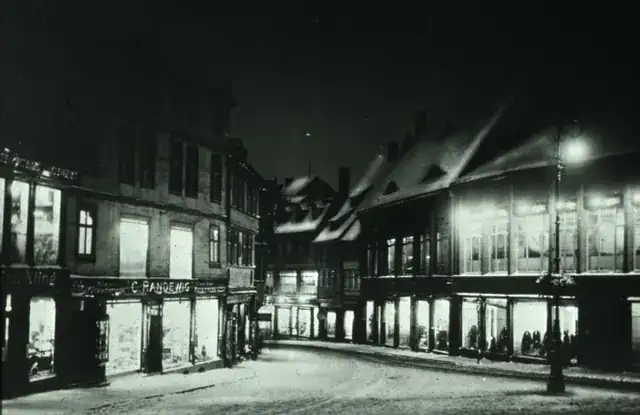 Municipal photograph group · 2 viewsHoher Weg and Martiniplan at nightThe direct museum slide is followed by a mounted print bearing a handwritten 1935 identification.Open all views
Select any view for a larger image, source and archive details.
The store’s own printed rooms
Twelve advertising stamps
The surviving Reklamemarken lead from the façade through the light court, staircase, sales floors, fitting room and workshops.
1866–1905 · four notices
The firm passes through the family
On 22 March 1866, the Prussian state gazette placed Jacob Reichenbach in Halberstadt’s firm register as owner of J. Reichenbach. It is the first public register act yet found, though the house’s own advertisements continued to give 1843 as the founding year.
Three years later Wernigerode was registered as a branch while Jacob was alive, with Adolph authorized to sign pp. J. Reichenbach. After Jacob’s death, the 13 March 1873 notice says the business passed durch Erbgang—by inheritance—to Helene and their sons Ludwig, Adolph and Gustav. On 4 April 1905, Gustav and Goldine left the partnership and Ludwig continued alone.
The records behind the store
One address, several businesses
In 1905, Ludwig Reichenbach appears as merchant of J. Reichenbach, court purveyor of men’s and women’s fashions, at Hoher Weg 27—printed in the directory as “Hoheweg.” A separate full-page advertisement signs the firm “J. Reichenbach, Halberstadt, Herzogl. Hoflieferant,” identifying the title as ducal; the particular duchy remains unknown.
In 1914, the address book names Ludwig and Willy Reichenbach as proprietors of J. Reichenbach and Paul and Ernst Reichenbach as proprietors of Paul’s women’s-fashion business. The printed listings name the proprietors but do not show their ownership shares or every legal relationship; Willy’s place in the family tree remains unknown.
In 1928, the directory again lists J. Reichenbach for men’s and boys’ clothing and Paul Reichenbach for women’s fashion at Hoher Weg 27 and Martiniplan 10, naming Paul and Ernst as proprietors. The 1917 award notice independently places Paul at Hoher Weg 27; the notice itself prints “Hoheweg.” The 1938 directory still shows both firms, while a printed correction deletes Paul’s women’s-clothing entry. That correction does not tell us exactly when or how the business closed.
Martiniplan 10 passed through Ludwig, Kurt, Paul’s firm, and later Ernst and Margarete in the land register. The sequence of owners is known, but the circumstances of every transfer are not.
1914 address-book records
Direct transcriptions
The business in its own words
From confirmation suits to 1,500 winter coats
The advertisements show a large, confident business with deep inventory and several kinds of customer. An early clipping directly courts Christian families buying clothing for confirmation students. By 1902, J. Reichenbach advertised in-house production and a stock of 1,500 winter coats.
In 1931, the firm presented itself as Halberstadt’s leading house for men’s, boys’ and occupational clothing. These records show a Jewish-owned store marketing broadly across the city; they cannot establish exact sales or profits.
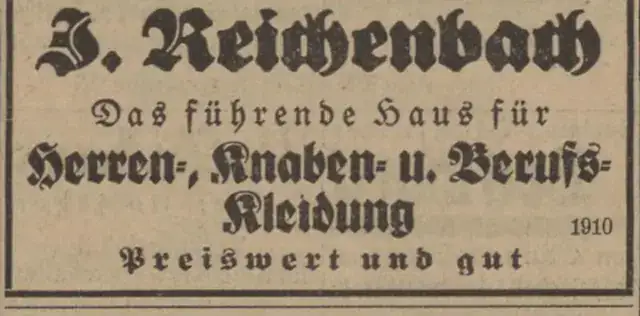 Two newspaper issues · 2 viewsJ. Reichenbach advertisement in Das ReichsbannerThe same advertisement appears in the 31 October and 14 November 1931 issues.Open all views
Select any view for a larger image, source and archive details.
8 October 1937 · Der Schild
The women’s-clothing firm still advertised after Paul’s death
Nearly two years after Paul died, a small national advertisement still offered P. Reichenbach women’s clothing and repeated the house’s 1843 founding date. It ran in Der Schild, the newspaper of the Jewish veterans’ association. That placement shows the firm addressing Jewish readers; it does not name Paul or the business to an RjF office.
A permissioned community discovery · September 2026
A jacket carried the shop name beyond the building.
An anonymous participant in an online discussion recognized the Reichenbach name on a jacket he owns and gave written permission for these photographs to be published. He reports a family memory that it was bought at the J. Reichenbach store around 1926 for his grandfather’s wedding, and that he later used it himself as a coat.
The photographs directly document the dark jacket and its woven “J. Reichenbach, Halberstadt” label. They also give physical form to a 1902 advertisement’s claim that coats made by the firm carried its name inside. The reported buyer, date and wedding connection remain family testimony: no purchase record, wedding record or period photograph has yet been found.
Patriotism and its cost
Patriotism at Hoheweg 27.
The 1917 notice awarded Paul Reichenbach the Verdienstkreuz für Kriegshilfe for his particular activity in patriotic auxiliary service. It addresses him as a merchant at Hoheweg 27, connecting that public service to the family business address. The document does not say exactly what Paul or the firm supplied, organized or financed.
Paul’s granddaughter Susan Reichenbach Heyman remembers an inherited account that Paul brought money held in Switzerland back to Germany and ultimately lost it. No bank, tax or foreign-exchange record has yet corroborated that account, so the archive preserves it as family testimony rather than financial fact. The family’s reflection about what the funds might have meant for flight is a counterfactual reflection, not a documented conclusion.
Family testimony: Susan Reichenbach Heyman, 5 August 2026 (RB-OH-0001) The notes are a generated meeting summary, not a verbatim transcript.
A customer’s memory · posted 6 May 2008
A warning remembered across generations
Jutta Keil recorded a story told by her mother, who was born near Halberstadt in 1925. Her mother remembered visiting the Reichenbach store with her parents, including after the November 1938 pogrom. The archive identifies the “old Herr Reichenbach” in this account as Kurt Reichenbach, Ludwig’s son, the man later listed at Dominikanerstraße 23.
Meine Mutter wurde 1925 als Bauerstochter in einem Dorf bei Halberstadt geboren und war nach der Grundschulzeit Schülerin im Pensionat in Halberstadt. Sie hat mir bis zu ihrem Tode viel über ihre Kindheit und Jugend erzählt.
Aber immer hatte sie beschäftigt, was wohl mit dem alten Herrn Reichenbach geschehen ist. Sie war mit ihren Eltern öfter bei Reichenbachs, mit ihrem Vater auch noch nach der Progromnacht. Ihr Vater, der 1940 starb, kaufte dort in der Herrenabteilung ein, sie sagte Reichenbachs waren bekannt für die gute Tuchabteilung. Es muss eine ganz bedrückte Stimmung geherrscht haben; als sie dann nochmals zu dem alten Herrn Reichenbach kamen, bat er meinen Großvater, nicht wiederzukommen, da es ja inzwischen für sie verboten war, dort zu kaufen. Meine Mutter sagte: Hoffentlich konnten sie sich retten.
Als ich im letzten Jahr mit meinem Mann in Halberstadt war, haben wir das Denkmal gesehen u. auch gesehen, dass keiner zurückgekommen ist.
Mit freundlichen Grüßen
Jutta Keil
In English: Keil’s mother remembered that the Reichenbach store was known for its cloth department. On a later visit, amid an oppressive atmosphere, Kurt asked Keil’s grandfather not to return because it had by then become forbidden for the family to shop there. Keil’s mother continued to hope that the Reichenbach family had escaped.
Source: Jutta Keil, comment posted 6 May 2008 to “Reichenbach, Familie,” Juden im alten Halberstadt. The vanished page survives in an Internet Archive capture dated 2 August 2016 ↗. The German text above is reproduced exactly, including the original spelling “Progromnacht.” The English paragraph is an archive summary, not a verbatim translation.
Can you help identify this family? The archive has not been able to identify the commenter beyond the name Jutta Keil. Her mother and maternal grandparents also remain unidentified. If you know who she was, or have information about her family, please contact the archive.
Through this family
Prosperity did not protect ownership
The store, property, travel and civic records describe a prosperous Jewish merchant family. Under Nazi rule, that standing became something the state and private buyers could exploit. Across Germany, “Aryanization” transferred Jewish-owned businesses and property to non-Jews through discriminatory law, pressure and sales made far below their value.
The archive can prove that mechanism directly at the family’s Wernigerode property, where the 1938 deed identifies Fritz as a Jew and requires official approval. For Halberstadt, a 1941 administrative list records Paul Reichenbach’s firm as “Aryanized by” Mennigen & Co. The list identifies the successor but not the price, purchase instrument or relationship between the business transfer and title to the building. Prosperity is part of the record; so are the limits of what it could protect.
Sources and evidence: USHMM: Aryanization · Halberstadt Aryanization list · Fritz Reichenbach’s forced-sale deed
The administrative record · 1 April 1941
The state’s own list names the successor.
Under “Kreis Halberstadt,” the headings read “Jüdische Firma” and “Arisiert durch”—“Jewish firm” and “Aryanized by.” The entry places Paul Reichenbach opposite Mennigen & Co. K.-G.
This is direct evidence of the Aryanization succession, but it is not the purchase contract. It does not give the exact transfer date, price, notarial instrument or property-title mechanism.
The address book · 1940
Mennigen’s textile house is still at Martiniplan 10.
The street-and-house register names “Halberst. Textilhaus Mennigen & Co.” at the exact former Reichenbach address. A separate alphabetical entry names Hans Mennigen as a Halberstadt merchant.
The directory does not say whether Hans Mennigen owned, managed or worked for the company. The shared surname makes the connection worth investigating, but it is not yet known.
The erasure made visible · listed as 1943
The building remains. The Reichenbach name is gone.
The illustrated postcard turns the former department-store façade into HATEX advertising. Enormous letters rise above the roofline; “HATEX, Mennigen & Co.” occupies the storefront where the Reichenbach businesses had stood.
The postcard is known through a watermarked marketplace photograph. The seller supplied the date 1943, but no reverse or postmark was available, so that date remains unverified. The visible card reads “Mennigen”; the listing title misspells it “Meiningen.”
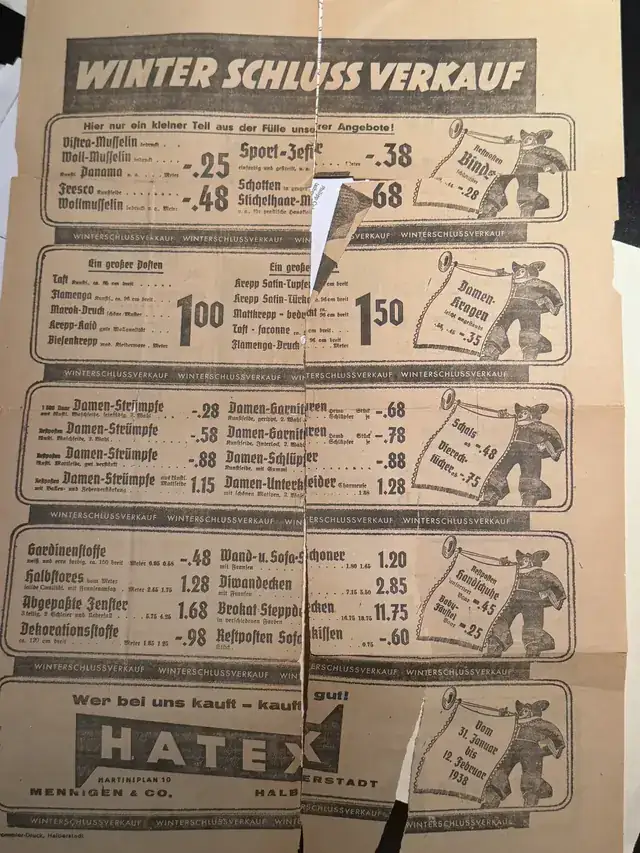 Family-held commercial ephemera · 2 viewsHATEX winter-sale handbillsFamily-held handbills identify the company as HATEX, Mennigen & Co., Martiniplan 10, and advertise both Halberstadt and Wernigerode.Open all views
Select any view for a larger image, source and archive details.
The address in public print · 1933–1938
The name above the same façade changed.
A museum comparison places a 1933 advertisement for P. Reichenbach beside a 1938 advertisement for the Halberstädter Textilhaus Menningen & Co. at Martiniplan 10. The museum caption uses the spelling “Menningen”; the official list and HATEX handbills read “Mennigen.”
Read together, the comparison, handbills, postcard and official list establish the documented commercial chain. They do not supply the purchase instrument, transaction price, exact transfer date or complete later legal history.
Further municipal records
The photographs lead into four Halberstadt dossiers.
These catalogue records contain street studies, newspaper material, address-book extracts and research on Jewish Halberstadt. Their complete museum records are linked below for further research.
- AH D 0020 · Die Schmiedestraße - einst und jetztA municipal dossier that includes Werner Hartmann material on Kaufhaus Reichenbach and Warenhaus Cohn.
- AH D 0139 · MartiniplanA 37-page street dossier containing Kaufhaus Reichenbach references, newspaper advertisements and articles.
- AH D 0530 · Die Jüdische Gemeinde Halberstadts und ihre Schicksale 1933–1942A research dossier containing address-book extracts and material on the city's Jewish community under Nazi rule.
- AH D 2205 · Juden und jüdische Schicksale in HalberstadtA wider dossier that also points toward the connected Wernigerode history.
A name from the workforce
A published account names Willy Friedländer as a Reichenbach clothing-house employee. The precise business and employment dates remain unverified.
Read the attributed finding and its source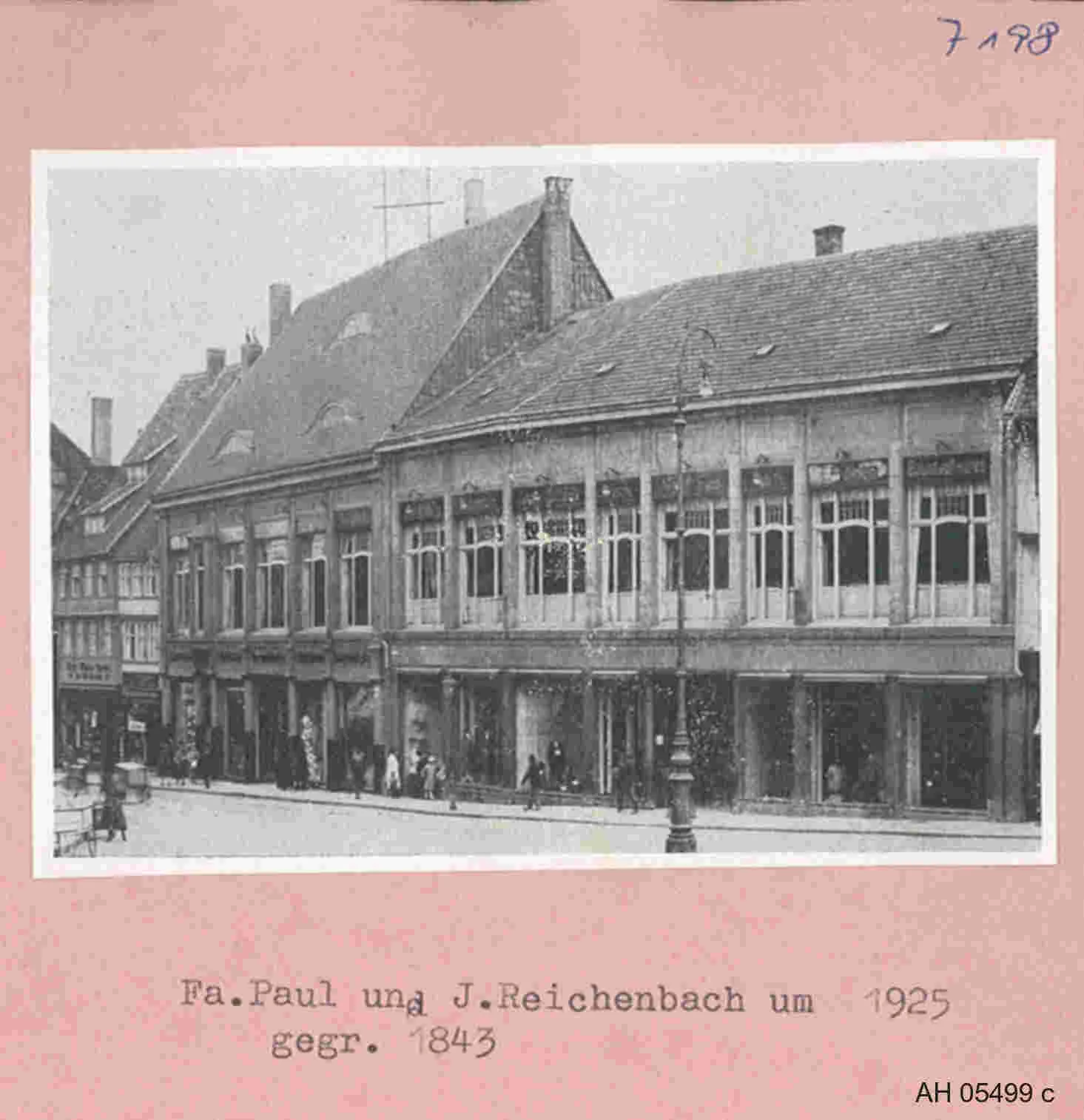
An object that left the building
The name on wood
A surviving hanger carries the J. Reichenbach men’s-and-boys’ fashion mark beyond the lost shop.
Open the hanger, or continue through its related views.
The Wernigerode branch · Breite Straße 7
Jeanette’s commercial house belonged to the same family story.
Gustav was Jacob and Helene’s son, Adolf’s brother. The Wernigerode shop was the same family in another Harz town.
Gustav married Jeanette Rosenbaum in 1883. Research in Wernigerode’s municipal records identifies Jeanette as the shop’s owner: her dowry helped establish it, her initial stood in the name J. Reichenbach, and she remained at the till into the 1930s. Gustav served as managing director; their son Fritz later operated the business.
The Halberstadt and Wernigerode firms had distinct local histories. Their exact legal or corporate relationship should not be assumed—but the people behind them were one documented family.
A neighboring commercial household
The Cohn family’s linen factory and store
Lillyan Rosenberg’s oral history remembers the Halberstadt linen business owned by her father, Ernst Cohn, alongside Orthodox family and communal life. It does not establish a business or family relationship to J. Reichenbach; it preserves another Jewish commercial household in the same city.