Documents and evidence
The record beside the story
Letters, passports, deeds and photographs — each opens to its full record: source, date, credit and how the image was prepared. German documents are paired with an English reading.
Featured record
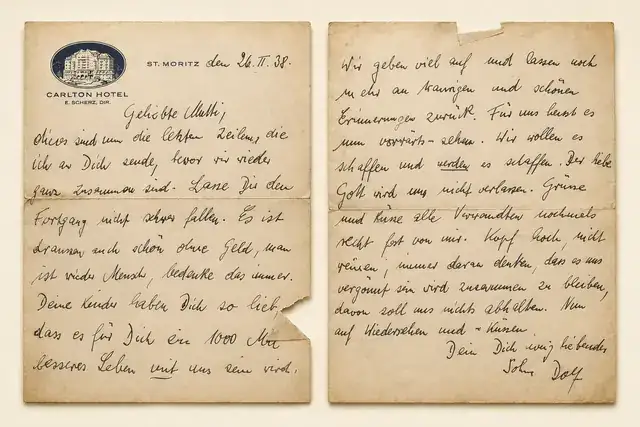
The St. Moritz letter
Two handwritten sheets carry the voice at the center of the archive: intimate, practical and determined.
Read, translate and examineFamily-held records
Paper carried forward
Passports, cards, membership papers and photographs of grave markers survive because the family kept them. Open any image for a high-resolution view, historical explanation, source, credit and archive reference.
Family life on paper
A public tribute, a wedding, a voyage and a meal
Not every surviving paper concerns business or persecution. A 1926 newspaper honored Paul on his fiftieth birthday; a wedding booklet, menu card and a friend’s playful shipboard verse preserve a family moving through ordinary civic and social worlds.
The S.S. Manhattan letter helps document Margarete’s Atlantic travel in 1937. Its author signs only as “Fred”; his full identity remains open.
Paul at fifty · 20 October 1926
“Mr. Paul Reichenbach, the long-serving former chairman of our Halberstadt local branch, celebrated his fiftieth birthday on 20 October. We offer our warmest congratulations to this deserving man, who for years has stood in the struggle against antisemitism with tireless energy.”
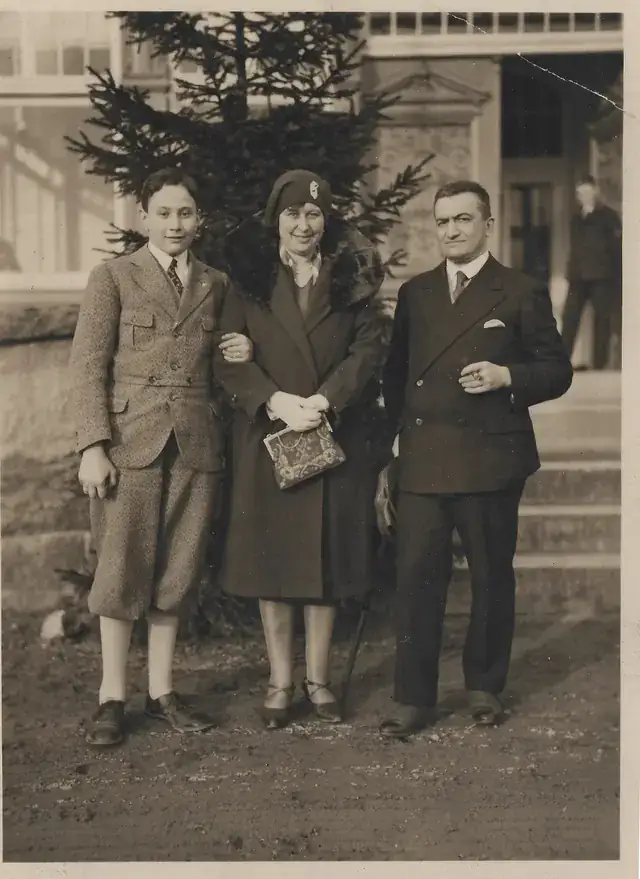
The Central-Verein-Zeitung notice documents Paul’s former chairmanship, many honorary offices and public work against antisemitism. Susan Reichenbach Heyman identifies the surviving party photograph as his fiftieth-birthday celebration. Read the complete clipping, transcription and translation →
A friend’s verse · working English reading
„Von ‘Washington’ und der ‘Manhattan’ … Und ob beim Bridge, beim Bingo war ‘Mutter’ Reichenbach obenauf! … Sie sind ’ne Künstlerin des Lebens! Von Herzen wünsch’ ich alles Gute für Dolf und Ihre Lebensroute!“
“From the Washington and the Manhattan … whether at bridge or bingo, ‘Mother’ Reichenbach came out on top! … You are an artist of life. From my heart I wish every good thing for Dolf and for the course of your life.”
Working translation prepared for the Reichenbach Family Archive. The reading is partial; some lines remain unread.
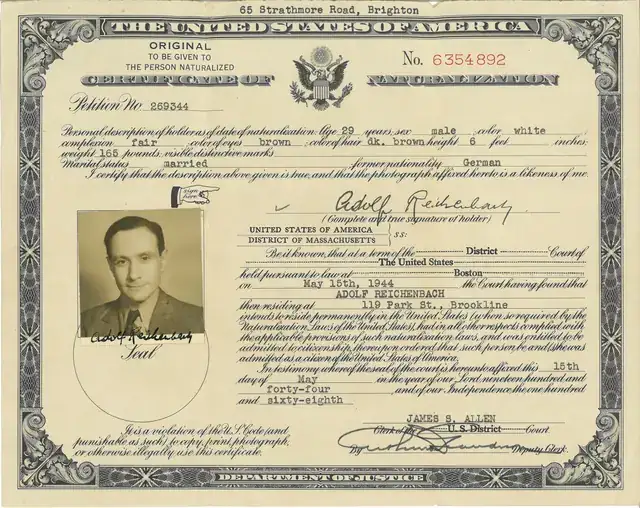
United States immigration records
Dolf’s AR-2 form
The National Archives delivered Dolf Reichenbach’s Alien Registration Form on 13 August 2026. The two-page record fixes his Brookline address, New York arrival aboard the SS Paris, first citizenship papers and early Boston employment.
The follow-up search added a second address source: Brookline’s 1940 street list names “Adolph” and “Margarette” Reichenbach at 3 Netherlands Road. It also found F & M Skirt Co. in the 1922 Boston register and business directory at 515 Washington Street, room 519; the exact 1940 employer listing remains open.
Source: National Archives and Records Administration, Digital Records Division, Reference Branch. Ordered reproduction `QO1-1110421874`; NARA file `AR005106001957.PDF`. The Brookline street list is cited but not republished because its Internet Archive metadata marks it as possibly in copyright.
Paul Reichenbach’s Trauer-Album
A mourning book, preserved page by page
The family retained a printed Jewish mourning volume dedicated to Paul after his sudden death in 1935. Its German title means “mourning album.” Inside are Kaddish, Yizkor, Jahrzeit tables, prayers for the grave and spaces where a family could assemble a record of loss.
The complete surviving sequence is available below—twenty-three views, without repeating the same image elsewhere on the page.
View the complete 23-image sequence
Genealogy as an archive
Charts, questions and the first family researcher
The Ahnentafel and later charts are displayed as historical research objects—not as automatic proof of every name. Beside them are the letters showing that Paul was already trying to recover the family’s earlier history in 1935.
The LBI cover and chart leaf are shown as unaltered access copies under written permission. Their exact institutional credit appears with each object.
What Paul wrote
“It is established that our family lived in Gröbzig at the beginning of the eighteenth century … After Easter I will travel immediately to Gröbzig, perhaps to determine at the cemetery there how many Reichenbachs lie buried there.”
Paul’s letter documents his research and intended cemetery visit. The stories he repeats about the Berezina and Lieutenant Katte remain inherited accounts until independent records are found. The separate query dated 4 February 1936 presents a genuine problem: that date follows Paul’s documented death in November 1935, so the sender cannot simply be assumed.
Persecution written into the record
The instrument, not only the aftermath
The documents below place family names inside civil, notarial and camp bureaucracies. They are shown as complete records, with the administrative language translated and its limits explained.
The publication copies retain full archive attribution. Private emails that accompanied the scans are not published.
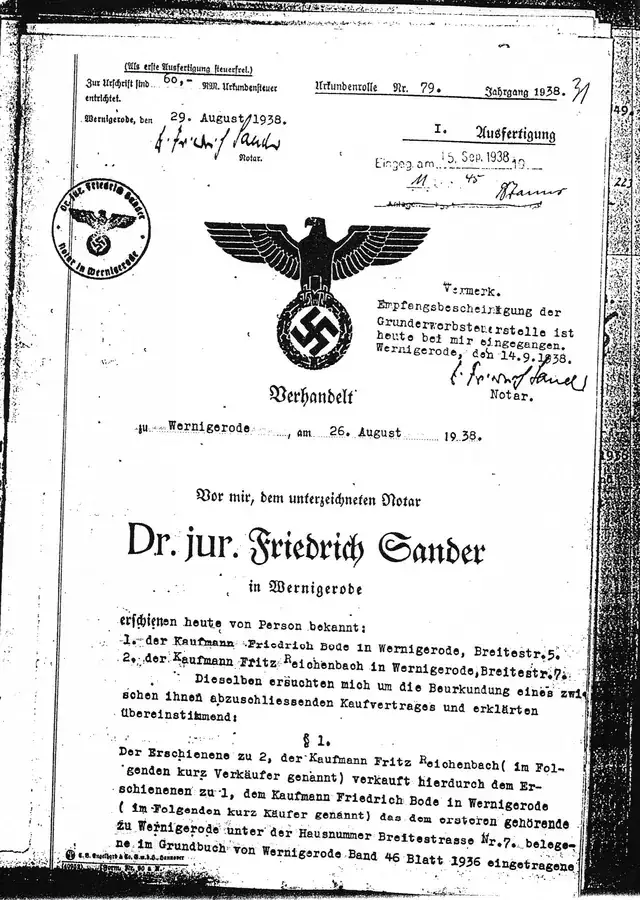
The decisive clause · German and English
„… dass der Erschienene zu 2 Jude ist und dass auf Grund der Anordnung zu der Verordnung über die Anmeldung des Vermögens der Juden vom 26. April 1938 die Genehmigung der höheren Verwaltungsstelle für dieses Rechtsgeschäft notwendig ist.“
“That the person appearing as no. 2 is a Jew, and that under the order pursuant to the Regulation on the Registration of Jewish Property of 26 April 1938, the approval of the higher administrative authority is required for this transaction.”
This is why the Breite Straße deed can be described as a forced sale under racial law: the coercive condition is written into the instrument itself. The Theresienstadt form is different. It records Jeanette’s death, but its cause-of-death field is the language of a camp administration, not a neutral medical verdict.
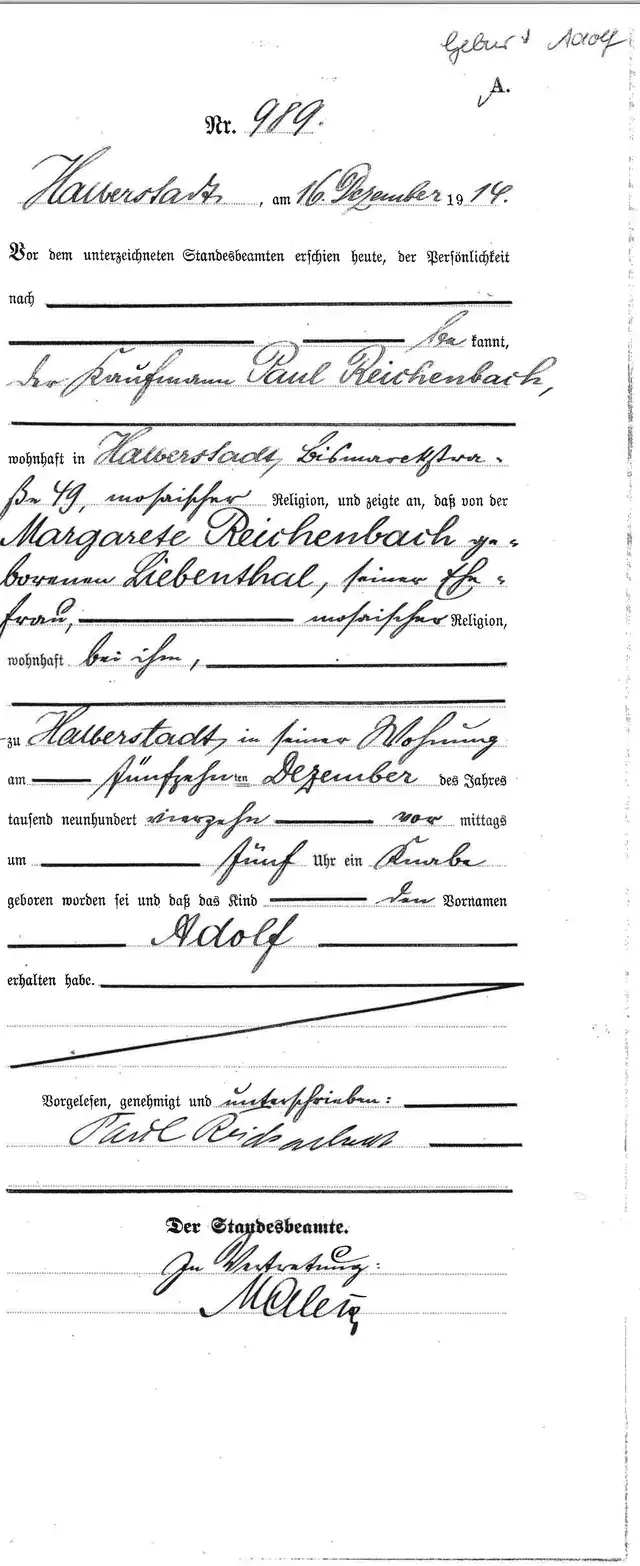
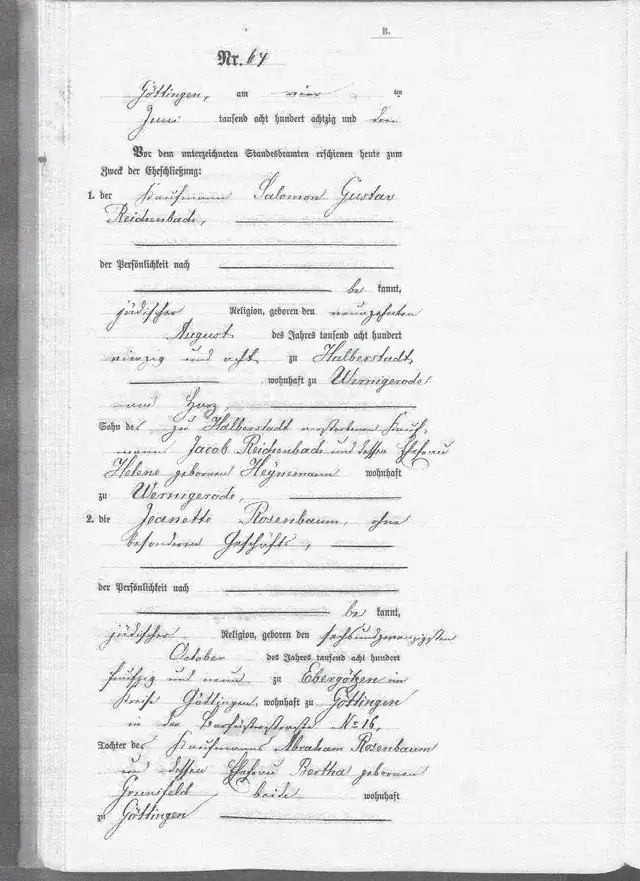
Historisches Archiv der Stadt Halberstadt
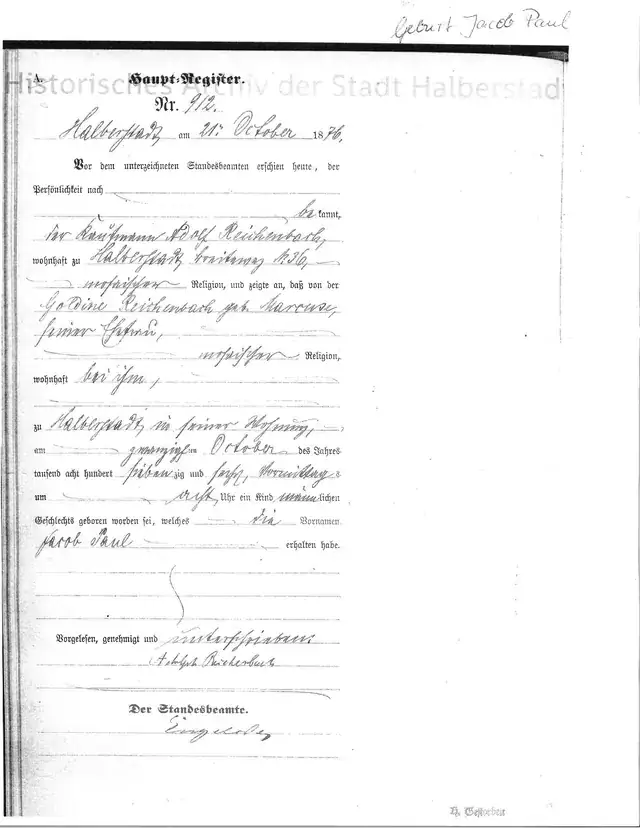
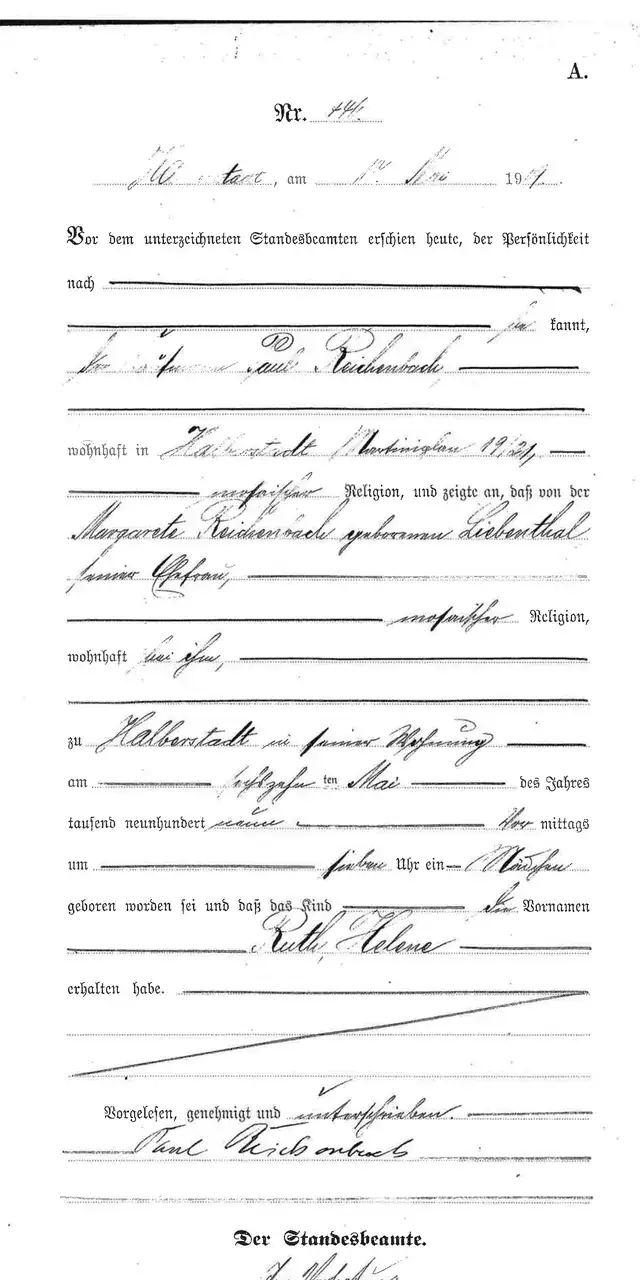
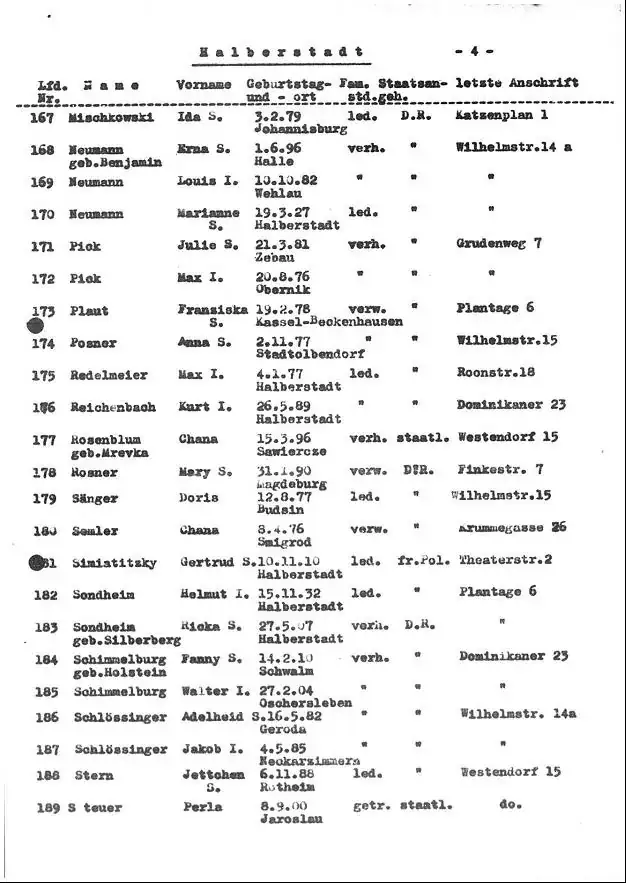
The civil record
All eight record photographs from the family’s Halberstadt visit appear here. Five are overlapping views of Ruth’s marriage record and are shown together as one record, not five independent sources.
Credit: Historisches Archiv der Stadt Halberstadt and Reichenbach Family Archive.
Deutscher Alpenverein · Halberstadt section
Membership, then formal exclusion
Four section reports place Paul in his own town’s Alpine Club from its founding year through 1931/32. The section’s 1934 statute then required applicants to prove “Aryan descent,” turning racial exclusion into a written admission rule.
Reports: Bibliothek des DAV, München. Statutes and archive inventory: Archiv des DAV, München. Published by permission.
1934 · the rule changes
Belonging was converted into a racial test.
Paul’s long membership record and the later statute belong together. The first documents participation; the second shows how a civic and recreational association rewrote admission under Nazi rule.
The object record preserves a complete transcription and English translation of the photographed page. The complete 1934 and 1936 statutes and the DAV collection inventory remain available as full PDFs.
Commerce in print
Handbills, correspondence and official recognition
HATEX sale sheets name both Halberstadt and Wernigerode, but they do not by themselves prove corporate continuity with J. Reichenbach. Paul’s award notice survives as a folded sheet, front and reverse, preserving how the Prussian state addressed a Jewish merchant for public service in 1917.
Reading the print
Winter-Schluss-Verkauf means “winter clearance sale.” The HATEX sheets list garments and prices for Halberstadt and Wernigerode. Verdienstkreuz für Kriegshilfe means “Merit Cross for War Aid”; the 1917 notice names “Herrn Kaufmann Paul Reichenbach in Halberstadt, Hoheweg 27.” Open the high-resolution scan, complete transcription and translation →
Family objects
Objects kept in the family
The objects are evidence of survival, but their family histories are not all equally documented. Each record separates what can be seen from what later generations remember.
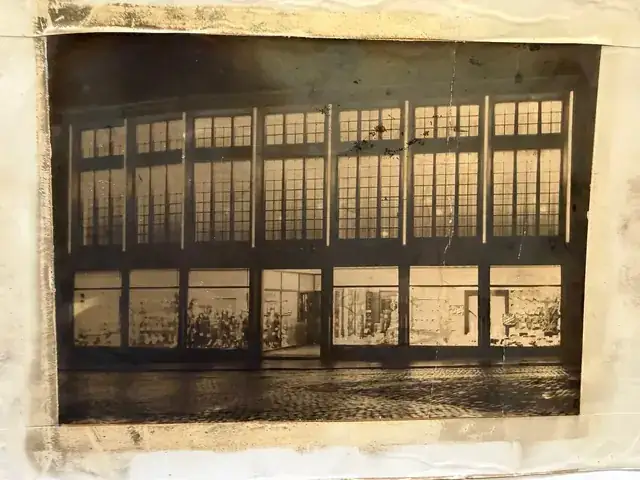
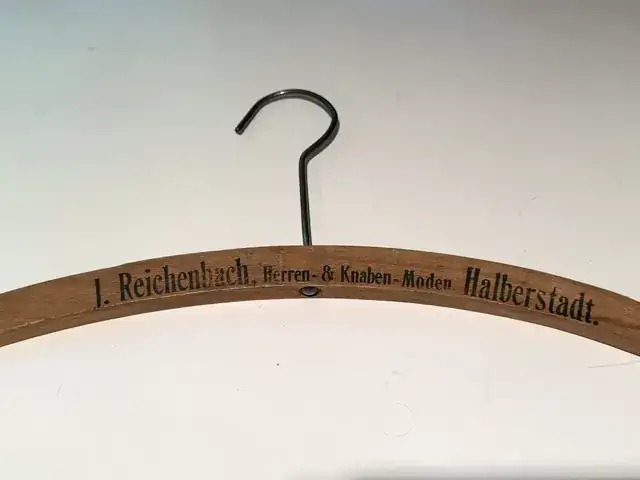
J. Reichenbach advertising stamps
Twelve rooms of a vanished store
These printed Reklamemarken, issued by the firm about 1910–1914, name the store’s rooms and departments. The complete set is presented together in its own gallery.
Open the dedicated gallery to compare every original crop with its conventionally adjusted viewing copy and inspect the full object records.
Historic Halberstadt address directories
The city in names and streets
These pages were photographed during the family’s research visit in Halberstadt. One opens to Sedanstraße; the other to the surname Reichenbach. The address-book identification is secure; the exact edition and year remain uncertain.
Paul J. Reichenbach · working manuscript
Seven pages for a room of young leaders
The surviving manuscript begins as a typed delivery copy marked up in Paul’s hand and then becomes a handwritten draft. Together the pages preserve both the address and the choices made while preparing it.
Internal references place the gathering in Savannah, within SETY and NFTY, and have Paul returning to New York. No date or title page survives. The Savannah gathering is a different occasion from the Temple Israel sermon delivered after the October 1969 UAHC Biennial.
Examine all seven manuscript pages
A growing archive
Sources remain with the objects
Family-held originals, institutional scans, commercial ephemera, civil records and translations appear with their sources and credits. Personal information concerning living people, private third-party correspondence and restricted legal records are not published. Corrections to descriptions and credits are welcome.