Dominikanerstraße 23
Kurt Reichenbach
The transport list records Kurt at Dominikanerstraße 23. A parallel list preserved by Yad Vashem gives the same address.
Halberstadt · Domplatz
On 12 April 1942 Halberstadt ordered 102 Jews to Domplatz. Among them were Kurt Reichenbach, Paula Wollenberg and Paula’s son Hans. On 16 April, at six in the morning, Adam Czerniaków wrote down a train of newcomers from Germany arriving in Warsaw. After that morning this archive has no named record of any of the three.
Last reviewed 27 August 2026.
Photograph at #LastSeen · reuse restricted
#LastSeen publishes a photograph of the Halberstadt departure, with Domplatz and the cathedral behind the group.
The atlas identifies several people, but not Kurt, Paula or Hans. Because the Beverstein family image is marked “all rights reserved,” it remains at #LastSeen.
See the departure photographPhotograph at #LastSeen
The names in the original sequence
Page 14 records Kurt Reichenbach at entry 176. Page 15 records Hans Wollenberg at entry 198 and Paula Wollenberg at entry 199.
The pages are shown whole, so the three names remain among their neighbors and in the order of the list.
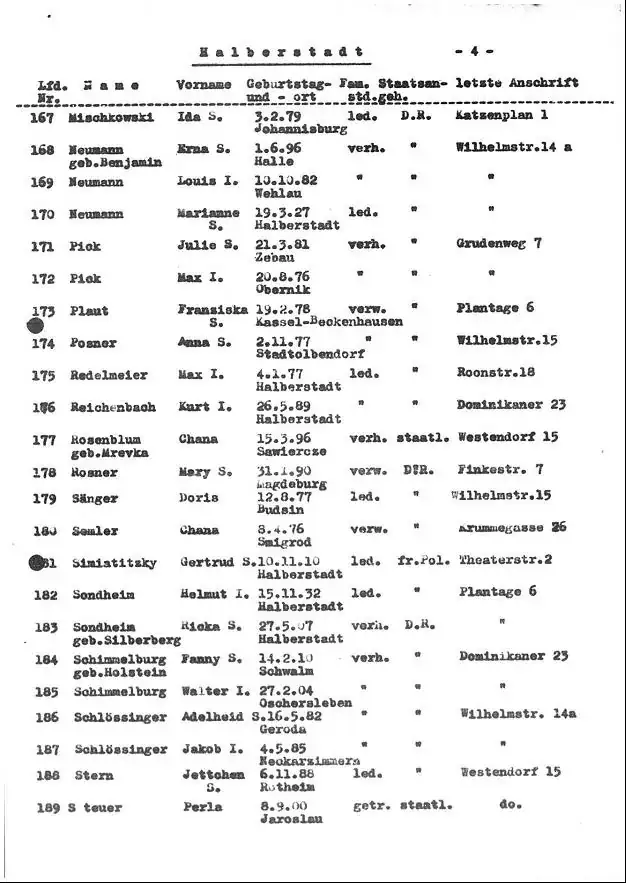 The list, two pages · 2 viewsMagdeburg-Halberstadt transport listRead the adjacent pages with Kurt Reichenbach, Hans Wollenberg and Paula Wollenberg in their original sequence.Open either page for the source.
 Open either page for the source.
Czerniaków’s morning
Dominikanerstraße 23
The transport list records Kurt at Dominikanerstraße 23. A parallel list preserved by Yad Vashem gives the same address.
Westendorf 15
Paula was registered at Westendorf 15, the former Jewish school and community building converted after 1938 into forced collective housing for Jews.
Hans appears there with his mother. The transport evidence corrects his birth date to 3 June 1907 and gives Eisenach as his birthplace.
Documented route
Four dated records carry the names east. They do not describe every mile of the journey.
12 April 1942
102 Jews from Halberstadt were ordered to report at the registration office on Domplatz.
13 April 1942
They were taken to a collection camp with other deportees from the Magdeburg district.
14 April 1942
The train was coupled with transports from Berlin, Potsdam and the surrounding region.
Whether the train was coupled at Moabit or at Grunewald is not settled in the surviving sources.
16 April 1942
Czerniaków recorded the arrival of a train with newcomers from Germany at 6 in the morning.
Arrival evidence
16 April 1942
“At 6 the train with newcomers from Germany arrived.”
The transport reconstruction cites this line for the day the Magdeburg-Halberstadt transport reached Warsaw. It is the nearest witness note to the arrival itself.
Read the sourceWarsaw · 16 April 1942
The Halberstadt transport arrived there on 16 April 1942. This public-domain photograph shows railway cars, luggage and people being forced into transit at the Warsaw Umschlagplatz in later months.
It is context, not the Halberstadt train, and no Reichenbach relative is identified in it.
Warsaw context, later months
USHMM testimony about other people
Warsaw ghetto, remembered later
“We still think sometimes...sometime will get better.”
Lewent remembered makeshift schools, libraries and the hunger for news inside the ghetto. His words give Warsaw a human interior without claiming that he saw the Halberstadt group.
Read the sourceUSHMM testimony about other people
Summer 1942
Meed described trying to reach her mother and brother at the Umschlagplatz. She recalled that “the truth was that they were being taken to Treblinka” and remembered the false promise of bread and marmalade before people were forced onto trains.
Read the sourceUSHMM testimony about other people
Summer 1942
“This is the last time I saw them.”
Lewent recalled hiding above a room while his mother and three sisters were taken away. It belongs here as a first-person account of deportation around Warsaw, not as a Reichenbach scene.
Read the sourceMemorial
Kurt’s name is carved on Halberstadt’s Domplatz memorial. The stone names him without supplying an ending the evidence cannot support.
Paula and Hans remain in transport lists and memorial-book entries. For both, the surviving sources end with their arrival in Warsaw. No later fate is claimed here.
Sources and image use
The transport pages link to their source. The Warsaw photographs are public-domain context. The #LastSeen departure image remains at its source because reuse is restricted.