Ten of the twelve prints · two more family views
The Halberstadt they kept
Dolf and Mutti loved Halberstadt—the look of its streets, the closeness of its houses, the feeling of the city itself. Long after their lives there had ended, these pictures remained in the family.
Why these pictures stayed
They kept the city close.
A cart passes beneath an arch. Tram rails curve through the Hoheweg. People walk, cycle, work and look into shop windows while the old timber-framed houses lean over the streets. These are not distant monuments. They are views of a city being lived in.
Walter Gemm understood that feeling. Halberstadt remembers him as a “chronicler with pen and brush,” an artist whose pictures kept the old city present in homes around the world. In this family, they did exactly that.
The prints are worn now. Some are stained by water; some are foxed; some edges have begun to crumble. They are shown as the family kept them, with that history still visible.
Why my family held on to them
Dolf and Mutti loved Halberstadt. Walter Gemm captured the way the city looked and felt, and my family held on to these pictures through all these years.
Daniel Reichenbach, 2026
Ten prints now shown
The city in streets, windows and people
Eight prints kept by my father were the beginning. Two more from the family set are now shown here: Judenstraße and Hinter dem Richthaus, both by Walter Gemm.
Six of the ten pictures are by Gemm. The others are by Käthe Lipke, Edwin Schiel, A. Thiemann and Walter Ebeling. The earlier scans retain their worn sheet edges; the two new photographs show the prints in their mounts.
Ten views from a set of twelve
The complete portfolio has twelve.
Seven pictures in the complete portfolio are by Gemm. Five more are by Ernst Datan, Käthe Lipke, A. Thiemann, Walter Ebeling and Edwin Schiel. Together they made a portrait of the Halberstadt that had just been devastated.
We can now show ten of the twelve prints. Holzmarkt zu Halberstadt by Walter Gemm and Fischmarkt by Ernst Datan are the two views not yet photographed in our family collection.
- 1. Holzmarkt zu Halberstadt · Walter GemmNot yet photographed in the family collection
- 2. Blick zum Fischmarkt · Walter GemmIn the family collection · See this print
- 3. Fischmarkt · Ernst DatanNot yet photographed in the family collection
- 4. Der Stelzfuß · Käthe LipkeIn the family collection · See this print
- 5. Alte Häuser in der Gerberstraße · A. ThiemannIn the family collection · See this print
- 6. Eingang zum Lichtengraben · Walter EbelingIn the family collection · See this print
- 7. Judenstraße · Walter GemmIn the family collection · See this print
- 8. Der Hoheweg · Walter GemmIn the family collection · See this print
- 9. Hinter dem Richthaus · Walter GemmIn the family collection · See this print
- 10. Fachwerkbau — Der alte Ratskeller · Edwin SchielIn the family collection · See this print
- 11. Die Gerberstraße / Das Gewerkschaftshaus · Walter GemmIn the family collection · See this print
- 12. Rathausfreitreppe · Walter GemmIn the family collection · See this print
Another Halberstadt the family kept · 1926
Walter Gemm had painted this city before.
The framed work already in the family is not one of the prints. It is an original Walter Gemm painting, signed and inscribed “Halberstadt 1926.”
It looks across the marketplace or Holzmarkt toward the Martinikirche, Rathaus, fountain and Roland—nearly twenty years before the portfolio, and before so much of the city was lost.
The city before it was lost
The painting and the prints hold two moments together: Halberstadt as Gemm painted it in 1926, and the beloved old city that artists tried to preserve after the destruction of 1945.
We do not yet know when this painting entered the family either. What we know is that it mattered enough to be kept beside the prints.
See the painting and its signature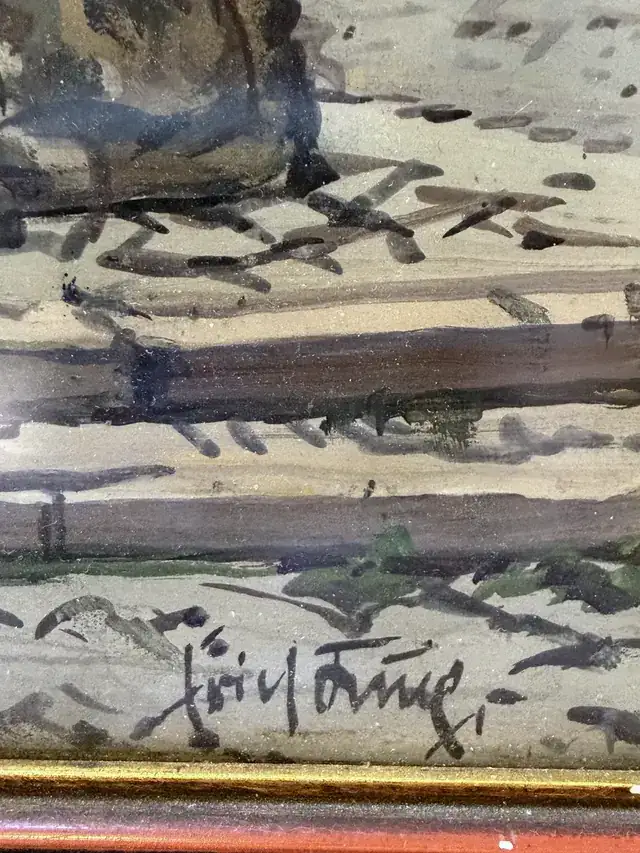 Two detail photographs · 2 viewsSignature and dated inscriptionClose photographs separate the painted Walter Gemm signature from the inscription ‘Halberstadt 1926.’Open the painting details
Select any view for a larger image, source and archive details.
When did Dolf buy them?
The pictures can be dated. The family story is harder.
The small mark at lower left reads Bestehorndruck, the Halberstadt printer or publisher. Several artists dated their pictures 1945, and another print from the same portfolio was catalogued as issued in 1945. A biography of Gemm places the memorial project in 1946. The pictures were therefore made in 1945, and the portfolio was probably printed in 1945 or 1946.
They came too late to have left Germany with the family before the war. Dolf returned to Germany once in the 1970s with his son, and he may have bought them then. We do not yet know. No receipt or inscription survives to tell us—but the care with which the family kept them tells its own story.
About the portfolio
What we know about these pictures
Surviving copies name the twelve views and their six artists. The signatures, the Bestehorndruck mark and Halberstadt’s own account of Walter Gemm place this family group within the city’s effort to remember what had been destroyed.
Walter Gemm’s life in the city
The school’s account remembers Gemm’s response to the destruction of 8 April 1945 and the twelve-view memorial portfolio that followed.
City of Halberstadt“Chronist mit Stift und Pinsel”
The city describes Gemm’s ability to preserve the feeling of Halberstadt and notes that his works remain in ordinary Halberstadt homes around the world.
A complete surviving setAll twelve pictures in order
This description gives the title and artist of every picture and preserves both names used for the Gerberstraße view.
Kunst- und Auktionshaus QuedlinburgThe portfolio as a physical object
A complete set shows twelve large card-stock sheets, about 40.5 × 29 cm—the same substantial, easily damaged material the family has preserved.