Reading Room
Selected documents and objects
Begin with a 14-record path through the family story, or browse all 64 records selected for the Reading Room. The Complete Catalog lists every one of the archive’s 375 public records across 9 series.
Filter and sort
The curated sequence is retained within this selected kind.
By kind
What survives
Open a selected card for its source, date, evidence status, credit and reuse terms. Use the Complete Catalog for the full public collection.
Showing 24 of 31 records
Halberstadt and Wernigerode
Commercial objects
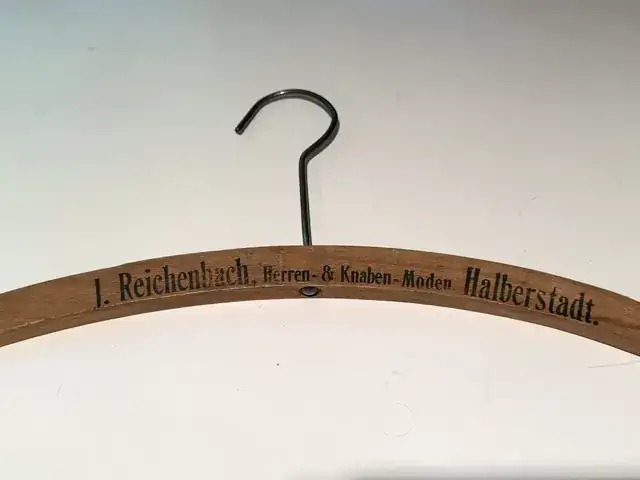
A wooden hanger marked for J. Reichenbach men’s and boys’ fashions
A surviving wooden hanger carries the J. Reichenbach men’s-and-boys’ clothing mark.
Halberstadt and Wernigerode
Commercial objects
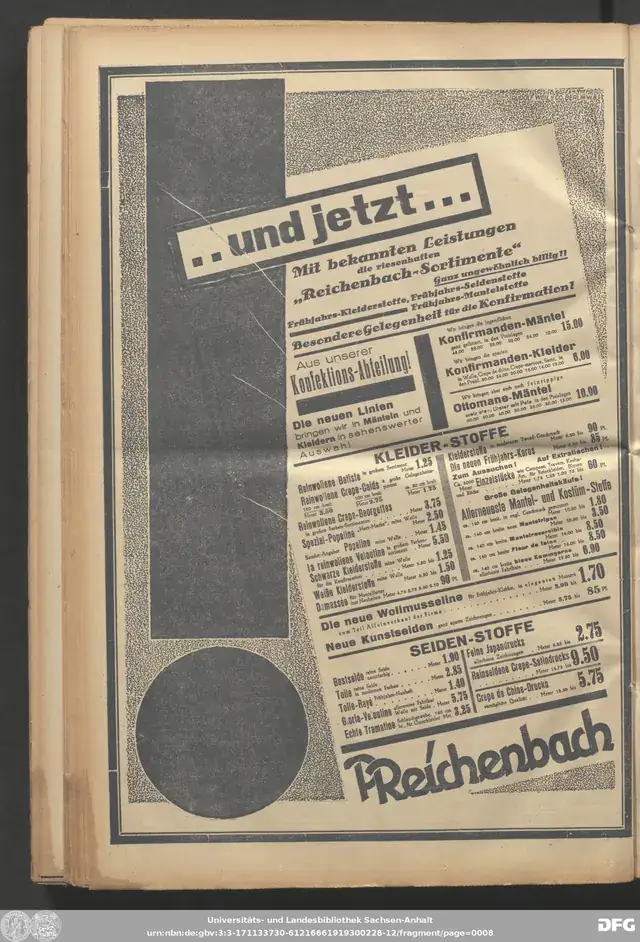
Reichenbach spring textiles and ready-made clothing advertisement
Reichenbach spring clothing and textile advertisement, 28 February 1930
The American chapter
Commercial objects
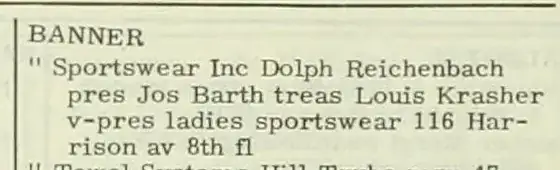
A Boston directory names Dolph Reichenbach as Banner Sportswear’s president
This 1964 Boston directory entry lists Banner Sportswear Inc. at 116 Harrison Avenue, eighth floor, as a ladies’ sportswear business. It names Dolph Reichenbach as president, Jos Barth as treasurer and Louis Krasher as vice-president. The entry places Dolf in Boston’s garment trade in 1964, but it does not establish when the company began or how its ownership was divided. It is not the entry for Adolfo Sardiña and not Banner Bros. of Jamaica Plain.
Halberstadt and Wernigerode
Commercial objects
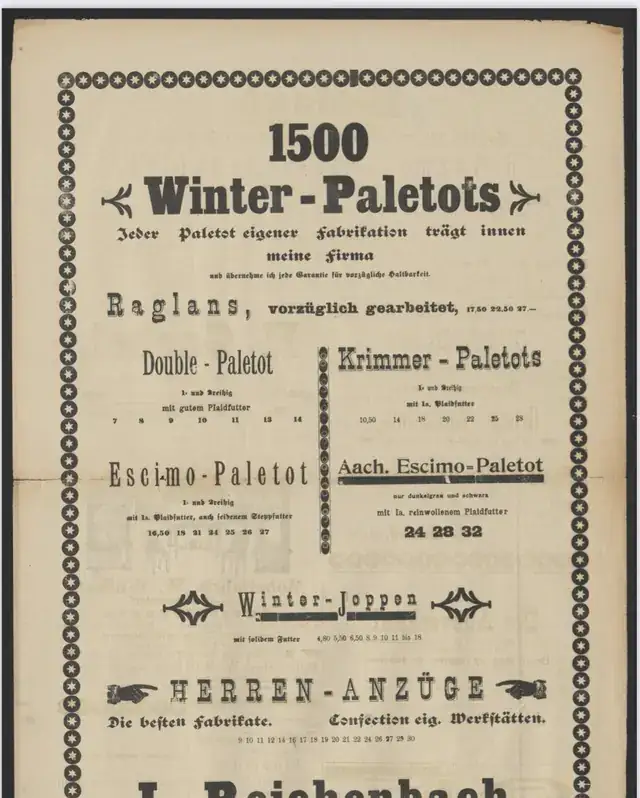
J. Reichenbach winter-clothing advertisement
A full-page advertisement presents J. Reichenbach as a large clothing manufacturer and retailer, with 1,500 winter coats and its own workshops.
Halberstadt and Wernigerode
Commercial objects
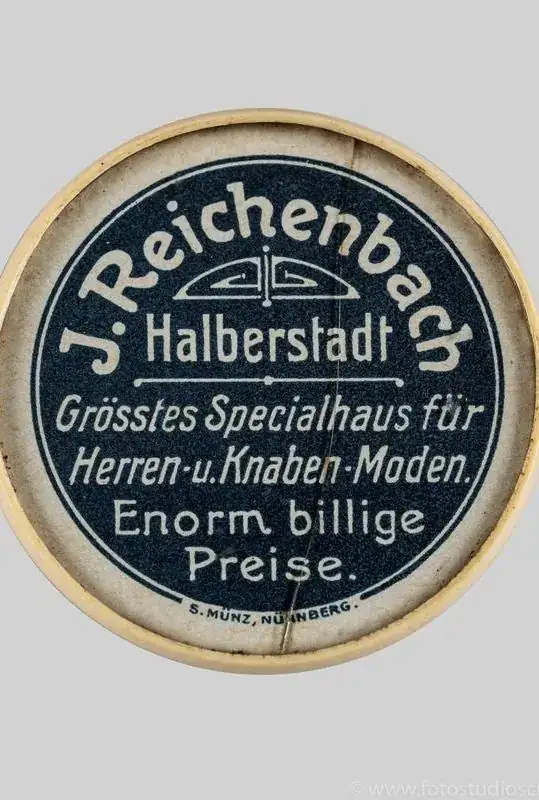
J. Reichenbach advertising button
A round advertising button presents J. Reichenbach as Halberstadt's largest specialist house for men's and boys' fashions; its maker's line names S. Münz of Nuremberg.
Halberstadt and Wernigerode
Commercial objects
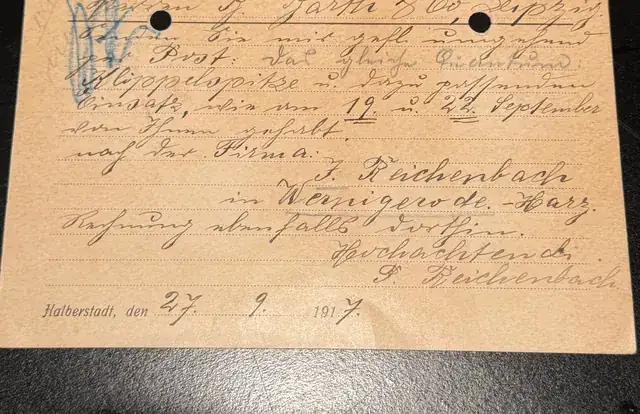
Paul’s business ordered goods for J. Reichenbach in Wernigerode
This message side, dated 27 September 1917, places an order with a Leipzig supplier and asks for goods and invoice to go to J. Reichenbach in Wernigerode. Someone in Paul’s business wrote the card, and postal hands carried it to the supplier. It connects the Halberstadt and Wernigerode firms in this transaction, but the writer’s signature and some wording remain a preliminary reading.
Persecution and flight
Commercial objects
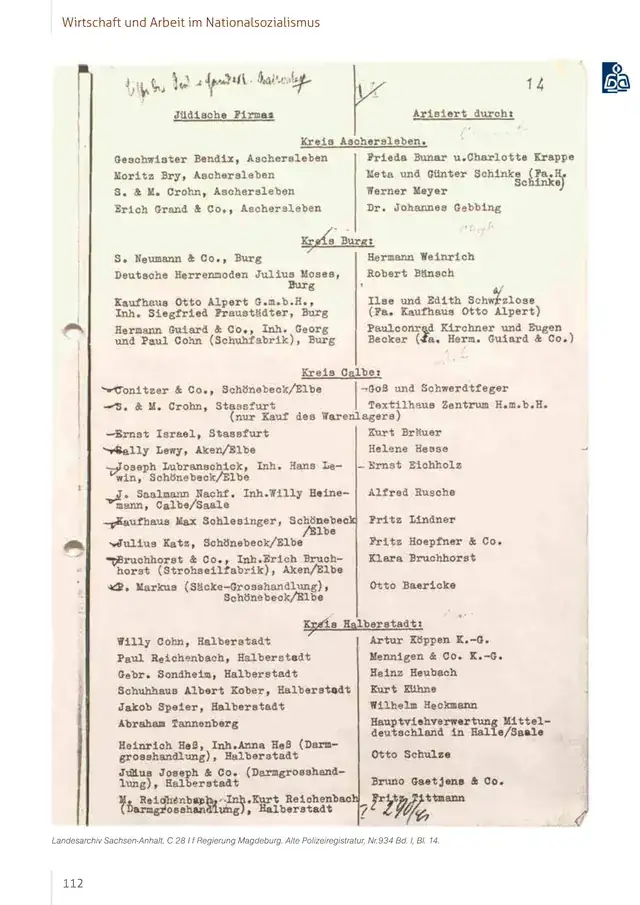
The state list naming Mennigen & Co. after Paul Reichenbach’s firm
Under ‘Kreis Halberstadt,’ the official list places ‘Paul Reichenbach, Halberstadt’ opposite ‘Mennigen & Co. K.-G.’ beneath the headings ‘Jüdische Firma’ and ‘Arisiert durch.’ This is direct administrative evidence that Mennigen & Co. was recorded as the Aryanization successor to Paul Reichenbach’s business. It is not the purchase contract.
Halberstadt and Wernigerode
Commercial objects
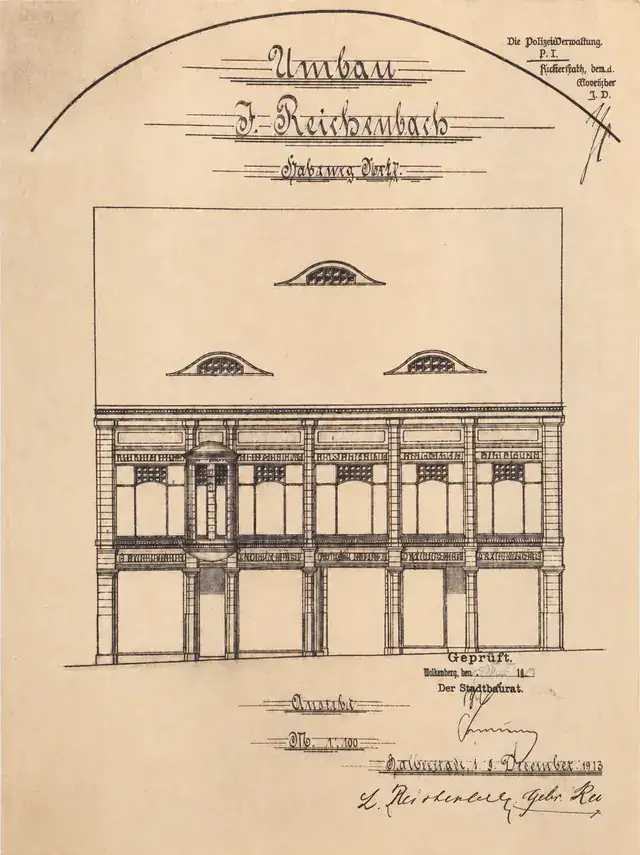
AI reconstruction of the 1913 J. Reichenbach façade drawing
AI reconstruction based on the December 1913 façade document for J. Reichenbach at Hoher Weg 27; this is not a scan of the original.
Halberstadt and Wernigerode
Commercial objects
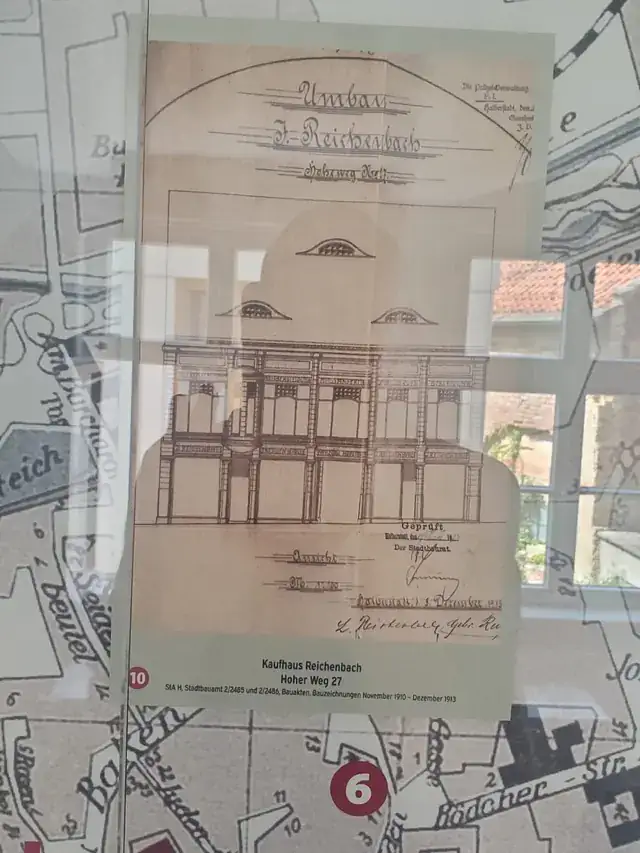
The Kaufhaus Reichenbach plan displayed in the museum
A museum display identifies the drawing’s municipal building files and their November 1910 to December 1913 date range. The display connects the plan to municipal files dated from November 1910 to December 1913. The venue and date of this photograph remain unrecorded.
Halberstadt and Wernigerode
Commercial objects
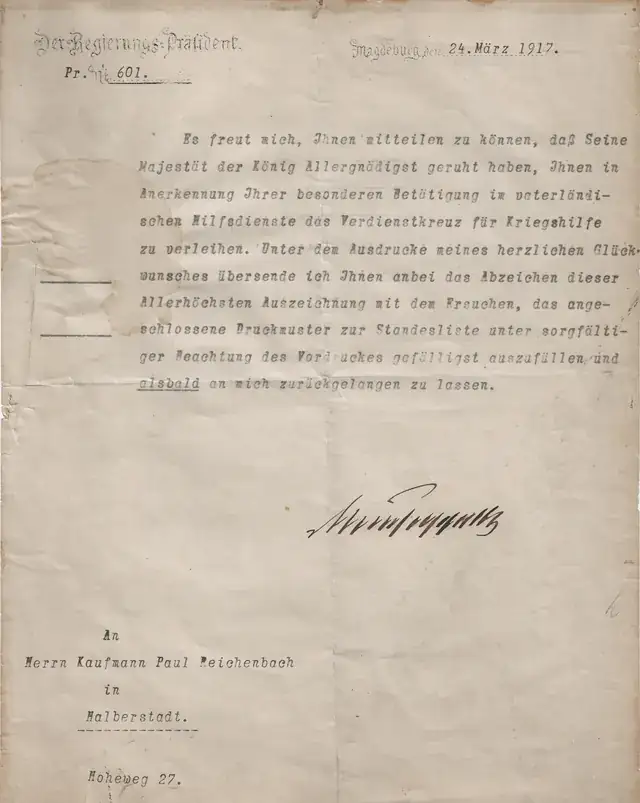
The notice awarding Paul the Merit Cross for War Aid
The Prussian notification naming Paul Reichenbach, merchant, at Hoheweg 27 as a recipient of the War Aid Merit Cross. The notice proves the award and gives Paul’s business address. It does not say that he served in combat or identify a specific act that prompted the honor.
Halberstadt and Wernigerode
Commercial objects
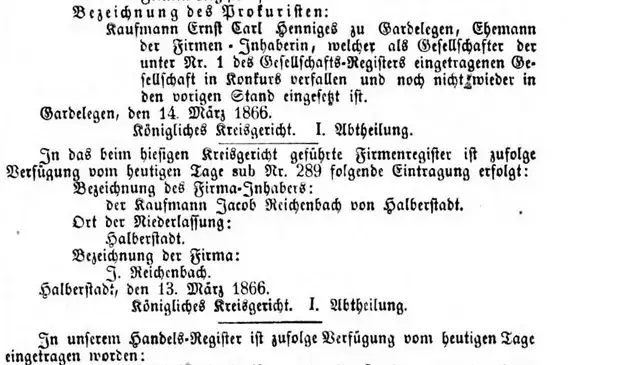
Jacob Reichenbach registers J. Reichenbach in Halberstadt
On 22 March 1866 the Prussian state gazette recorded merchant Jacob Reichenbach as the owner of J. Reichenbach in Halberstadt firm register no. 289. This is the first public register act yet found for Jacob’s firm. The business’s own advertisements continued to give 1843 as its founding year, so the notice registers an existing house rather than dating its beginning.
Halberstadt and Wernigerode
Commercial objects
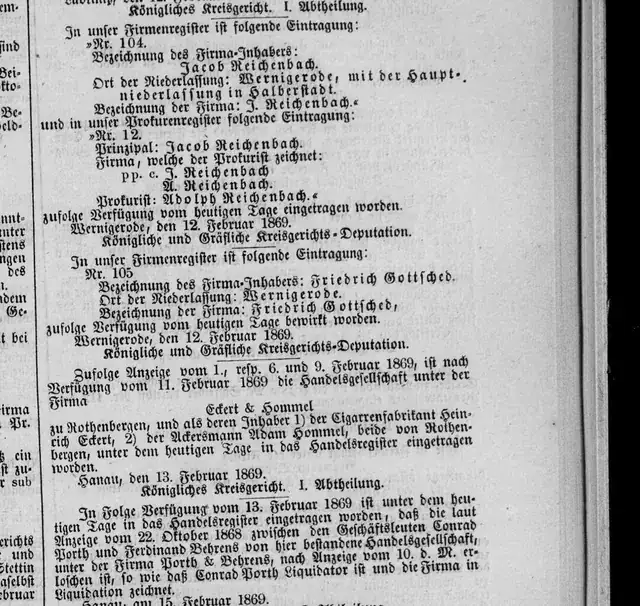
Wernigerode becomes a branch of the Halberstadt house
The notice of 19 February 1869 registers Wernigerode as a branch of the Halberstadt house while Jacob Reichenbach was still alive. Under Prokura no. 12, Adolph Reichenbach was authorized to sign “pp. J. Reichenbach.” It ties the two Harz cities to one business during Jacob’s lifetime.
Halberstadt and Wernigerode
Commercial objects
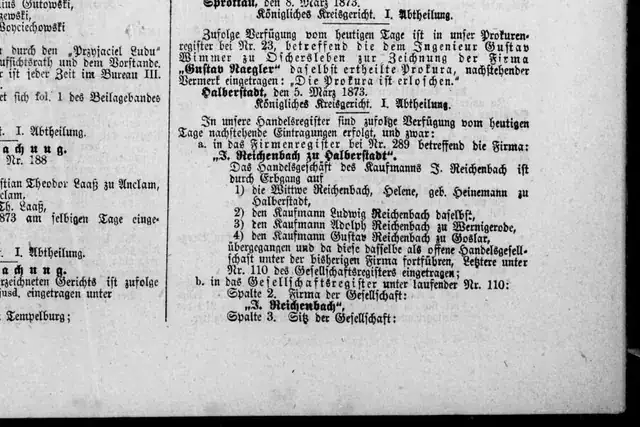
Jacob’s widow and sons inherit J. Reichenbach
After Jacob’s death on 17 December 1872, the gazette recorded that the business passed durch Erbgang—by inheritance—to his widow Helene née Heinemann and their sons Ludwig, Adolph and Gustav. The 13 March 1873 notice places Ludwig in Halberstadt, Adolph in Wernigerode and Gustav in Goslar, and registers the house as general partnership no. 110. It names a family succession, not a sale.
Halberstadt and Wernigerode
Commercial objects
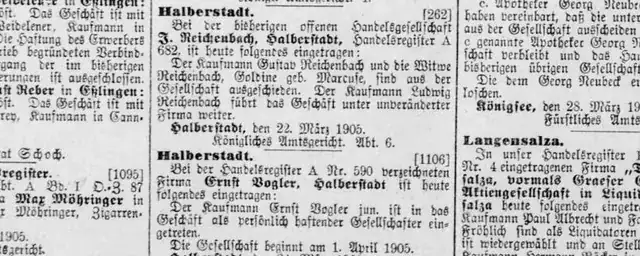
Ludwig Reichenbach continues the firm alone
On 4 April 1905 the Reichsanzeiger recorded Gustav Reichenbach and the widowed Goldine Reichenbach leaving the partnership. Ludwig Reichenbach continued J. Reichenbach alone. The notice gives the legal change; it does not describe the family decisions behind it.
Halberstadt and Wernigerode
Commercial objects
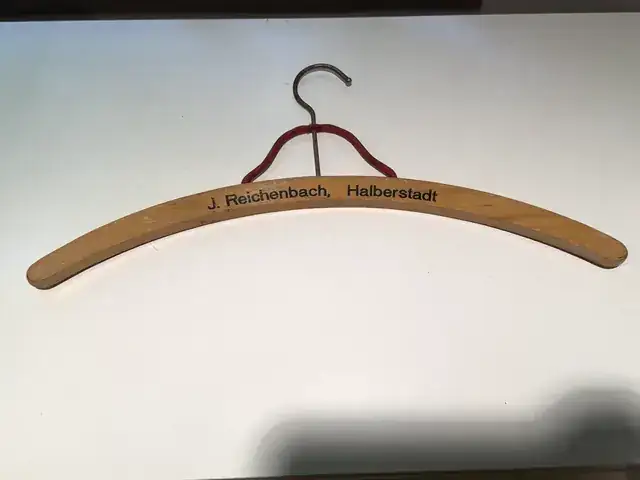
A wooden J. Reichenbach hanger with the complete court-purveyor mark
The clearest complete “Hoflieferant” mark in the surviving set. The ink ties the object to the Halberstadt clothing house. It does not identify the customer or employee who last handled it.
Halberstadt and Wernigerode
Commercial objects
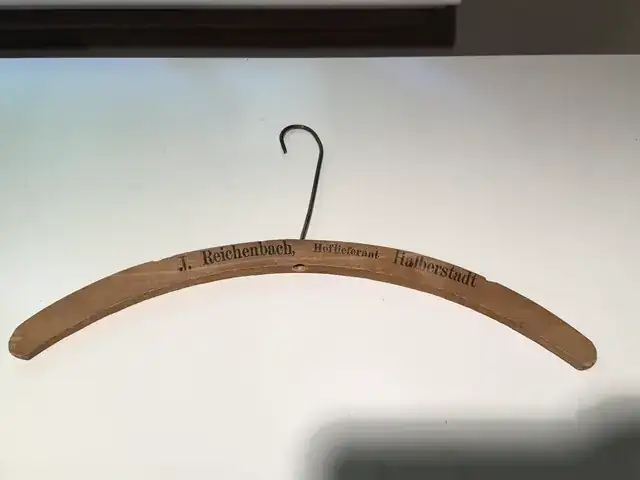
A second pattern of J. Reichenbach wooden hanger
A second pattern of Reichenbach-branded wooden hanger. Its shape shows that more than one hanger pattern carried the shop name. The object does not carry a secure date or user’s name.
Halberstadt and Wernigerode
Commercial objects
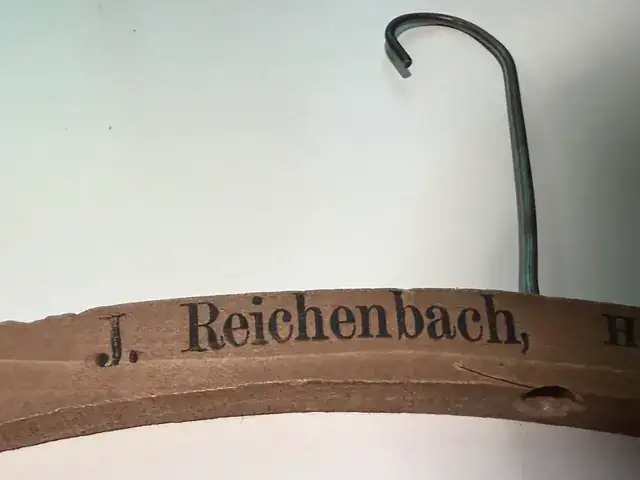
Ink marks on a J. Reichenbach wooden hanger
Close view of a Reichenbach hanger mark. The ink preserves the retailer’s name at close range. It does not identify the garment or person once attached to the hanger.
Halberstadt and Wernigerode
Commercial objects
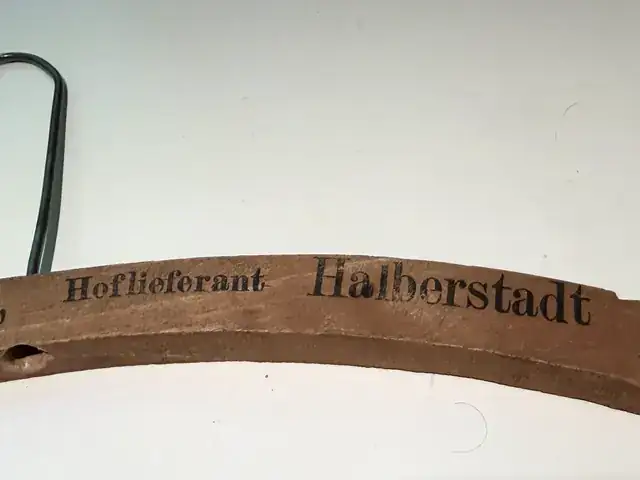
A second close view of a J. Reichenbach hanger mark
A second close view of the surviving retailer mark. This detail makes the surviving ink easier to compare with the other hangers. It does not establish when or by whom the hanger was used.
Halberstadt and Wernigerode
Commercial objects
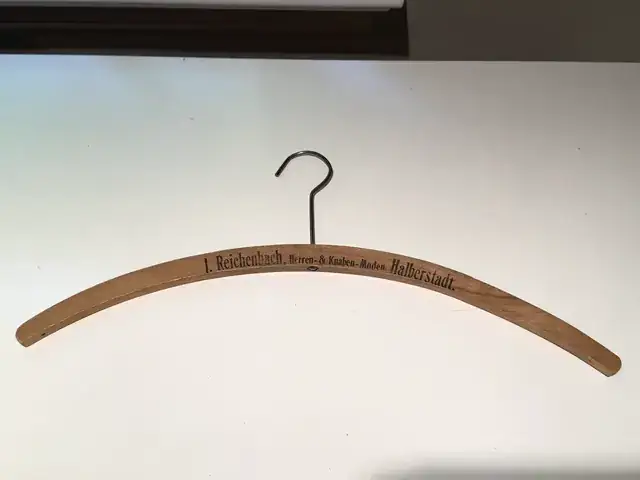
A third pattern of J. Reichenbach wooden hanger
A third surviving Reichenbach hanger pattern. The form broadens the surviving group of shop objects. It does not carry a secure date or name its user.
Halberstadt and Wernigerode
Commercial objects
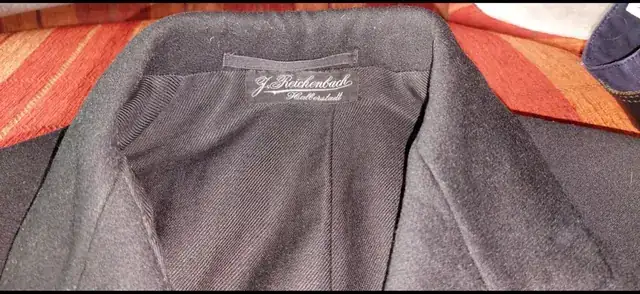
J. Reichenbach label inside a surviving jacket
A J. Reichenbach label inside a surviving jacket
Halberstadt and Wernigerode
Commercial objects
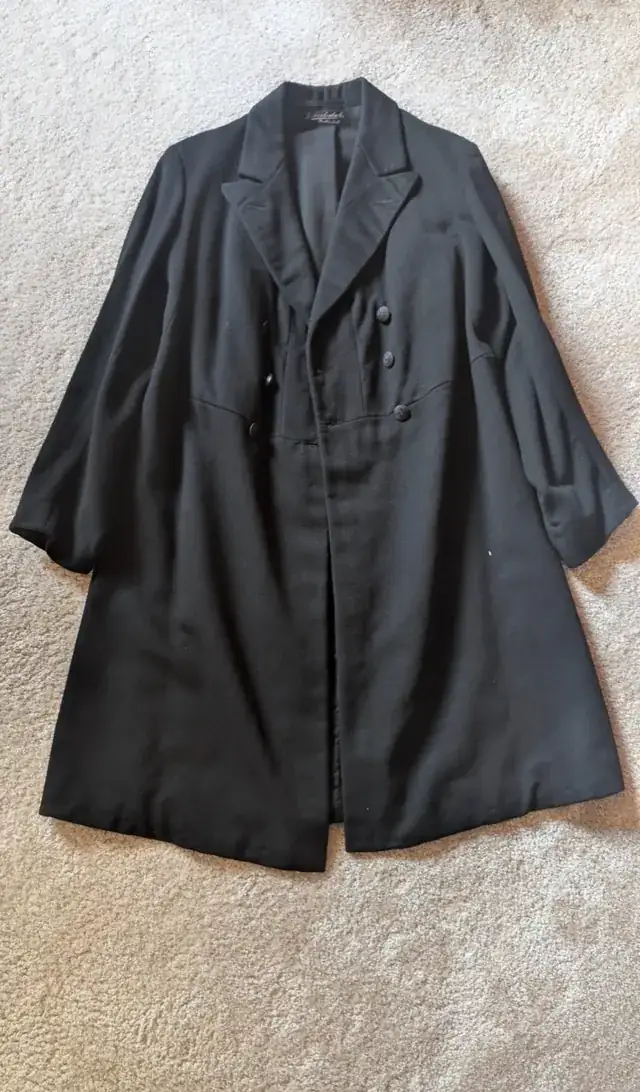
A surviving J. Reichenbach jacket
A privately held jacket bearing a J. Reichenbach label
Halberstadt and Wernigerode
Commercial objects
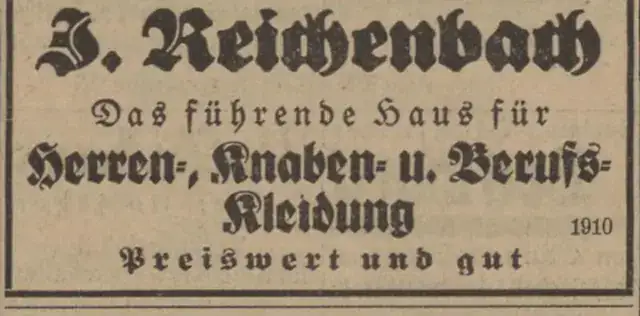
J. Reichenbach advertisement in Das Reichsbanner
This small advertisement appeared in the Halberstadt section of Das Reichsbanner on 31 October 1931, two weeks before the second surviving copy. The number 1910 printed inside the notice appears to be an advertiser index, not a date for the firm.
Halberstadt and Wernigerode
Commercial objects
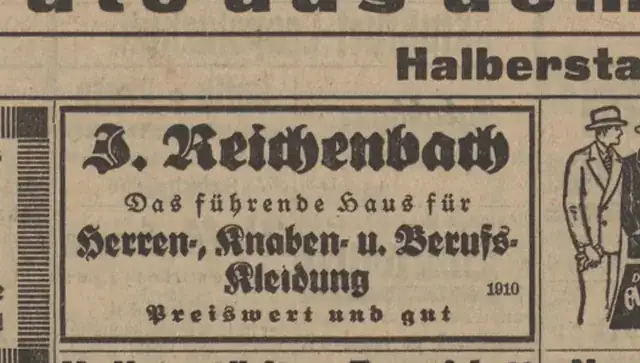
J. Reichenbach advertisement in Das Reichsbanner
The advertisement appeared again in the Halberstadt section of Das Reichsbanner on 14 November 1931, preserving the same message in a second issue. The repeated printing shows that the business continued to advertise through the city paper; it does not identify who chose or placed the notice.
Halberstadt and Wernigerode
Commercial objects
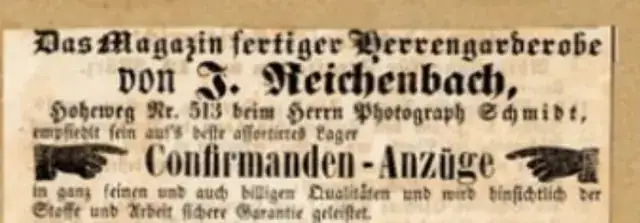
J. Reichenbach confirmation-suits advertisement
An early advertisement names Hoherweg 513 and offers confirmation suits in fine and inexpensive grades, guaranteed for cloth and workmanship. The clipping preserves what the shop sold, but its surviving photograph does not establish an issue title or date.
Explore all civil evidence: registers, citizenship, addresses and sources cited in the biographies.