Browse one archival series
Commercial objects and records
Store photographs, advertisements, stamps, hangers and business records.
58 · 1866–2022
Arrangement: historical records follow their date; conventional viewing copies stay with their source, while new interpretations use their creation date. Related pages and views stay together; undated records follow.
Filter record results by archival series
Documents and objects Showing 1–48 of 58
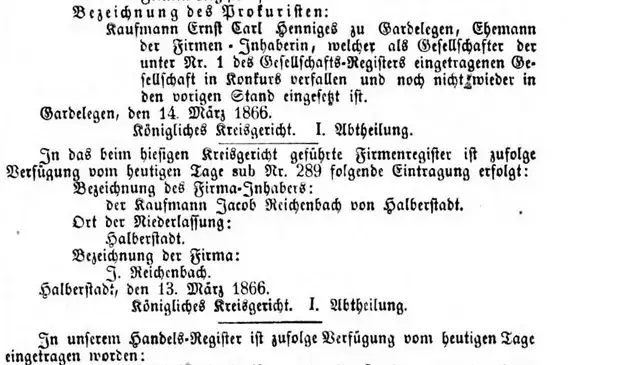 Document / objectJacob Reichenbach registers J. Reichenbach in HalberstadtOn 22 March 1866 the Prussian state gazette recorded merchant Jacob Reichenbach as the owner of J. Reichenbach in Halberstadt firm register no. 289. This is the first public register act yet found for Jacob’s firm. The business’s own advertisements continued to give 1843 as its founding year, so the notice registers an existing house rather than dating its beginning.
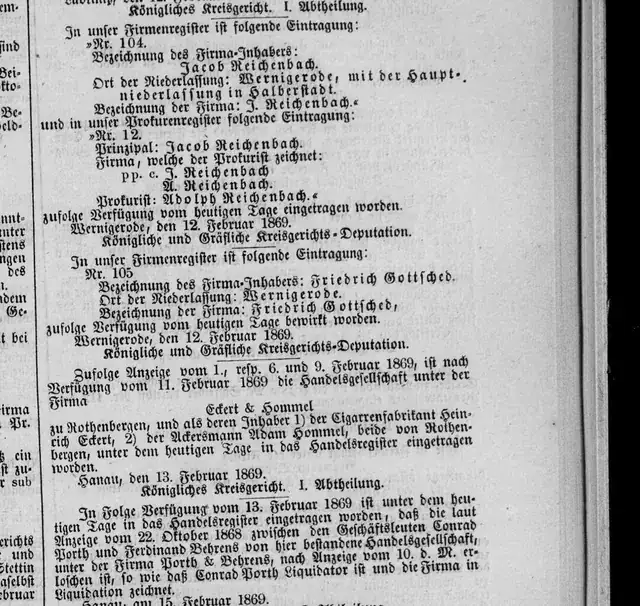 Document / objectWernigerode becomes a branch of the Halberstadt houseThe notice of 19 February 1869 registers Wernigerode as a branch of the Halberstadt house while Jacob Reichenbach was still alive. Under Prokura no. 12, Adolph Reichenbach was authorized to sign “pp. J. Reichenbach.” It ties the two Harz cities to one business during Jacob’s lifetime.
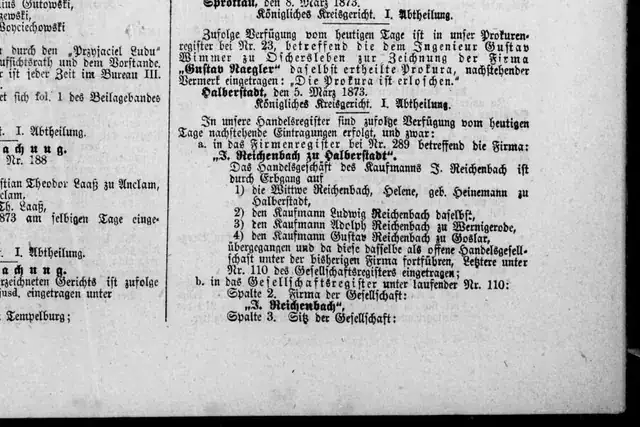 Document / objectJacob’s widow and sons inherit J. ReichenbachAfter Jacob’s death on 17 December 1872, the gazette recorded that the business passed durch Erbgang—by inheritance—to his widow Helene née Heinemann and their sons Ludwig, Adolph and Gustav. The 13 March 1873 notice places Ludwig in Halberstadt, Adolph in Wernigerode and Gustav in Goslar, and registers the house as general partnership no. 110. It names a family succession, not a sale.
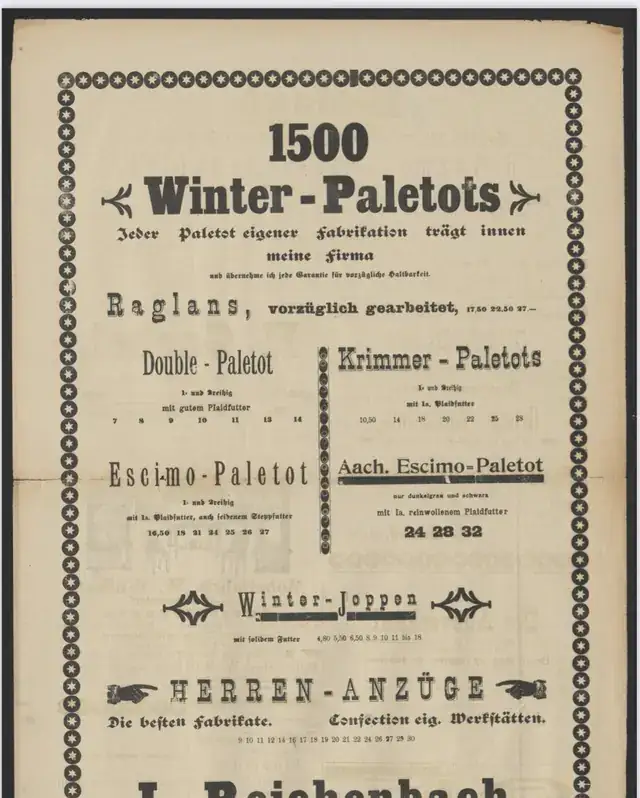 Document / objectJ. Reichenbach winter-clothing advertisementA full-page advertisement presents J. Reichenbach as a large clothing manufacturer and retailer, with 1,500 winter coats and its own workshops.
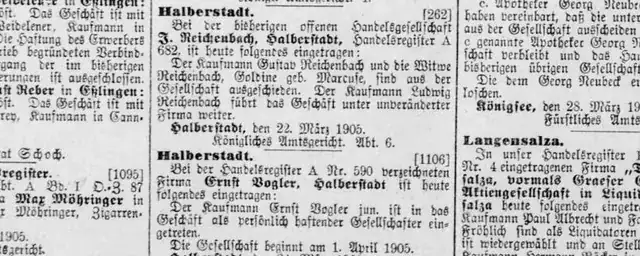 Document / objectLudwig Reichenbach continues the firm aloneOn 4 April 1905 the Reichsanzeiger recorded Gustav Reichenbach and the widowed Goldine Reichenbach leaving the partnership. Ludwig Reichenbach continued J. Reichenbach alone. The notice gives the legal change; it does not describe the family decisions behind it.
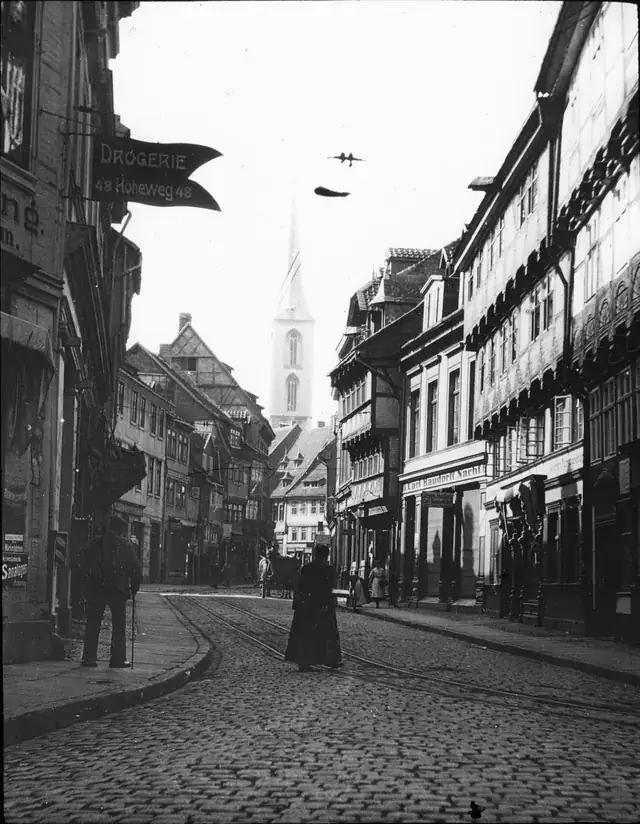 Document / objectHoher Weg with MartinikircheThis open-use street photograph predates the 1910–1913 Reichenbach rebuild and shows Hoher Weg as a dense retail street near Martinikirche. The visible sign reads Drogerie 48 Hoheweg, so it is contextual, not a view of Hoher Weg 27.
 Document / objectThe J. Reichenbach stamp shows the store buildingThis original advertising stamp shows the store building that J. Reichenbach chose to promote. The museum scan preserves the small printed view handled by the business and its customers or collectors. It lets us see how the firm presented the space, but it does not identify individual workers or shoppers.
 Document / objectThe J. Reichenbach stamp shows the store building from a second angleThis original advertising stamp shows the store building from a second angle that J. Reichenbach chose to promote. The museum scan preserves the small printed view handled by the business and its customers or collectors. It lets us see how the firm presented the space, but it does not identify individual workers or shoppers.
 Document / objectThe J. Reichenbach stamp shows the glazed light courtThis original advertising stamp shows the glazed light court that J. Reichenbach chose to promote. The museum scan preserves the small printed view handled by the business and its customers or collectors. It lets us see how the firm presented the space, but it does not identify individual workers or shoppers.
 Document / objectThe J. Reichenbach stamp shows the main staircaseThis original advertising stamp shows the main staircase that J. Reichenbach chose to promote. The museum scan preserves the small printed view handled by the business and its customers or collectors. It lets us see how the firm presented the space, but it does not identify individual workers or shoppers.
 Document / objectThe J. Reichenbach stamp shows the ground-floor salesroomThis original advertising stamp shows the ground-floor salesroom that J. Reichenbach chose to promote. The museum scan preserves the small printed view handled by the business and its customers or collectors. It lets us see how the firm presented the space, but it does not identify individual workers or shoppers.
 Document / objectThe J. Reichenbach stamp shows the ground-floor salesroom from a second angleThis original advertising stamp shows the ground-floor salesroom from a second angle that J. Reichenbach chose to promote. The museum scan preserves the small printed view handled by the business and its customers or collectors. It lets us see how the firm presented the space, but it does not identify individual workers or shoppers.
 Document / objectThe J. Reichenbach stamp shows the first-floor salesroomThis original advertising stamp shows the first-floor salesroom that J. Reichenbach chose to promote. The museum scan preserves the small printed view handled by the business and its customers or collectors. It lets us see how the firm presented the space, but it does not identify individual workers or shoppers.
 Document / objectThe J. Reichenbach stamp shows the boys’ departmentThis original advertising stamp shows the boys’ department that J. Reichenbach chose to promote. The museum scan preserves the small printed view handled by the business and its customers or collectors. It lets us see how the firm presented the space, but it does not identify individual workers or shoppers.
 Document / objectThe J. Reichenbach stamp shows the fitting roomThis original advertising stamp shows the fitting room that J. Reichenbach chose to promote. The museum scan preserves the small printed view handled by the business and its customers or collectors. It lets us see how the firm presented the space, but it does not identify individual workers or shoppers.
 Document / objectThe J. Reichenbach stamp shows the made-to-measure departmentThis original advertising stamp shows the made-to-measure department that J. Reichenbach chose to promote. The museum scan preserves the small printed view handled by the business and its customers or collectors. It lets us see how the firm presented the space, but it does not identify individual workers or shoppers.
 Document / objectThe J. Reichenbach stamp shows the tailors’ workshopThis original advertising stamp shows the tailors’ workshop that J. Reichenbach chose to promote. The museum scan preserves the small printed view handled by the business and its customers or collectors. It lets us see how the firm presented the space, but it does not identify individual workers or shoppers.
 Document / objectThe J. Reichenbach stamp shows the cutters’ workshopThis original advertising stamp shows the cutters’ workshop that J. Reichenbach chose to promote. The museum scan preserves the small printed view handled by the business and its customers or collectors. It lets us see how the firm presented the space, but it does not identify individual workers or shoppers.
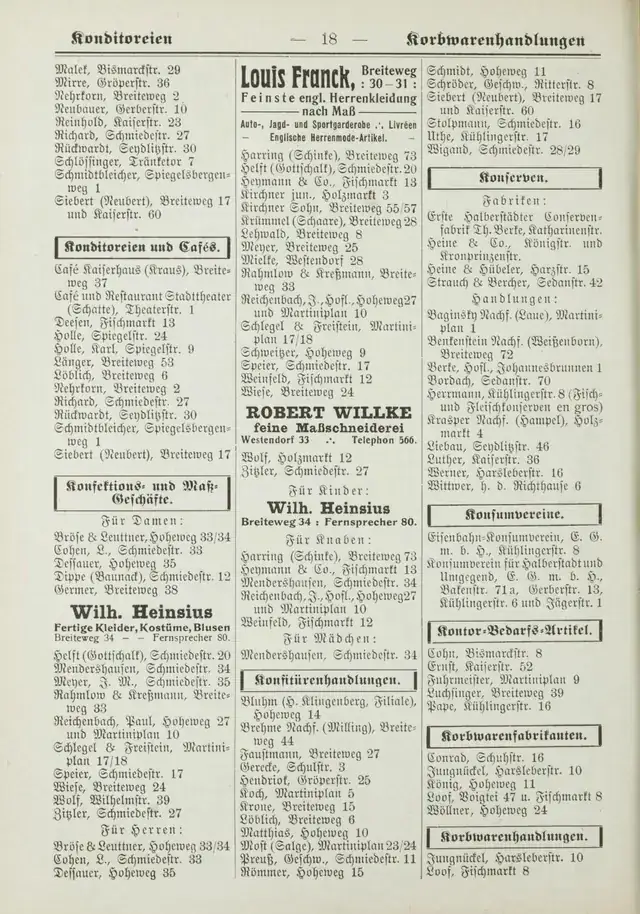 Document / objectJ. and Paul Reichenbach clothing listingsThe 1914 business directory places J. Reichenbach and Paul Reichenbach on the same page. J. Reichenbach appears under men’s and boys’ clothing; Paul Reichenbach appears under women’s clothing, both at Hoheweg 27 and Martiniplan 10.
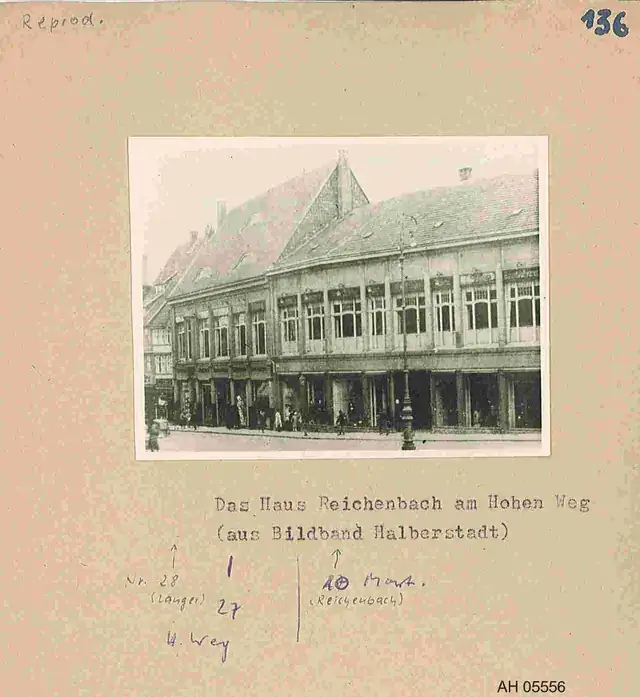 Document / objectKaufhaus Reichenbach façadeThis view gives the clearest straight-on record of the shopfront rhythm, upper windows and roofline.
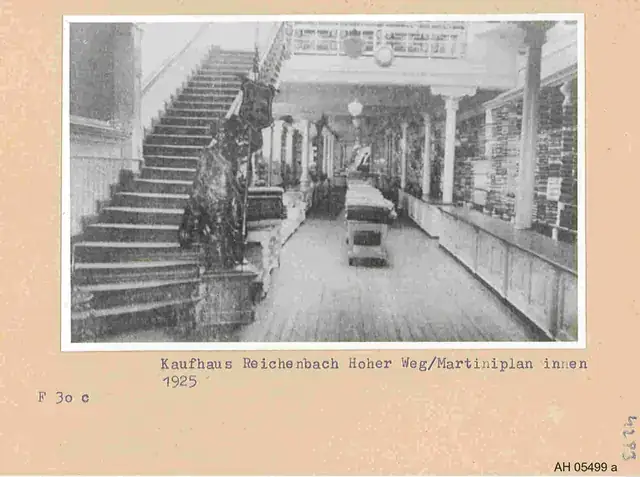 Document / objectA mounted print of the Kaufhaus Reichenbach sales floorA museum-mounted 1925 print preserves the same sales-floor view with its contemporary catalogue label and signature. The mount shows how the museum kept and catalogued the photograph, not a different room.
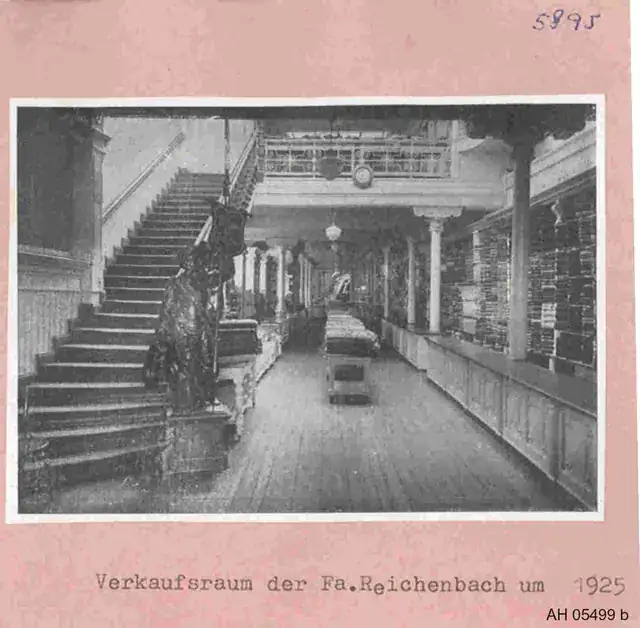 Document / objectA second mounted print of the Kaufhaus Reichenbach sales floorA second mounted print preserves the same interior photograph with a different crop and catalogue mount. Its changed crop does not establish a second room or a second date.
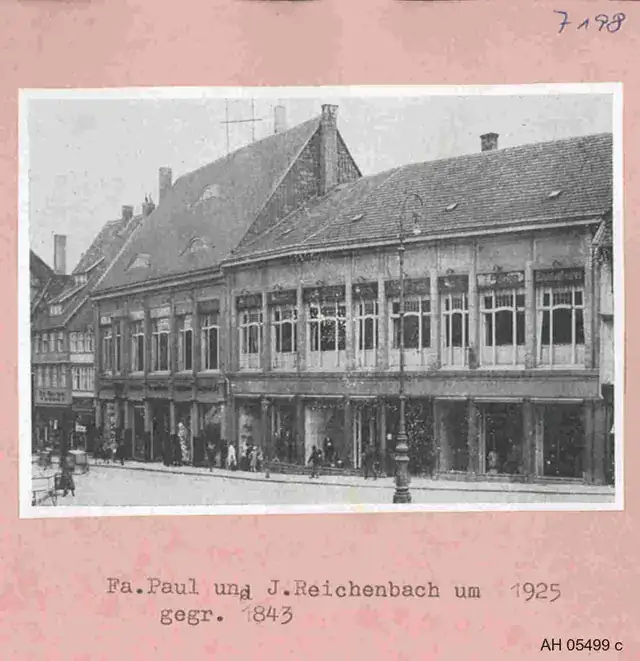 Document / objectKaufhaus Reichenbach exteriorThe mounted print names Paul and J. Reichenbach and preserves the long Hoher Weg frontage as it was catalogued in 1925.
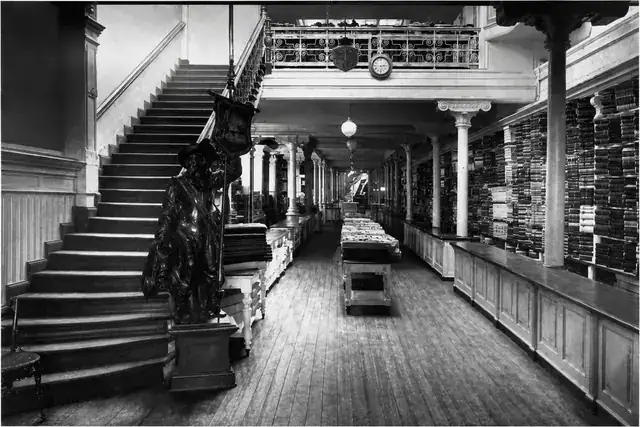 Document / objectThe wooden staircase rose through the Kaufhaus Reichenbach sales floorThis historical photograph shows the store’s wooden staircase, carved newel figure, gallery, counters and shelves of cloth. The published image lets us see how customers and staff moved between floors. It does not identify the people who worked or shopped there.
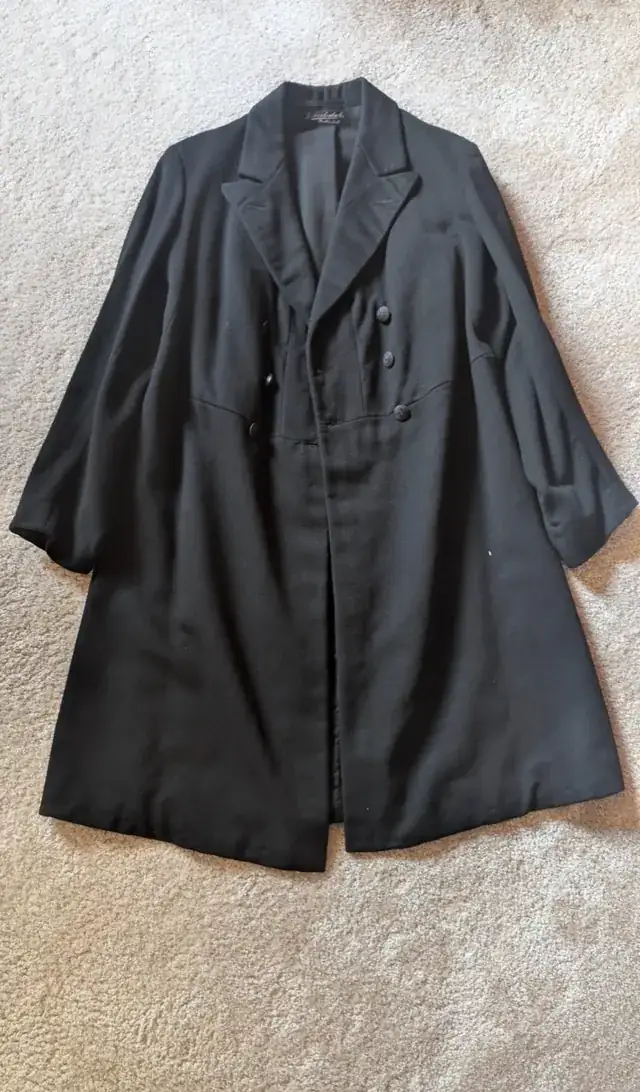 Document / objectA surviving J. Reichenbach jacketA privately held jacket bearing a J. Reichenbach label
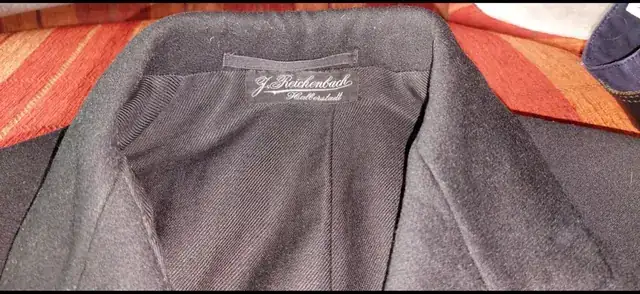 Document / objectJ. Reichenbach label inside a surviving jacketA J. Reichenbach label inside a surviving jacket
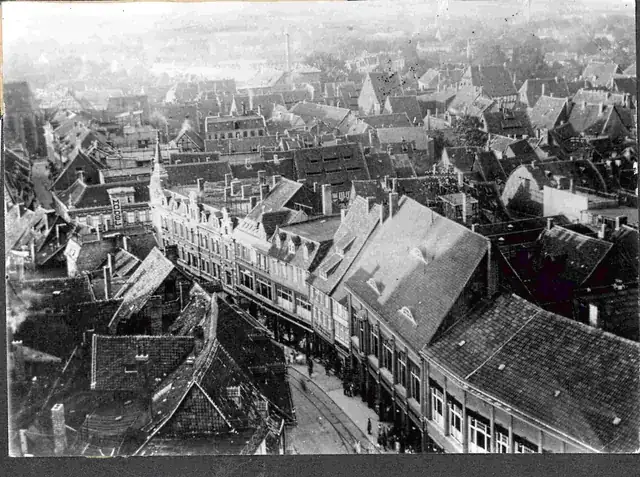 Document / objectHoher Weg 35–27 and Martiniplan 10The elevated city view places the long commercial block within Halberstadt’s dense roofs and adjoining streets.
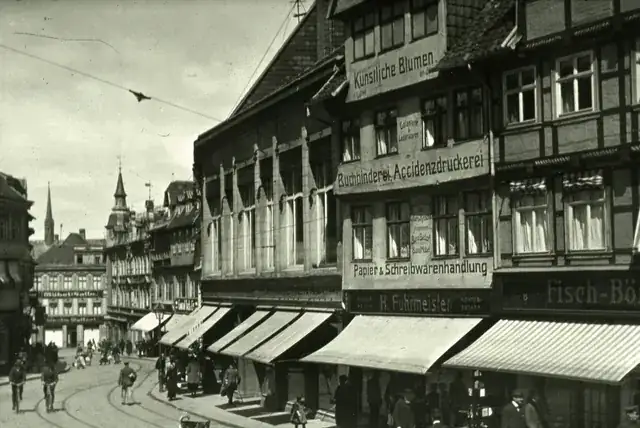 Document / objectHoher Weg toward MartiniplanRather than isolating the store, this view records the approach along a busy retail street of awnings, signs, pedestrians and neighboring businesses.
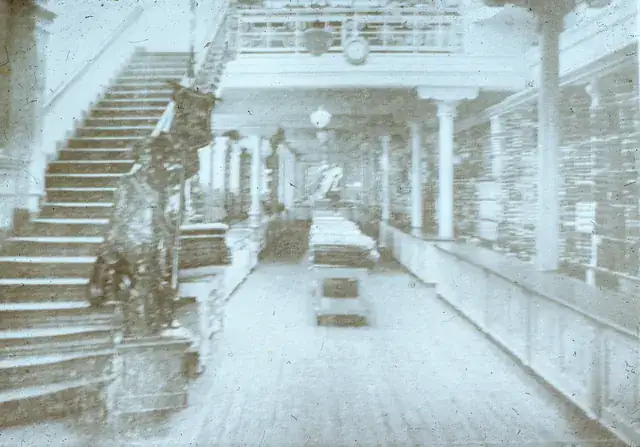 Document / objectInside the Kaufhaus Reichenbach sales floorThe sales floor joins the building plans to a working interior: staircase, counters, shelving and the upper gallery occupy one continuous space. The museum catalogue does not name the photographer, and the faded slide cannot tell us who was working in the room.
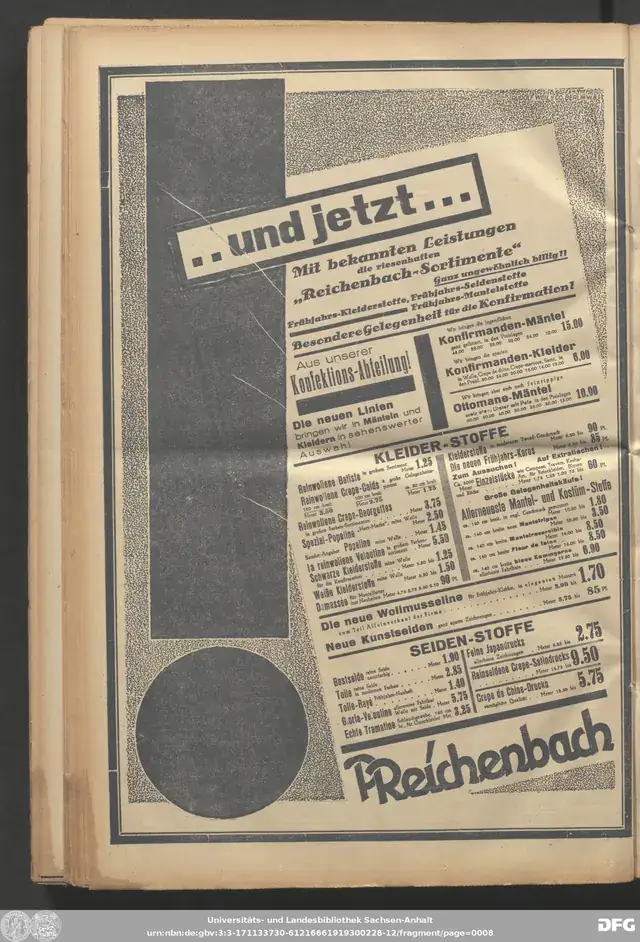 Document / objectReichenbach spring textiles and ready-made clothing advertisementReichenbach spring clothing and textile advertisement, 28 February 1930
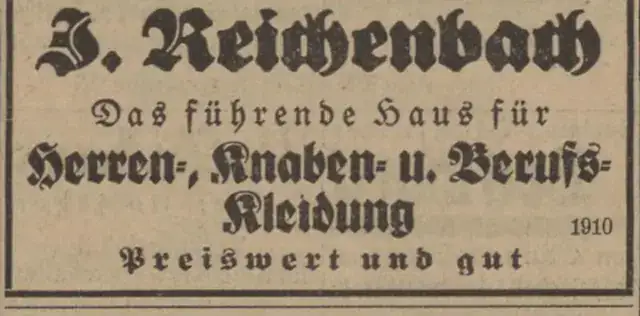 Document / objectJ. Reichenbach advertisement in Das ReichsbannerThis small advertisement appeared in the Halberstadt section of Das Reichsbanner on 31 October 1931, two weeks before the second surviving copy. The number 1910 printed inside the notice appears to be an advertiser index, not a date for the firm.
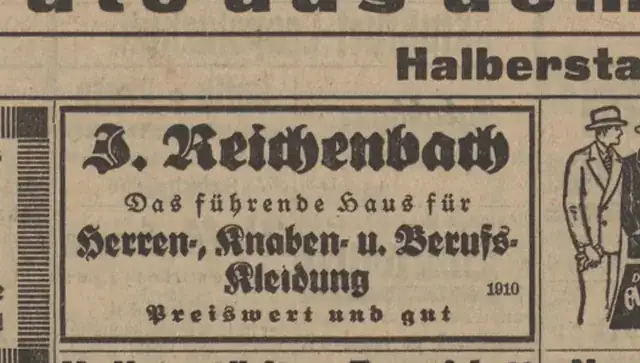 Document / objectJ. Reichenbach advertisement in Das ReichsbannerThe advertisement appeared again in the Halberstadt section of Das Reichsbanner on 14 November 1931, preserving the same message in a second issue. The repeated printing shows that the business continued to advertise through the city paper; it does not identify who chose or placed the notice.
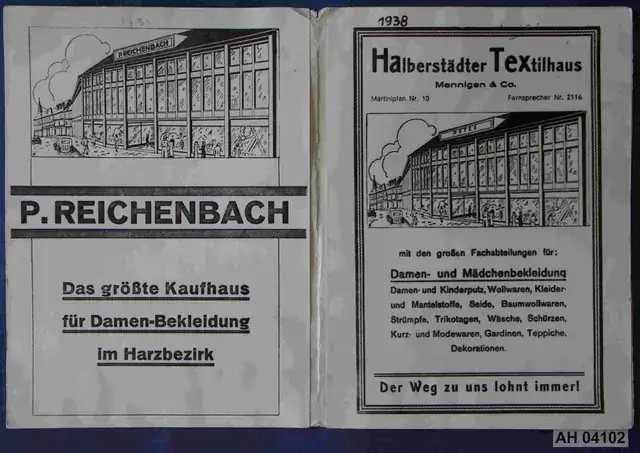 Document / objectPaul Reichenbach’s shop and Mennigen & Co. at the same addressA museum comparison places a 1933 P. Reichenbach advertisement beside a 1938 Menningen & Co. advertisement for the same Martiniplan 10 address.
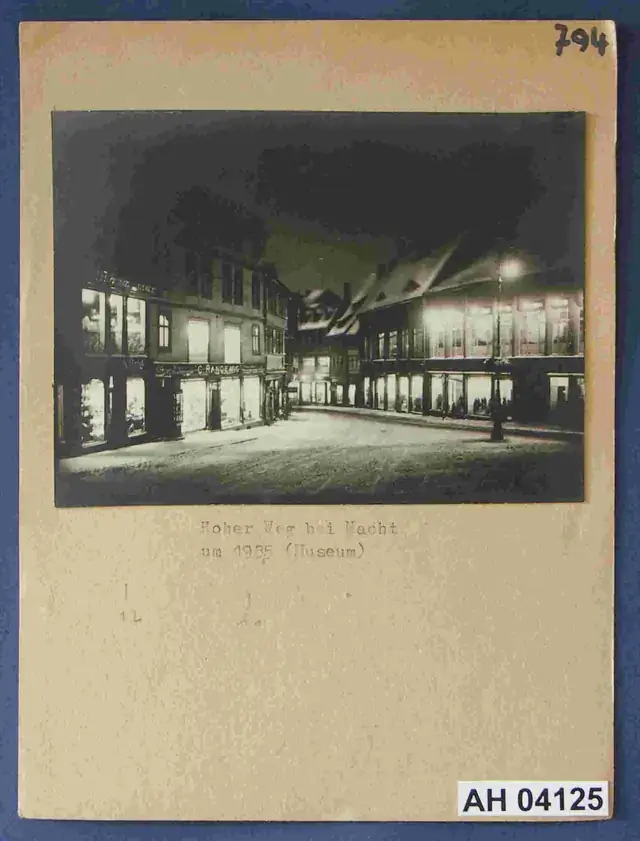 Document / objectHoher Weg and Martiniplan lit at nightThe mounted print preserves a brighter version of the same night scene and the museum's handwritten 1935 identification. It shows the same scene as the direct slide; it does not document a separate night or a second view of the building.
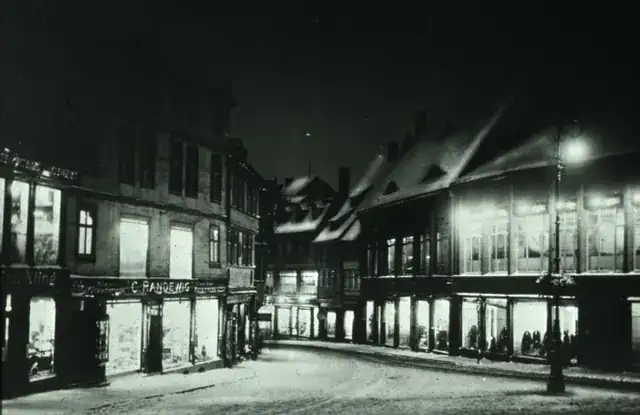 Document / objectMartiniplan and Kaufhaus Reichenbach after darkAt night, the block becomes a field of illuminated display windows. The museum record identifies Martiniplan 11 at left and Nos. 10, 9 and 8 at right, including Kaufhaus Reichenbach.
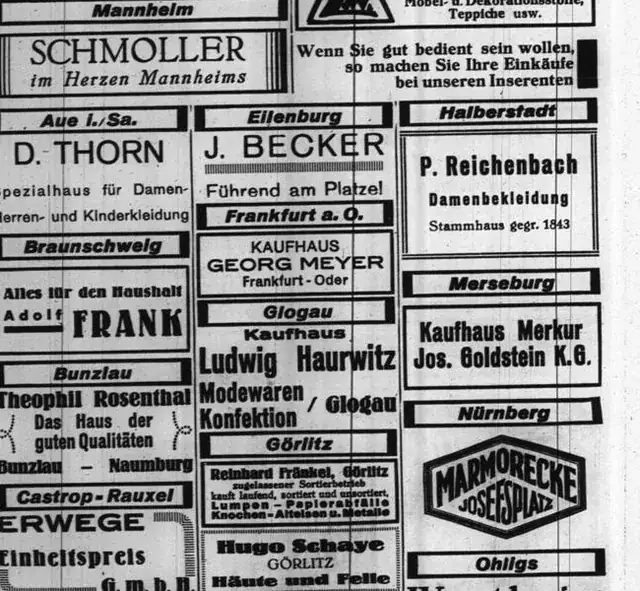 Document / objectP. Reichenbach advertises women’s clothing in 1937This small Halberstadt advertisement reads “P. Reichenbach / Damenbekleidung / Stammhaus gegr. 1843.” It shows the women’s-clothing firm still advertising nearly two years after Paul’s death, now to readers of a national Jewish veterans’ newspaper. Its placement in Der Schild does not make Paul or the firm an office of the Reichsbund jüdischer Frontsoldaten.
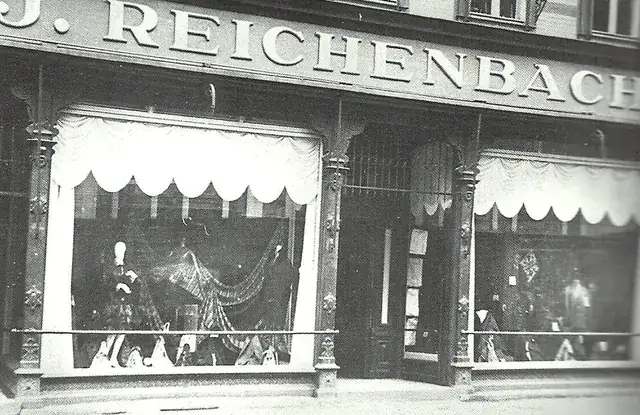 Document / objectJ. Reichenbach storefront, WernigerodeThe J. Reichenbach storefront at Breite Straße 7, Wernigerode, photographed in 1938.
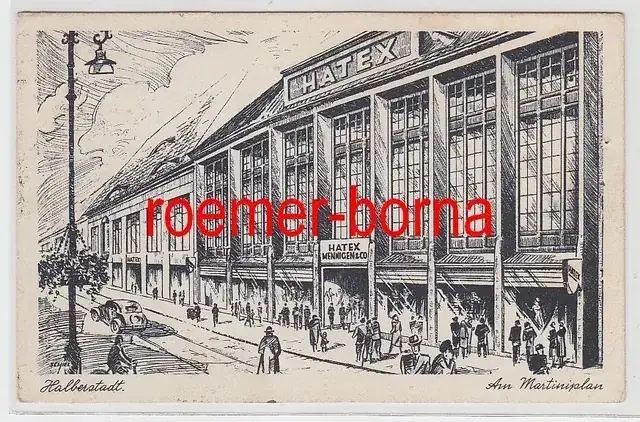 Document / objectHATEX, Mennigen & Co. postcard of the former Reichenbach storeAn illustrated postcard turns the former Reichenbach façade into an advertisement for HATEX, Mennigen & Co. The roofline carries enormous HATEX letters; the Reichenbach name has disappeared. Read beside the official Aryanization list, the image gives the transfer of a Jewish family’s commercial world an unusually direct visual and emotional force.
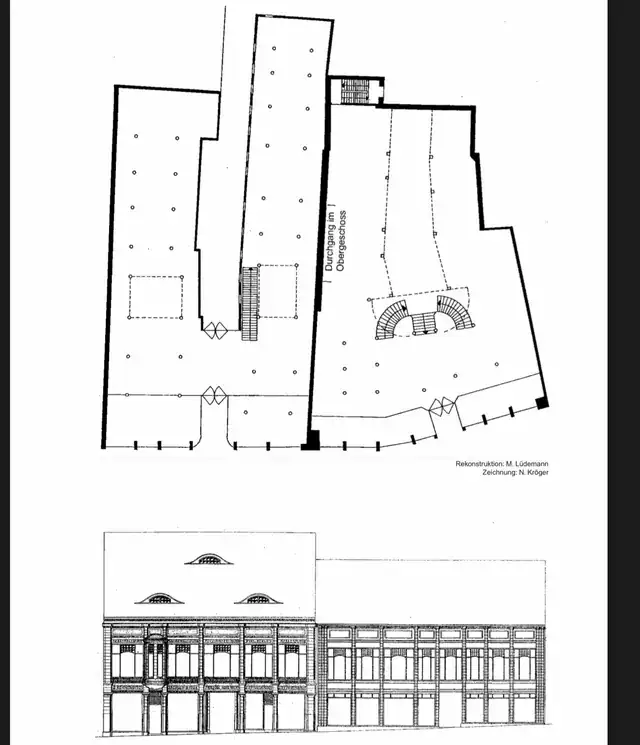 Document / objectReconstructed plan and elevations of Kaufhaus ReichenbachMonika Lüdemann’s 2004 study reconstructs the connected ground plan and 1913 street elevations of Hoher Weg 27 and Martiniplan 10, drawn by Nicola Kröger from the cited municipal building files. The plate lets us see how the two street fronts joined. Exact dimensions and linework still have to be checked against the original municipal drawings.
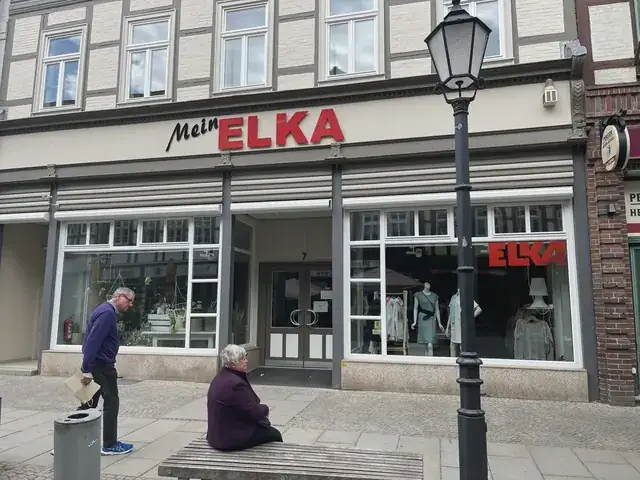 Document / objectA shopfront still faces Breite Straße 7This modern photograph shows the Wernigerode building where Jeanette and Fritz Reichenbach kept the family shop. Four Stolpersteine now lie outside the surviving shopfront. The building connects the address to the street today, but its present appearance is not proof of the 1930s interior.
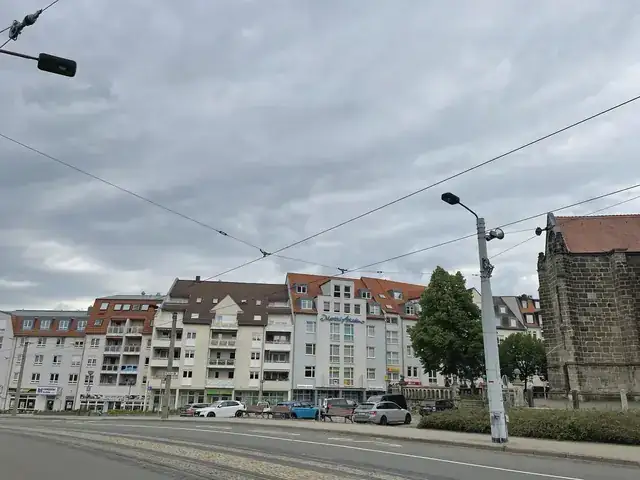 Document / objectThe Reichenbach store quarter was rebuilt after the warThis modern photograph shows Martiniplan and Hoher Weg after wartime bombing destroyed the Reichenbach building. A visitor photographed the rebuilt streets where the family’s store once stood. The view locates the quarter today, but it does not preserve the historic shop footprint by itself.
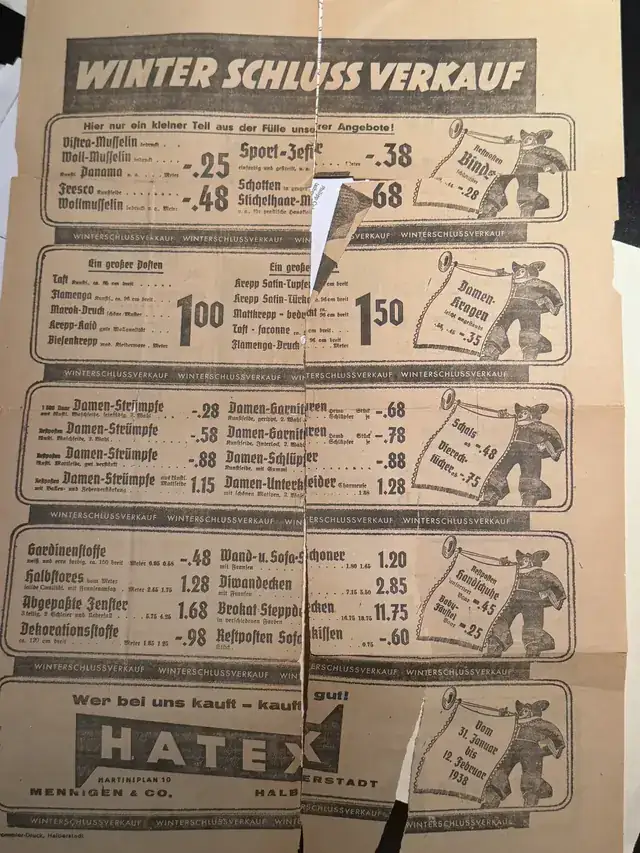 Document / objectHATEX winter-sale handbills — first view‘Winter-Schluss-Verkauf’ handbills name ‘HATEX, Mennigen & Co., Martiniplan 10, Halberstadt’ and list the Wernigerode branch. Read with the official Aryanization list, they establish HATEX as the trading name used by Mennigen & Co., the firm recorded as successor to Paul Reichenbach’s business.
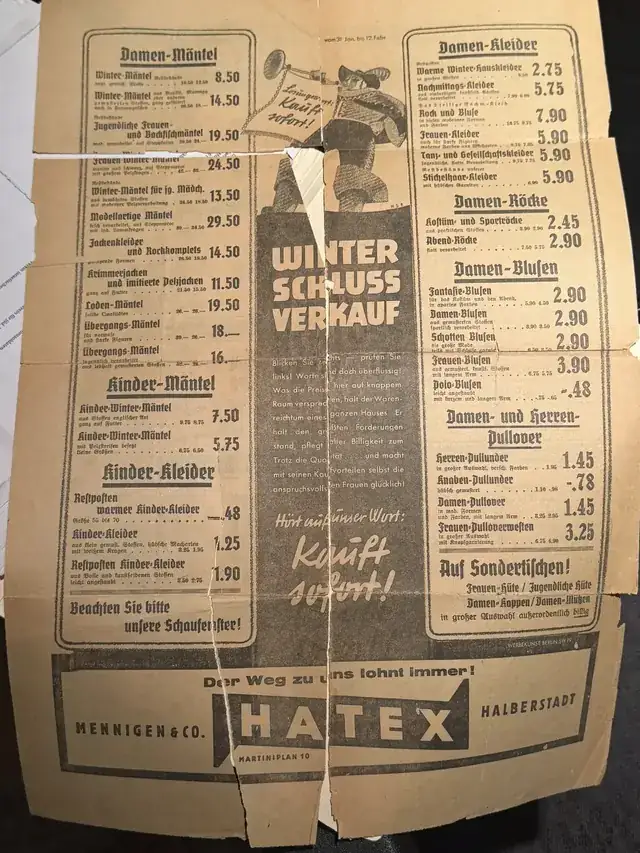 Document / objectHATEX winter-sale handbills — second viewA second view preserves the full arrangement and reverse context of the HATEX handbills. Their printed company and address now connect directly to the official record naming Mennigen & Co. as the Aryanization successor to Paul Reichenbach’s business.
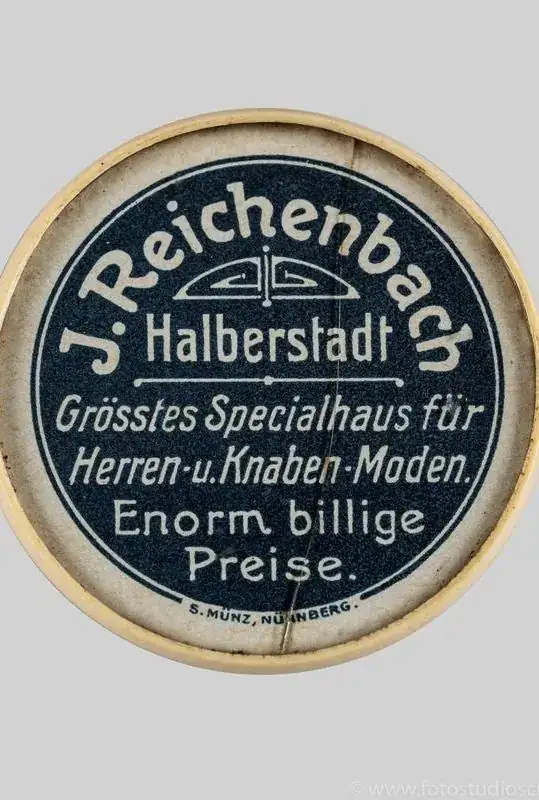 Document / objectJ. Reichenbach advertising buttonA round advertising button presents J. Reichenbach as Halberstadt's largest specialist house for men's and boys' fashions; its maker's line names S. Münz of Nuremberg.
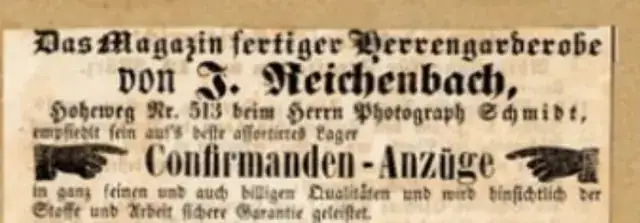 Document / objectJ. Reichenbach confirmation-suits advertisementAn early advertisement names Hoherweg 513 and offers confirmation suits in fine and inexpensive grades, guaranteed for cloth and workmanship. The clipping preserves what the shop sold, but its surviving photograph does not establish an issue title or date.
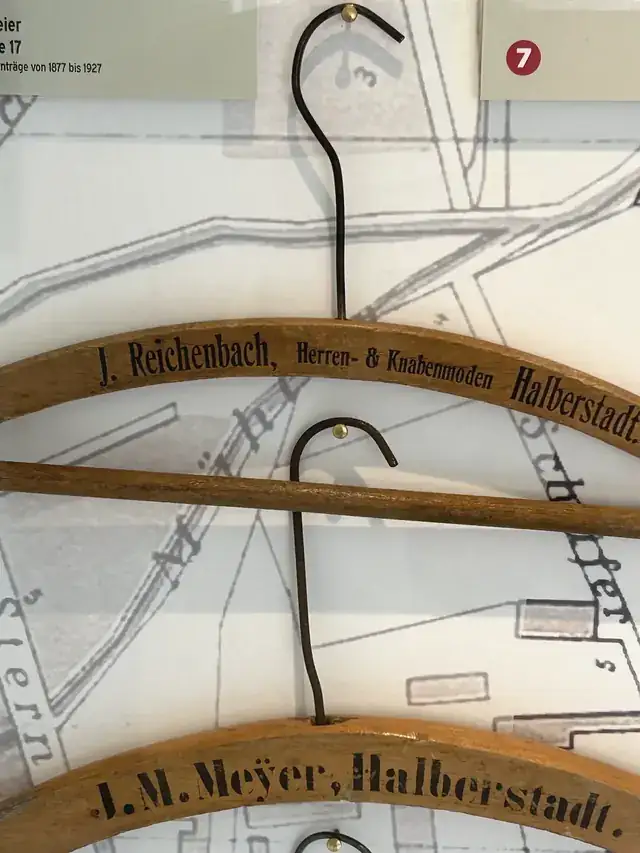 Document / objectA museum display places two Halberstadt shop hangers over the city mapThis display pairs a J. Reichenbach hanger with another Halberstadt retailer’s hanger over a map. Museum staff arranged the objects so visitors could connect shop names with city streets. The display shows the surviving retail objects, but it does not establish that the two businesses shared ownership or customers.
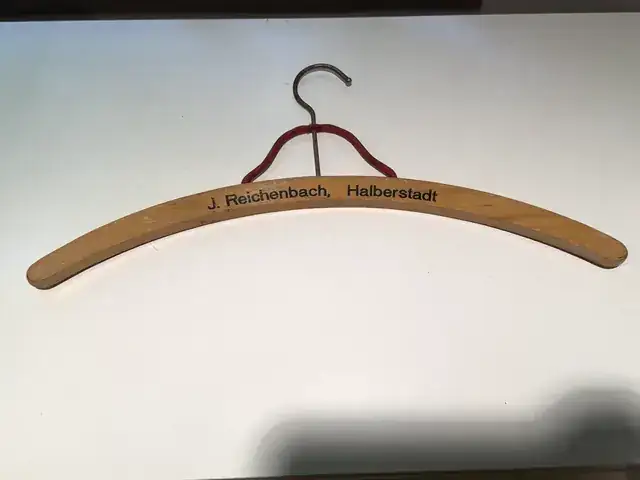 Document / objectA wooden J. Reichenbach hanger with the complete court-purveyor markThe clearest complete “Hoflieferant” mark in the surviving set. The ink ties the object to the Halberstadt clothing house. It does not identify the customer or employee who last handled it.
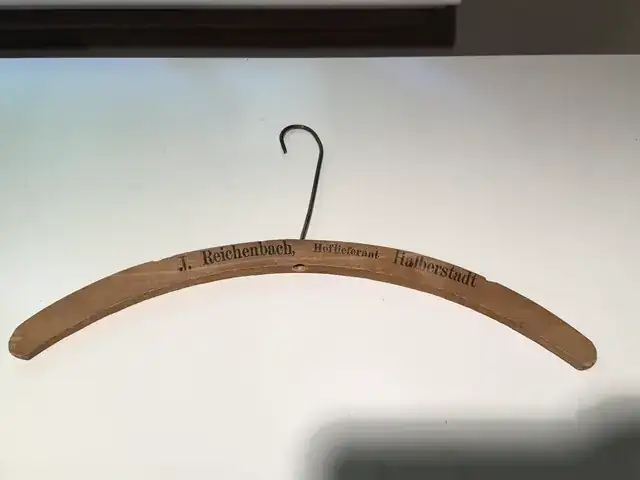 Document / objectA second pattern of J. Reichenbach wooden hangerA second pattern of Reichenbach-branded wooden hanger. Its shape shows that more than one hanger pattern carried the shop name. The object does not carry a secure date or user’s name.