Search by a name: Dolf
Filter record results by archival series
Documents and objects 50
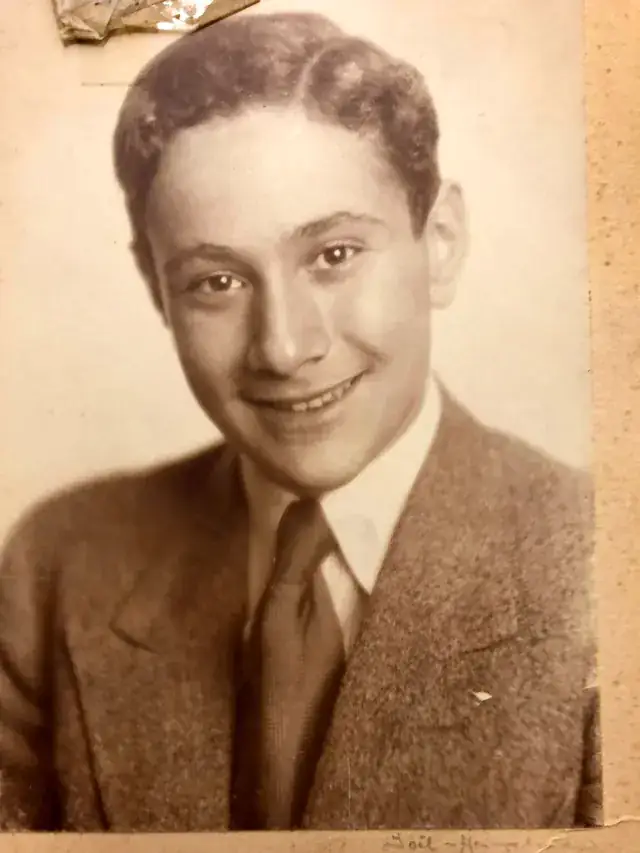 Document / objectDolf ReichenbachAdolf “Dolf” Reichenbach as a young man. The family identifies him, but the portrait’s date, studio and photographer have not been established.
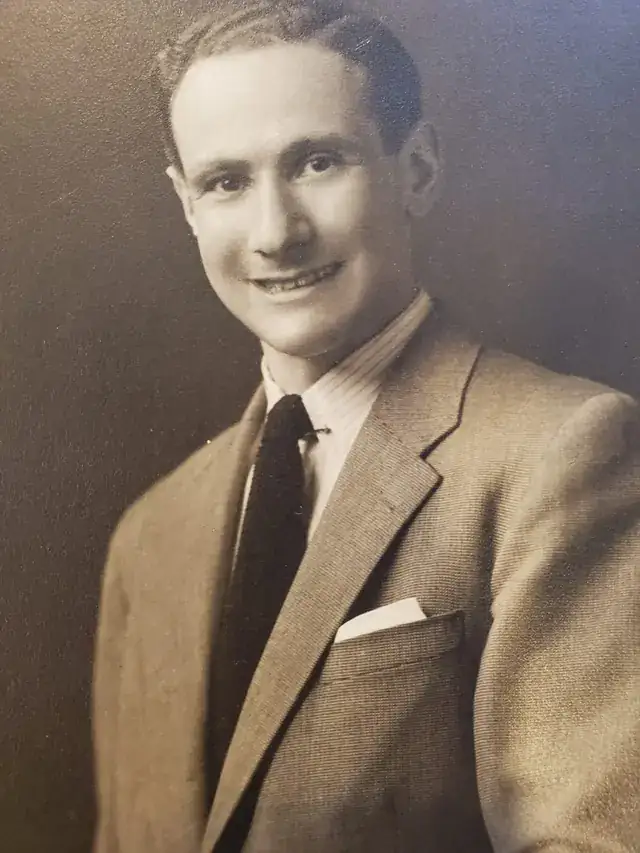 Document / objectDolf Reichenbach as an adultAdolf “Dolf” Reichenbach as an adult. The date and photographer have not yet been established.
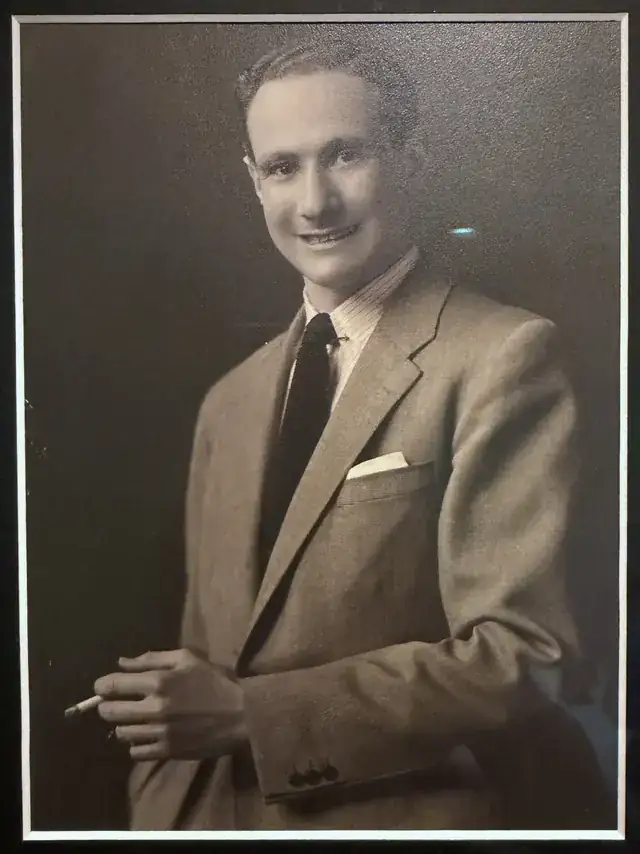 Document / objectDolf Reichenbach in his twentiesAdolf “Dolf” Reichenbach in his twenties, before leaving Germany. The family identifies Dolf before his departure from Germany. The exact year, studio and photographer remain unknown.
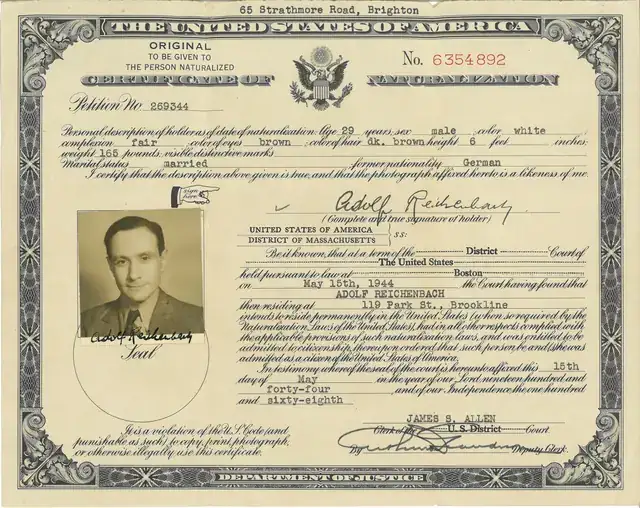 Document / objectDolf Reichenbach’s Certificate of NaturalizationDolf’s original naturalization certificate records his admission as a United States citizen in Boston on 15 May 1944. His photograph and signature remain attached to the family-held original. The certificate proves completed naturalization, but the typed Brighton address above its border is not yet explained.
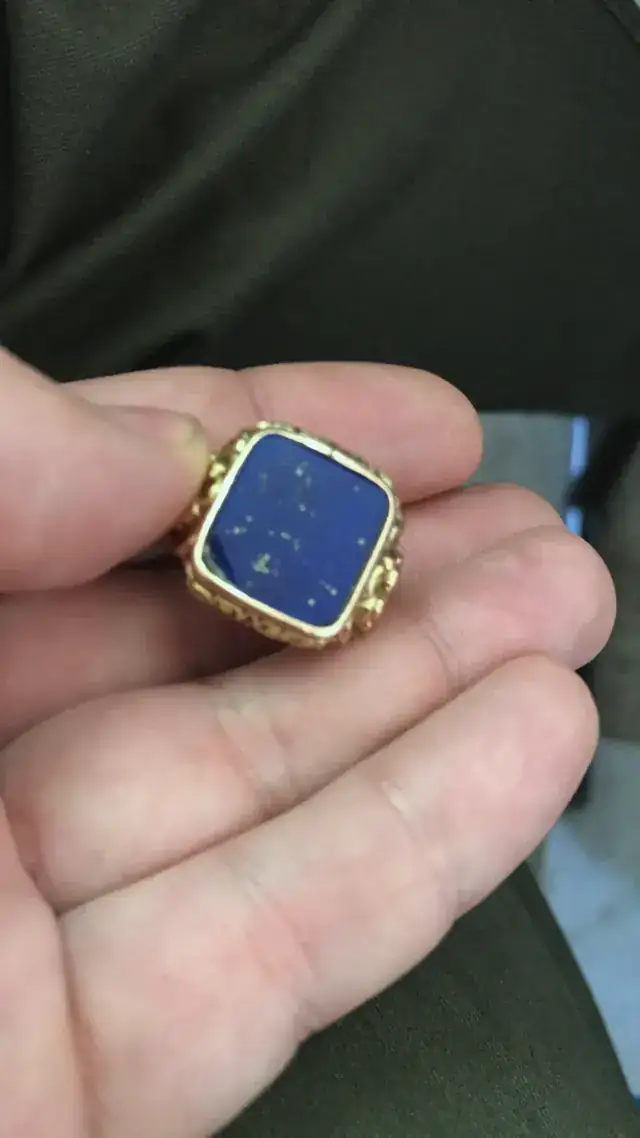 Document / objectDolf wore this gold signet ringThis gold ring with a blue intaglio stone belonged to Dolf Reichenbach. Family memory allows that it may have come from an earlier generation. The object proves Dolf’s ownership, but no document yet names its maker, first owner or date.
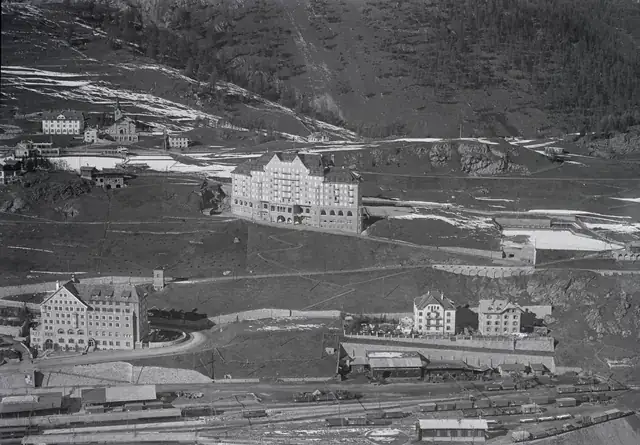 Document / objectDolf wrote to Mutti from the Carlton HotelThis historical photograph shows the Carlton Hotel in St. Moritz sometime between 1918 and 1937. Dolf wrote to his mother from this hotel on 26 November 1938. The picture places the building before us, but it does not show Dolf or the room in which he wrote.
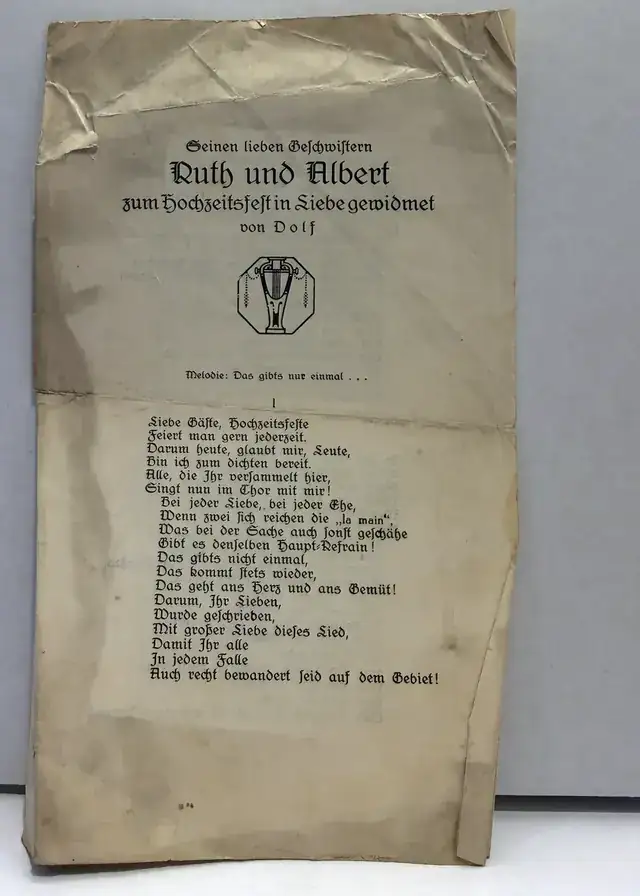 Document / objectDolf’s dedication and first wedding-song verse for Ruth and AlbertDolf dedicated this humorous song to his sister Ruth and Albert Rothschild for their Halberstadt wedding on 3 August 1933. The booklet lets us hear a brother address the couple at their wedding. It is a family performance, not a neutral account of Ruth’s earlier life.
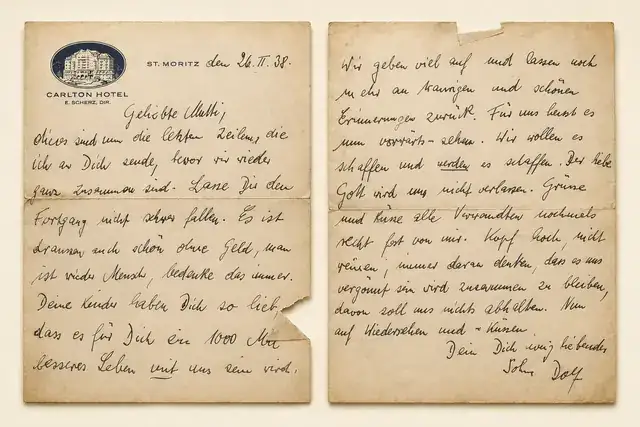 Document / objectDolf’s letter from St. Moritz to MuttiDolf Reichenbach to his mother Margarete, St. Moritz, 26 November 1938.
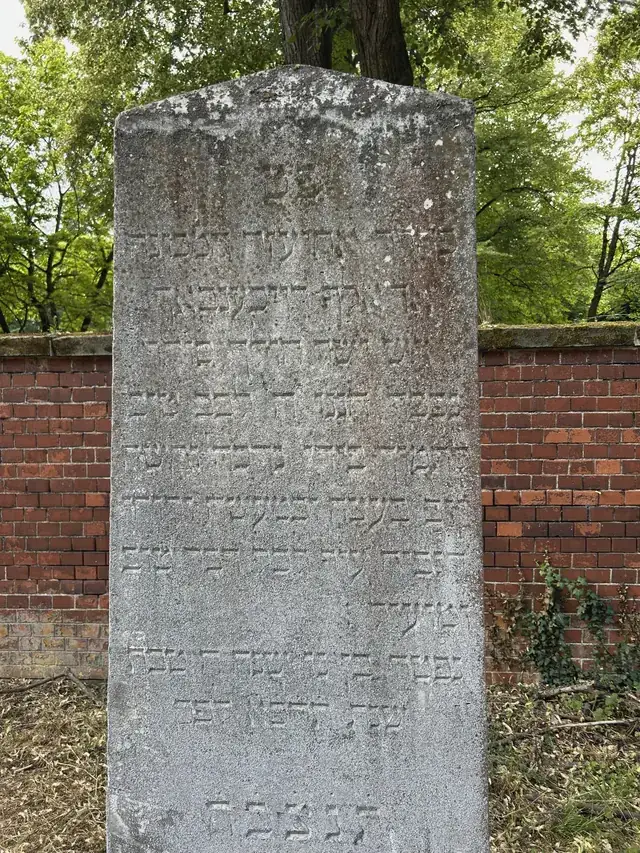 Document / objectAdolf Reichenbach’s Hebrew gravestone face preserves Baruch AchiezerThis photograph shows the Hebrew face of Adolf Reichenbach’s gravestone in Halberstadt. Mourners named him Baruch Achiezer and praised his integrity and good works. The stone preserves his name and death date, but weathering prevents a letter-perfect reading of every line.
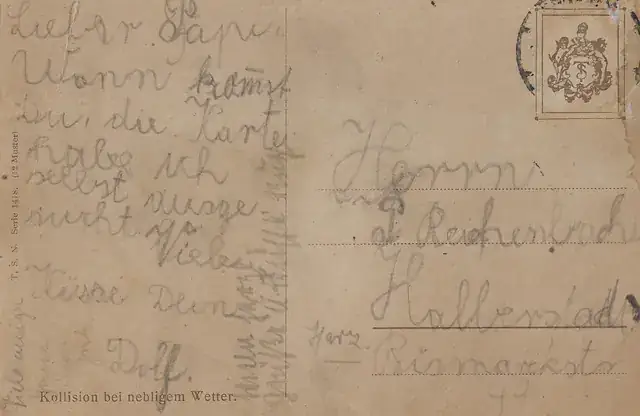 Document / object“Dear Papa” — a postcard signed DolfA child writes to Papa: “I chose the card myself.” Signed Dolf; undated.
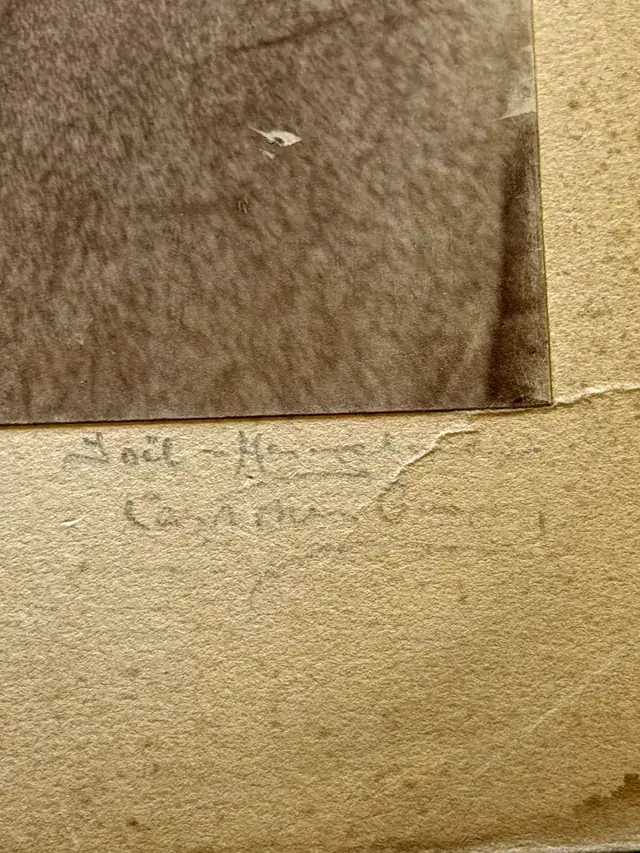 Document / objectA faint pencil note begins with Dolf’s nameThis close view enlarges the writing beneath young Dolf’s mounted portrait. The family identifies the sitter, while the matching paper, tape and tears prove that this is the front of the same mount. The note appears to begin “Dolf,” but the remaining words cannot be read responsibly.
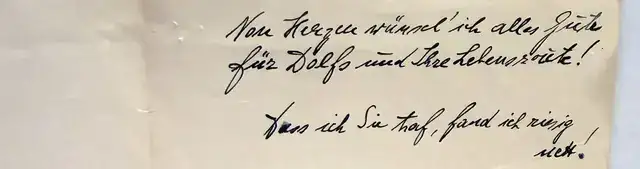 Document / objectFred closes his shipboard verse with wishes for Margarete and DolfThis second leaf ends the verse written to Margarete aboard the S.S. Manhattan and signs it “Ihrem Fred, Le Havre.” Fred wishes her well for Dolf and the course of her life. The page documents the 1937 crossing, but the writer’s full identity remains unknown.
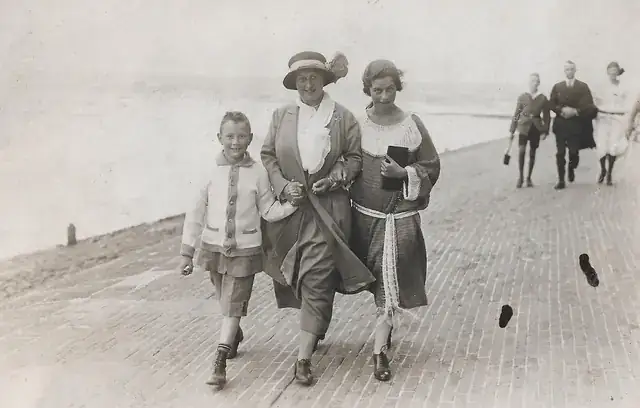 Document / objectMargarete, Dolf and Ruth at WesterlandDolf, Margarete and Ruth Reichenbach walking on Westerland’s seaside promenade on Sylt, probably in the early 1920s. The family kept the photograph with the three names and the place. Its date remains approximate.
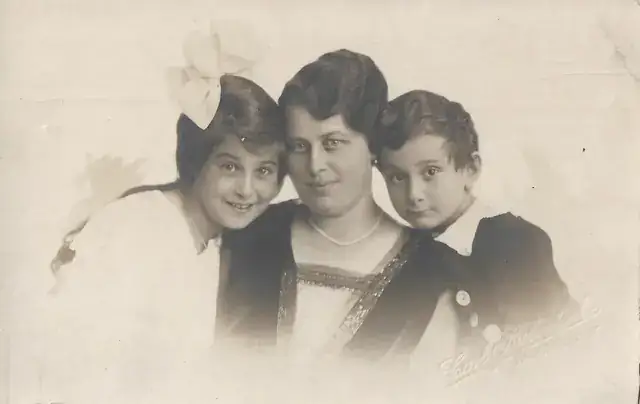 Document / objectMargarete, Ruth and DolfMargarete Reichenbach with Ruth and Dolf. The family identifies the mother and her two children. The photograph does not carry a secure date or place.
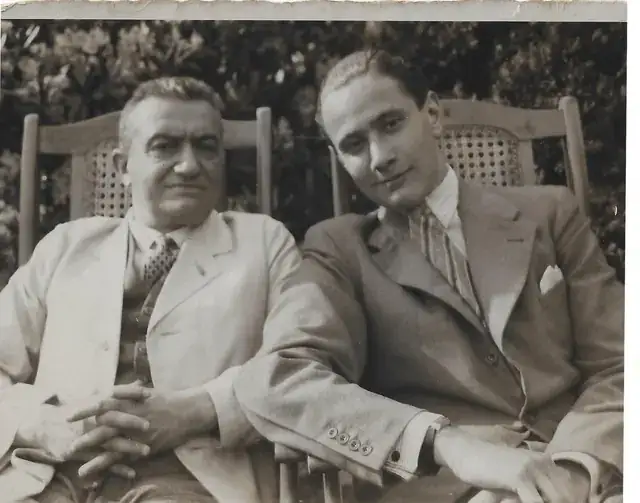 Document / objectPaul and DolfPaul and Dolf stand together in this family photograph. No place, date or photographer survives with the print.
- Document / objectPaul and Dolf are briefly set in motionThis AI-generated animation begins with the family photograph of Paul and Dolf seated together. The still image is the historical object; the movement is an openly labeled interpretation. It cannot recover an actual gesture, moment or conversation.
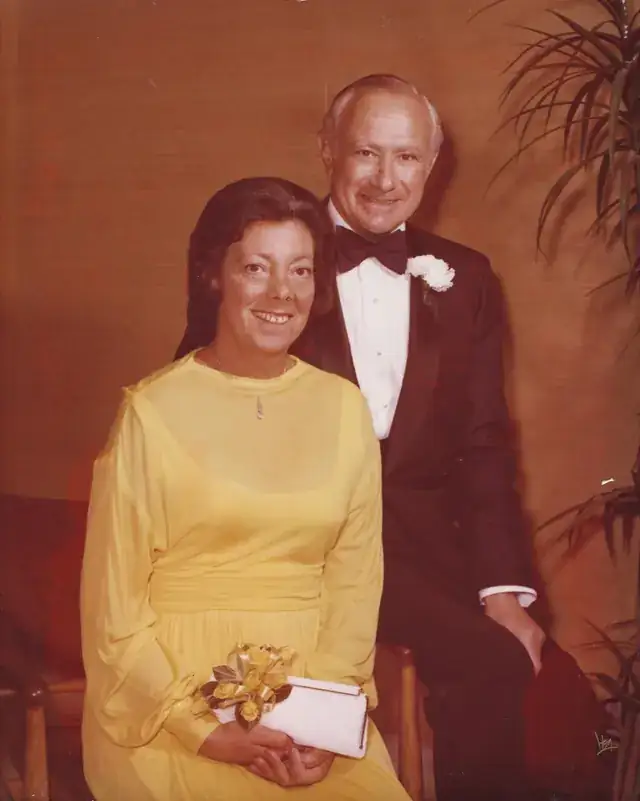 Document / objectSubie and Dolf sit together later in lifeThis direct scan shows Susan “Subie” Ulmer Reichenbach and Adolf “Dolf” Reichenbach together. The family kept the print with its color cast and surface marks intact. Their identities are known, but the date, occasion, location and photographer are not.
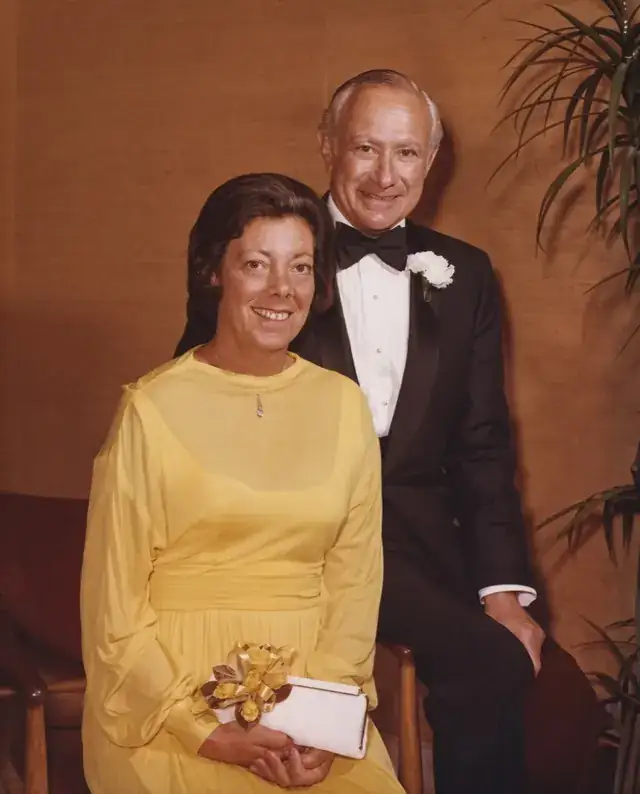 Document / objectSusan “Subie” Ulmer Reichenbach and Dolf — enhanced viewSusan “Subie” Ulmer Reichenbach and Adolf “Dolf” Reichenbach together later in life. The enhanced presentation image is shown first; its About record opens the direct scan as a second view.
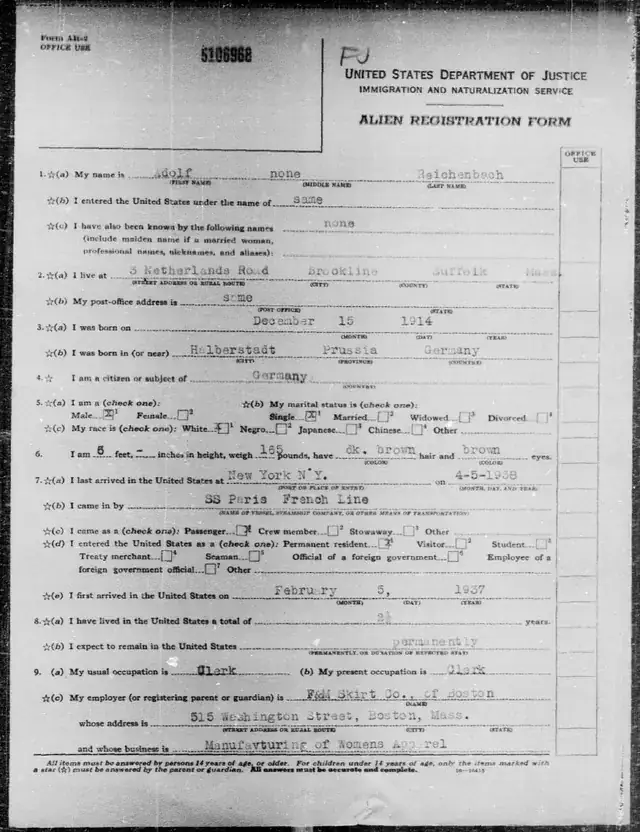 Document / objectThe first page of Dolf’s Alien Registration FormThe first page records Dolf Reichenbach, A5106968, at 3 Netherlands Road in Brookline. It gives his Halberstadt birth, last arrival at New York on 4 May 1938 aboard the SS Paris, first U.S. arrival on 5 February 1937, and his work for F & M Skirt Co. of Boston.
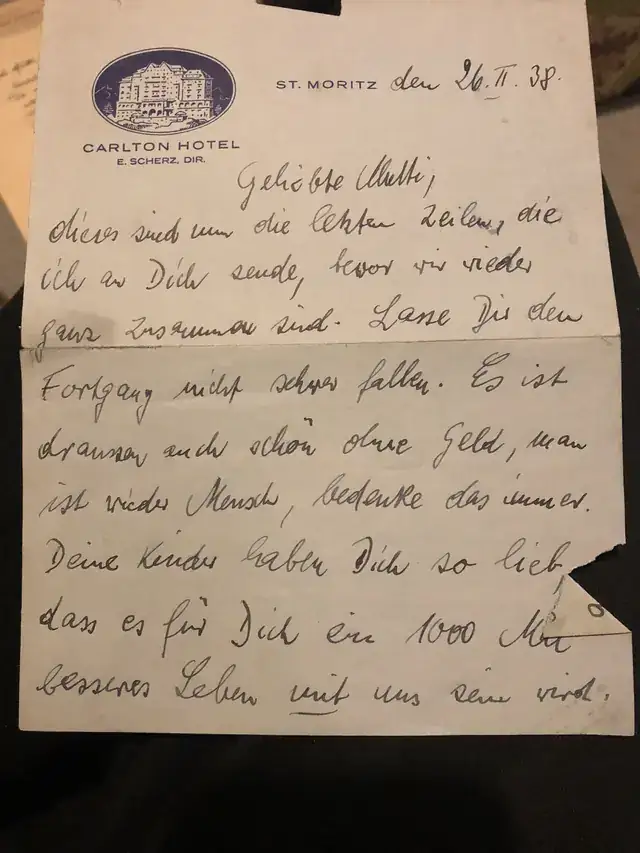 Document / objectThe first surviving sheet of Dolf’s letterFirst surviving sheet, photographed directly. Dolf wrote these lines to his mother, Margarete, on 26 November 1938. This is only the first half of the letter; the second sheet completes his message.
- Document / objectThe full mount keeps Dolf’s childhood portrait and pencil marks togetherThis photograph shows the complete mounted portrait of young Dolf Reichenbach, including tape, tears and faint writing along the lower edge. The family kept the physical mount, and matching details join it to the separate inscription view. It confirms that the pencil is on the front mount, but the note remains only partly legible.
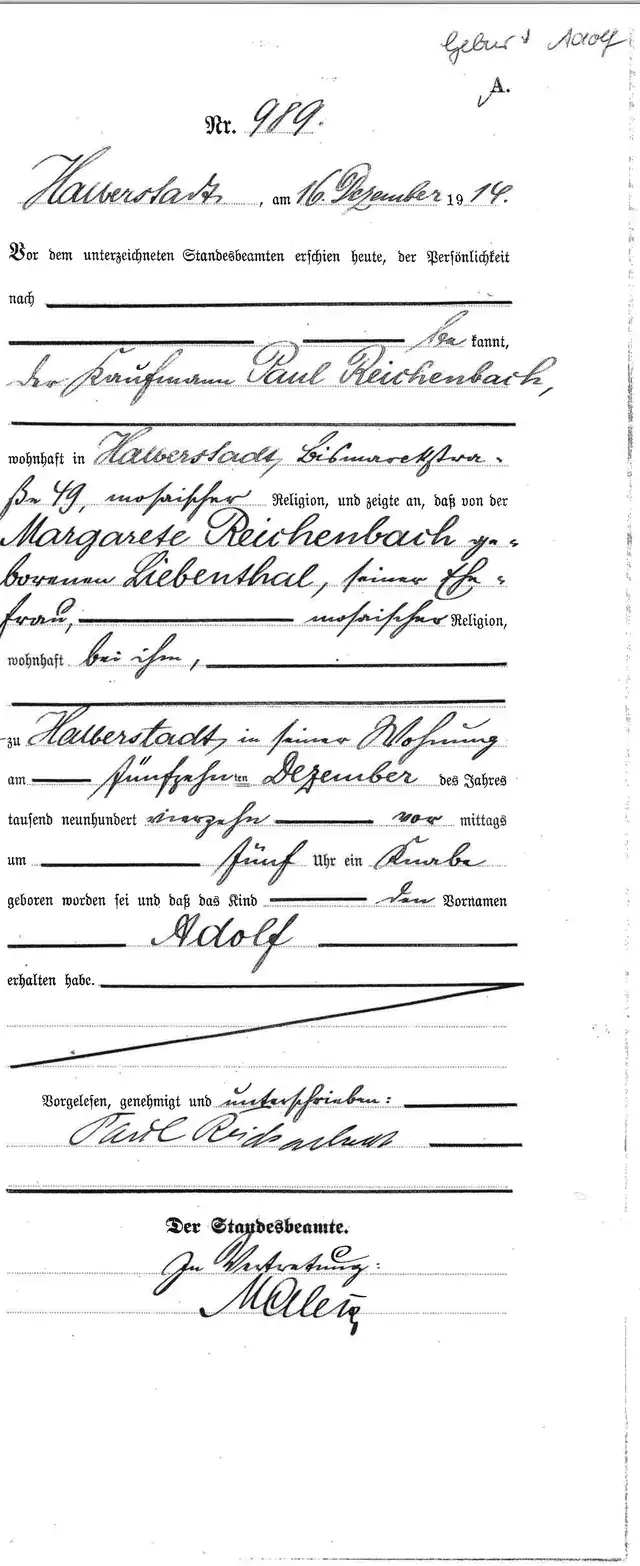 Document / objectThe register records Dolf’s birth in HalberstadtThis civil entry records Adolf Reichenbach’s birth on 15 December 1914 to Paul and Margarete Reichenbach. The family later called him Dolf. The page anchors his name, date and parents before exile, but it does not tell the later story of his departure.
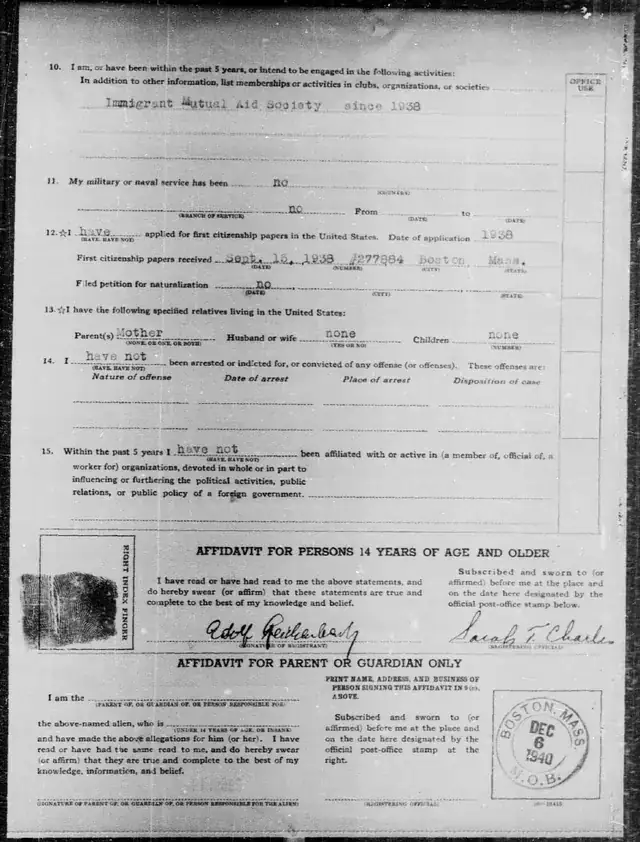 Document / objectThe second page of Dolf’s Alien Registration FormThe second page records membership in the Immigrant Mutual Aid Society since 1938, Boston first citizenship papers dated 15 September 1938, and Dolf’s signature and fingerprint. Together with the first page, it documents Dolf’s legal position in America. It does not resolve the travel sequence that also places him in St. Moritz in November 1938.
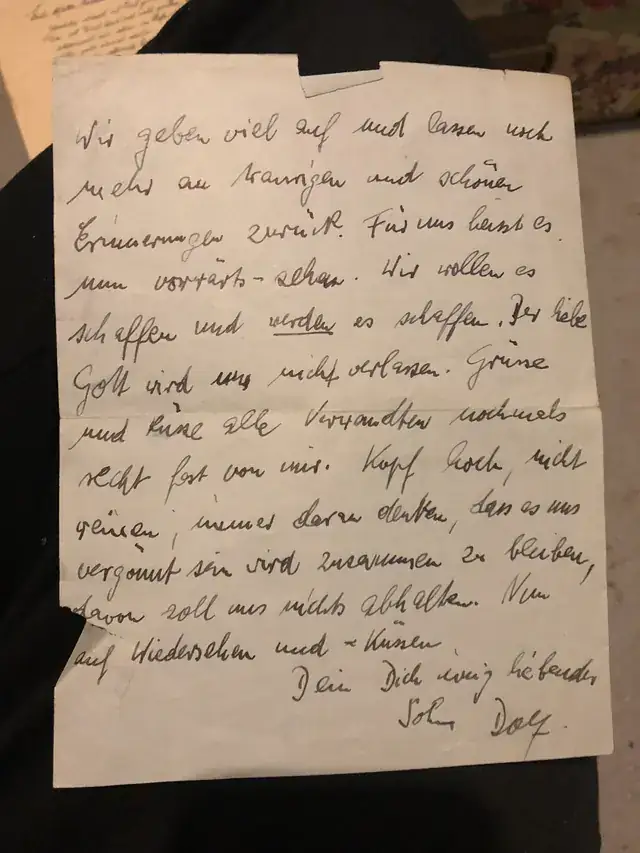 Document / objectThe second surviving sheet of Dolf’s letterSecond surviving sheet, photographed directly. Dolf closes the letter to his mother with the words preserved in Rabbi Dr. Esther Jilovsky’s English translation. This sheet should be read after the first surviving page.
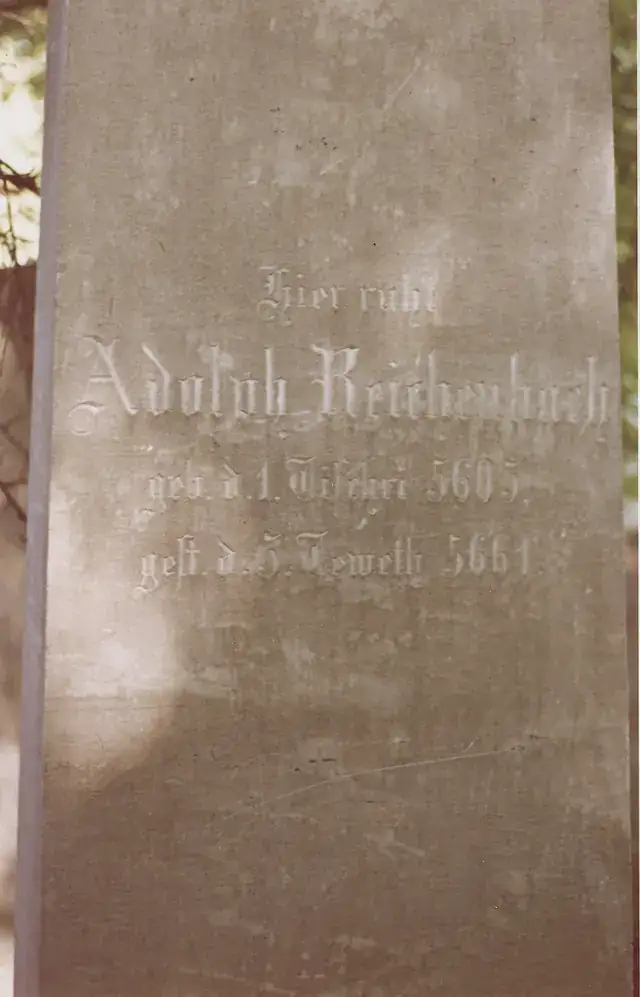 Document / objectAdolf’s gravestone looked less weathered in the 1970sThis family photograph shows Adolf Reichenbach’s gravestone during a return to Halberstadt in the 1970s. A descendant stood before the stone and recorded its condition before another half-century of weathering. The image supports comparison with the stone today, but it does not fix the exact visit date or photographer.
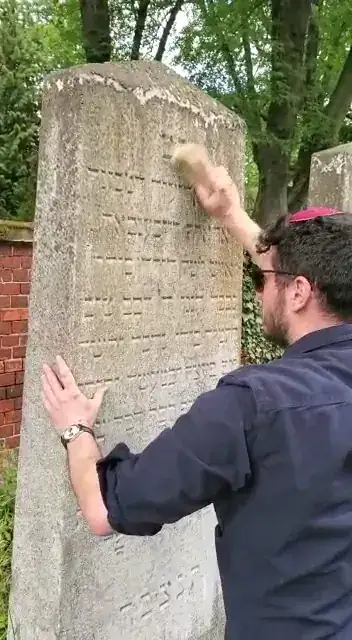 Document / objectDaniel cleans the Hebrew face of Adolf’s gravestoneIn this family-held video Rabbi Daniel Dolph Reichenbach cleans the Hebrew face of Adolf Reichenbach’s gravestone. His hands help the weathered inscription emerge during the family return. The video records the cleaning, but it cannot restore every lost letter or resolve the conflicting civil and Hebrew dates.
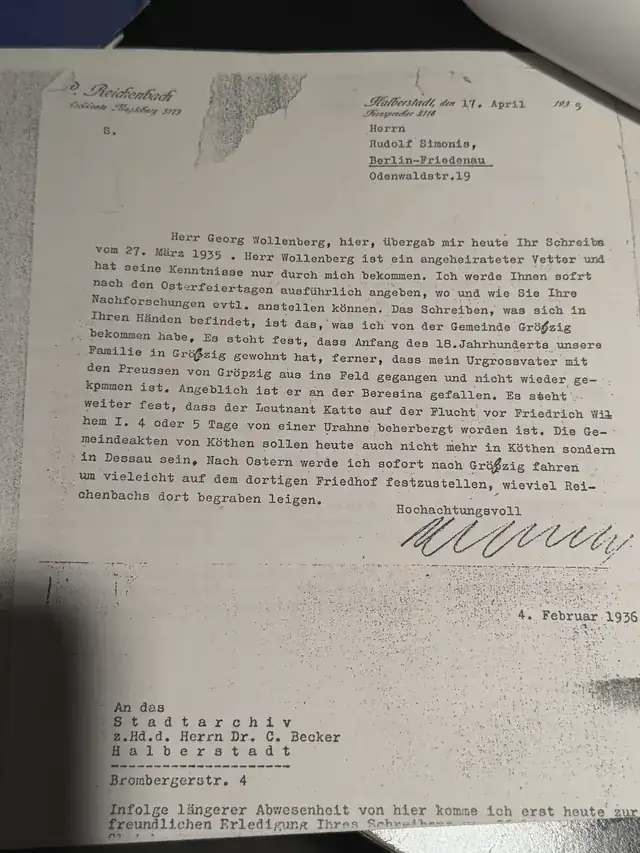 Document / objectPaul Reichenbach to Rudolf SimonisPaul reports what he had learned about the family in Gröbzig and planned to inspect the cemetery after Easter. The same signed letter survives in Rudolf Jakob Simonis’s professional genealogy collection. Paul’s Berezina and Lieutenant Katte accounts are inherited traditions reported in the letter, not independently proved by it.
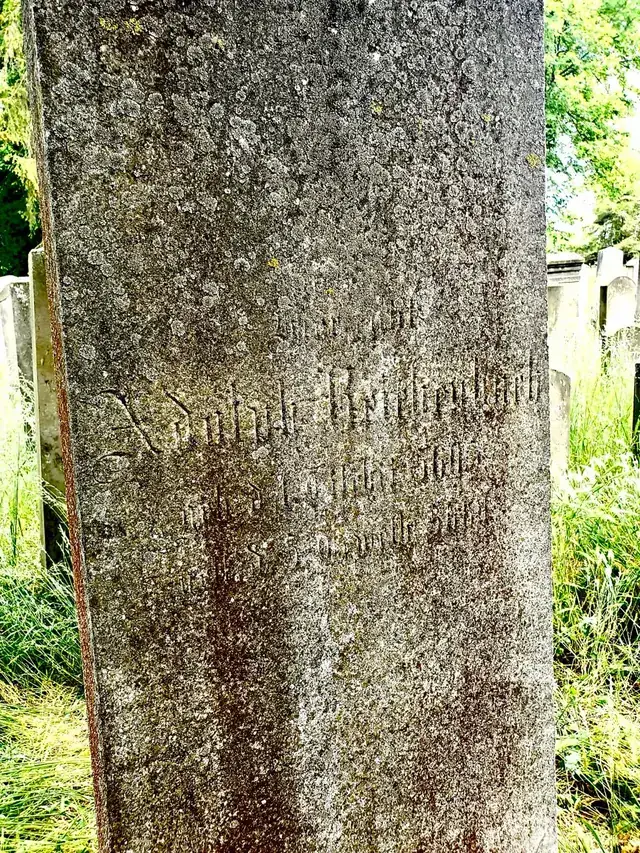 Document / objectThe German face of Adolf’s stone gives a second death dateThis photograph shows the German face of Adolf Reichenbach’s gravestone in its present condition. The stone gives 5 Tevet 5661, corresponding to 26 December 1900, while the cemetery register records 27 December. Both dates remain visible because the photograph cannot decide which record is correct.
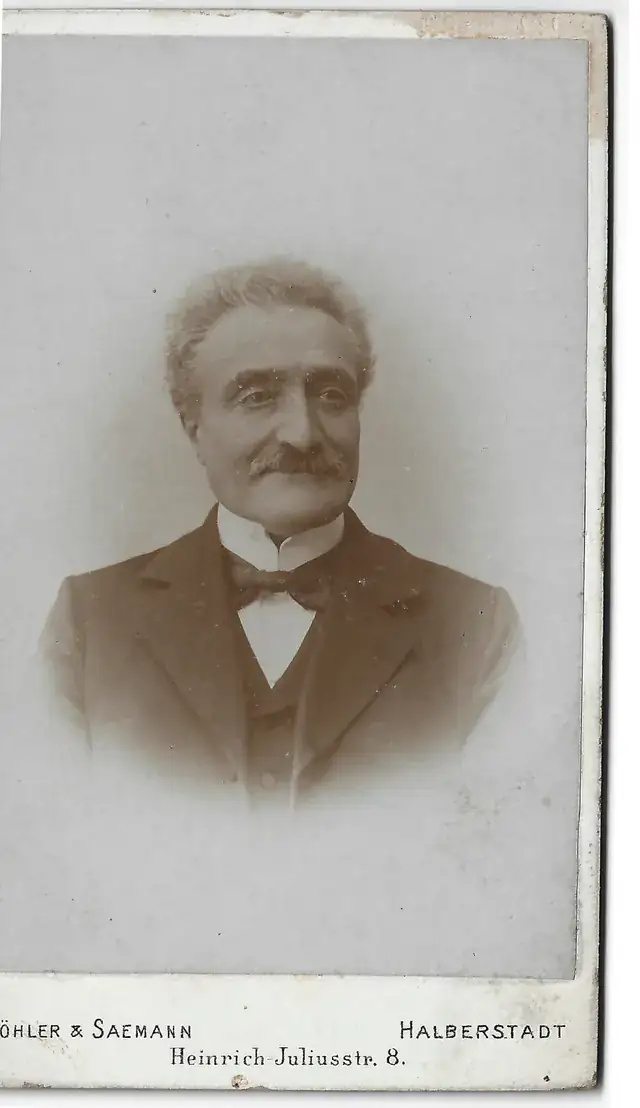 Document / objectThis portrait shows Adolf Reichenbach, Paul’s fatherThe family identifies the sitter as Adolf Reichenbach. Comparison with the memorial portrait and gravestone photographs supports the name that descendants kept with the image. The likeness is secure enough to publish, but its date, studio and photographer remain unknown.
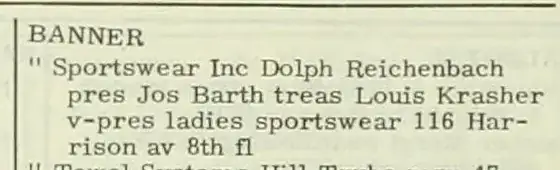 Document / objectA Boston directory names Dolph Reichenbach as Banner Sportswear’s presidentThis 1964 Boston directory entry lists Banner Sportswear Inc. at 116 Harrison Avenue, eighth floor, as a ladies’ sportswear business. It names Dolph Reichenbach as president, Jos Barth as treasurer and Louis Krasher as vice-president. The entry places Dolf in Boston’s garment trade in 1964, but it does not establish when the company began or how its ownership was divided. It is not the entry for Adolfo Sardiña and not Banner Bros. of Jamaica Plain.
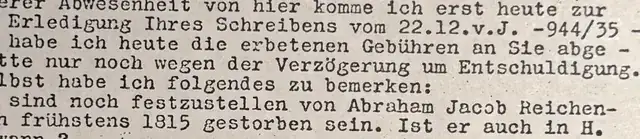 Document / objectAn unsigned page continues the search Paul beganThis archival query asks about Abraham Jacob Reichenbach and Therese Frank and cites a Halberstadt file. It sits in Rudolf Jakob Simonis’s genealogy papers immediately after Paul’s signed 1935 letter and postdates Paul’s death. The placement strongly suggests Simonis continued the inquiry, but the unsigned page does not prove authorship.
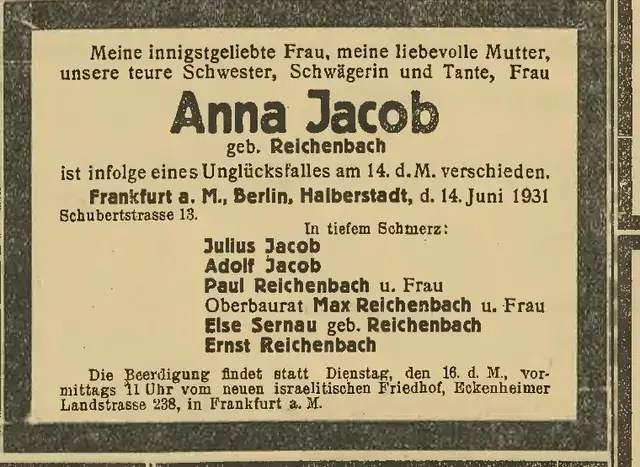 Document / objectAnna Jacob’s death notice gathers the family around her nameThis 1931 newspaper notice names Anna’s husband Julius, their son Adolf, and Paul, Max, Else and Ernst Reichenbach among the mourners. The family placed the notice after Anna’s death following an accident. It establishes a close household and family circle, but it does not assign every stated relationship or name Anna’s parents.
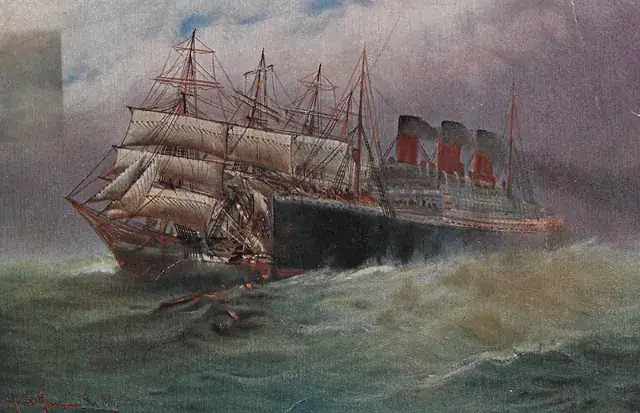 Document / objectCollision in Foggy Weather — postcard pictureThe dramatic ship picture on the postcard signed Dolf.
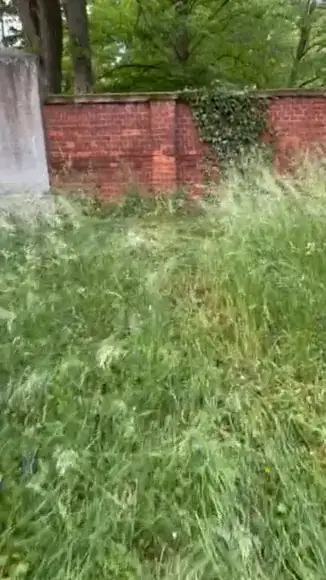 Document / objectDaniel and Paul J. walk the family cemeteryThis family-held video follows Daniel and Paul J. Reichenbach through the Jewish cemetery at Klein Quenstedter Straße. Father and son move among the stones during their return to Halberstadt. The walk connects living descendants with the burial ground, but it is not a complete survey of every family grave.
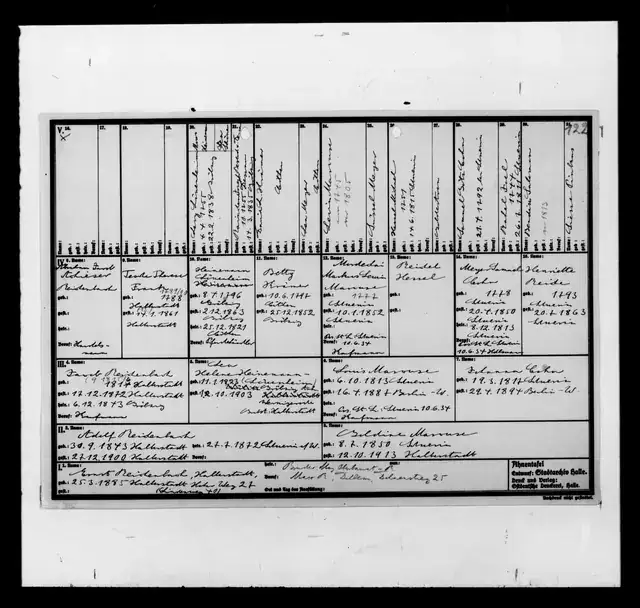 Document / objectErnst Reichenbach’s chart reaches into earlier family generationsThis compiled pedigree names Ernst, his parents Adolf and Goldine, and earlier Reichenbach, Heinemann and Marcuse ancestors. A genealogist made the chart, and the family names passed through that hand before reaching the institutional collection. It guides research, but each relationship still requires support from civil, communal or cemetery records.
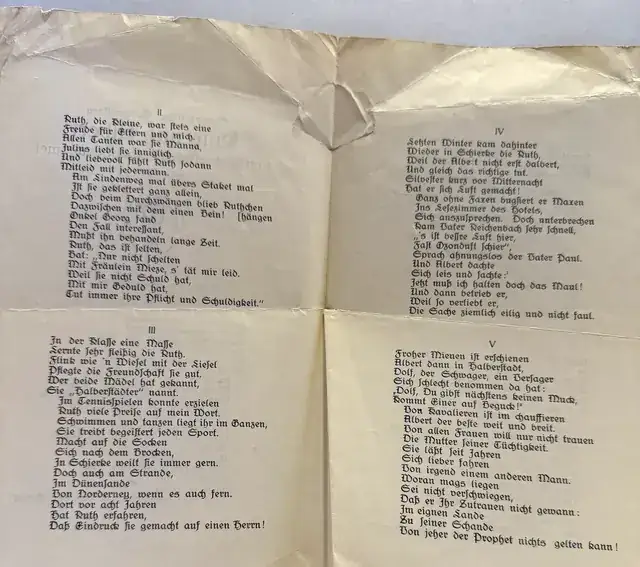 Document / objectFour verses from Ruth and Albert’s wedding songFour comic verses move from Ruth’s childhood and athletic life to the courtship in Schierke and Albert’s arrival in Halberstadt. Dolf wrote the song for a family celebration. Its jokes preserve family knowledge, but they do not establish every date or place they mention.
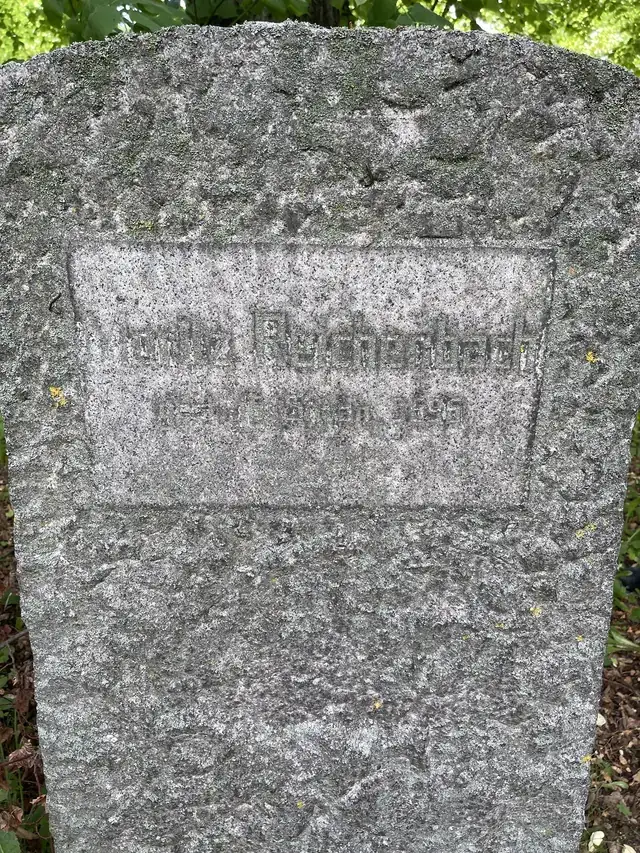 Document / objectMoritz Reichenbach’s gravestone names the Quedlinburg merchantThis gravestone belongs to Moritz Reichenbach, the merchant connected with Quedlinburg and recorded in Hebrew family evidence as Moshe HaLevi. Mourners placed the stone in the Halberstadt cemetery beside his wife’s plot. It identifies this household, but their relationship to the principal Jacob–Adolf–Paul line remains unresolved.
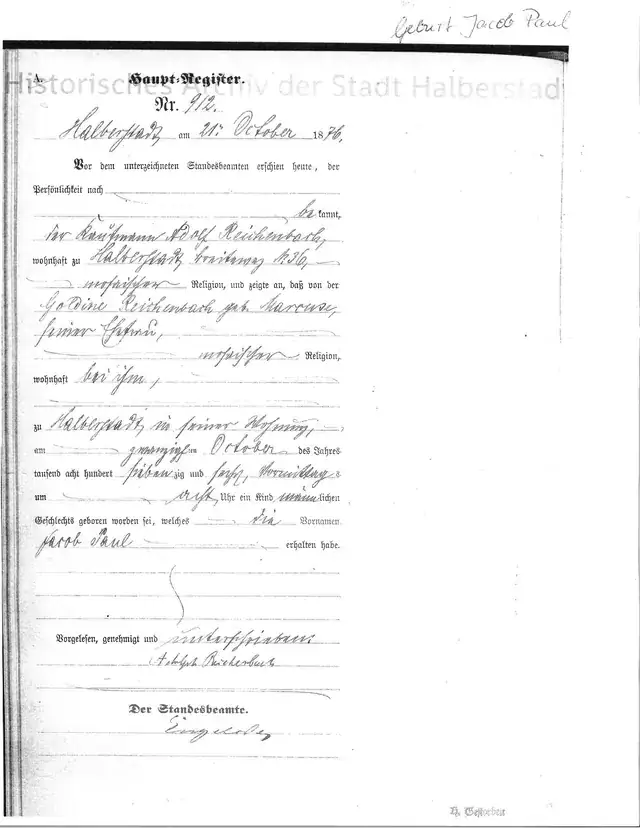 Document / objectPaul entered the civil register as Jacob Paul ReichenbachThis birth entry records Jacob Paul Reichenbach, born on 20 October 1876 to Adolf and Goldine Reichenbach. The family and later public records usually call him Paul, while his gravestone uses the Hebrew form Yaakov. The page establishes his civil name and parentage, not how he chose among those names in daily life.
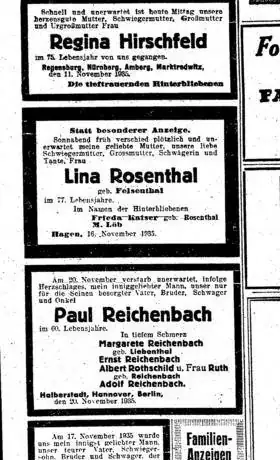 Document / objectPaul Reichenbach’s family announces his deathTwo days after Paul’s sudden death, his family placed this notice in the Central-Verein-Zeitung. It names Margarete née Liebenthal, Ernst, Albert Rothschild and Ruth née Reichenbach, and Adolf. This is a paid family Todesanzeige, distinct from the family-held Trauer-Album; it does not list Paul’s offices.
 Document / objectReverse with Boston and Newton voter-registration stampsReverse with Boston and Newton voter-registration stamps, preserved as a related view of RB-DOC-0213.
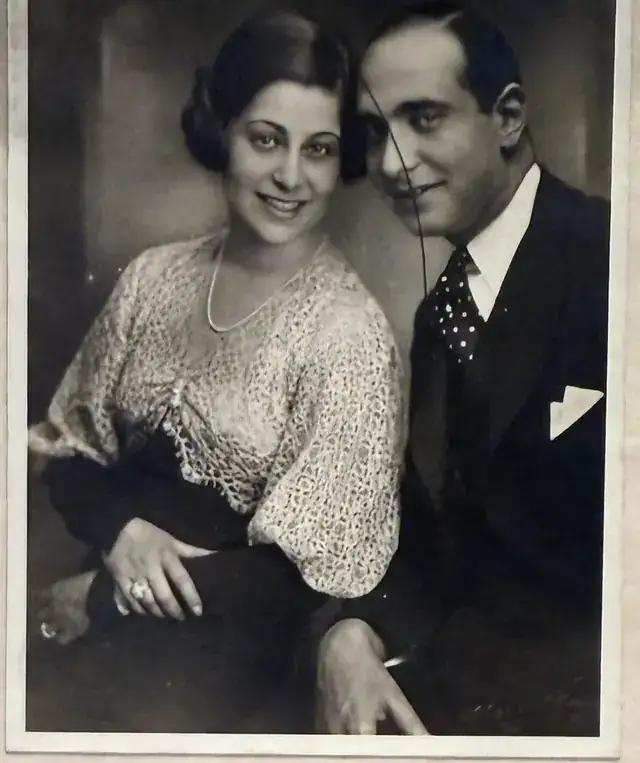 Document / objectRuth Reichenbach and Albert RothschildThe wedding booklet preserves this photograph of Ruth and Albert together. The booklet names them as the couple being celebrated. The small print does not identify its photographer or date.
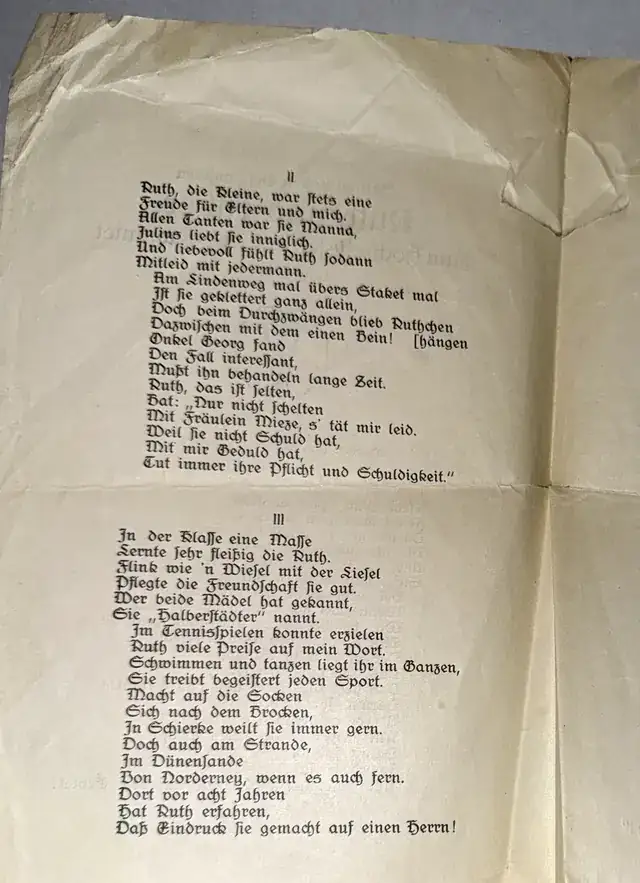 Document / objectRuth’s childhood in a closer view of the wedding songA closer overlapping view preserves the booklet’s account of Ruth’s childhood, sport and travel. The overlap helps read damaged or faint lines in the same booklet. It is another view of the same pages, not a separate version of the song.
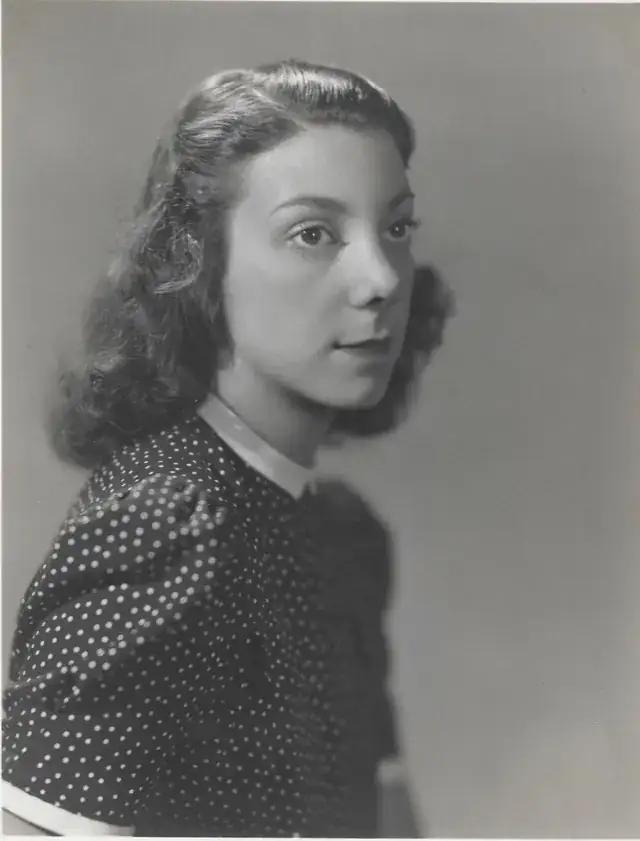 Document / objectSusan “Subie” Ulmer Reichenbach at seventeen or eighteenSusan “Subie” Ulmer Reichenbach at about seventeen or eighteen years old, before her marriage to Dolf. The family identifies Subie and gives her approximate age. The studio, place and photographer remain unknown.
- Document / objectSusan Reichenbach Heyman remembers her father’s escapeDolf and Subie’s daughter recalls her father’s escape. Recorded in Newton, Massachusetts, on 5 August 2026 and published with the speaker’s permission.
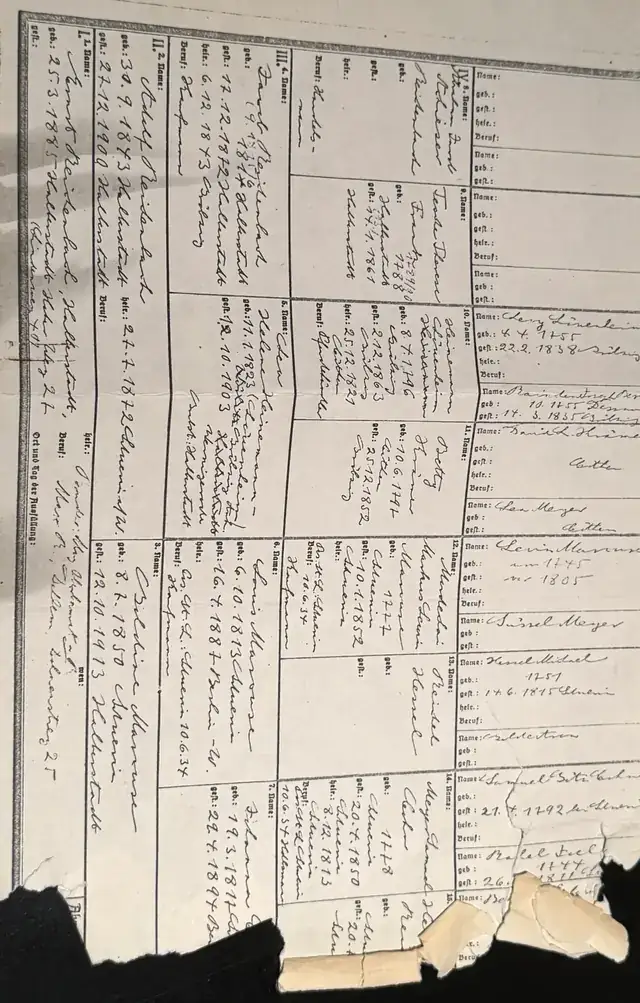 Document / objectThe family filled this ancestry chart by handThis original pedigree names Adolf and Goldine, Jacob and Helene, and earlier Marcuse, Cohn, Heinemann and Krömer ancestors. A family compiler wrote the names into the printed form and passed it down with the papers. It preserves remembered genealogy, but each relationship still needs independent confirmation.
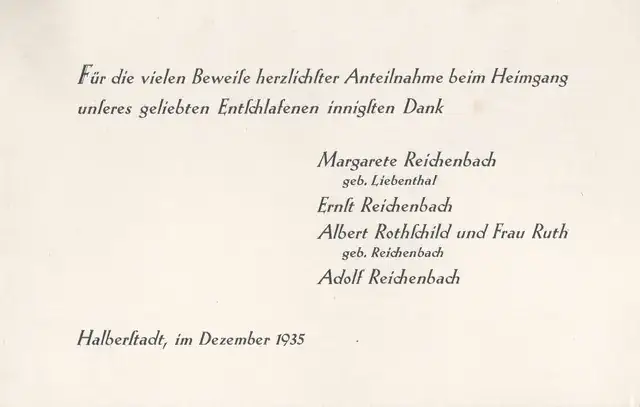 Document / objectThe family thanked mourners after Paul’s deathThis printed card acknowledges the condolences received after Paul Reichenbach died. Margarete and the family sent or kept it as part of the public rituals of mourning. It records their thanks, but it does not name every person who wrote or visited.
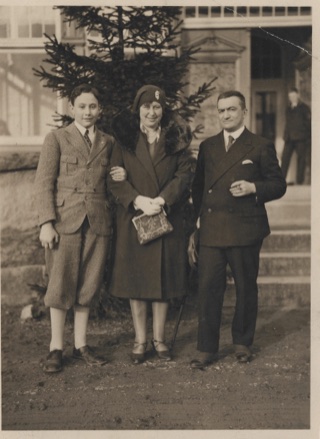 Document / objectThe Reichenbach familyDolf, Margarete and Paul Reichenbach, before 1935. The family kept this photograph of one household together. No date or photographer survives with the print.
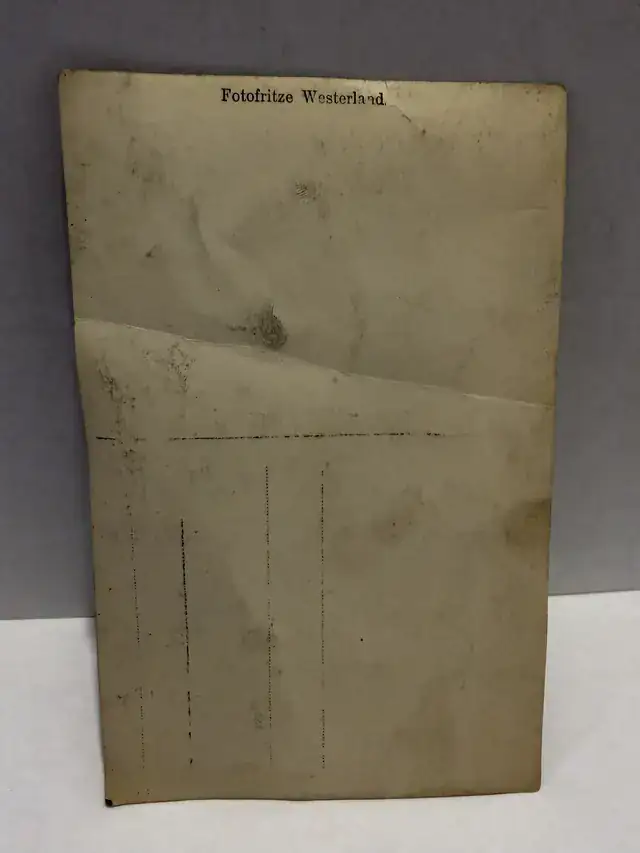 Document / objectThe reverse names the Westerland photo shopThis photographed reverse bears the mark “Fotofritze Westerland” behind the seaside family print. The mark shows where the photograph was processed or sold and remained attached as the family kept it. It does not identify the photographer or fix the exact date.
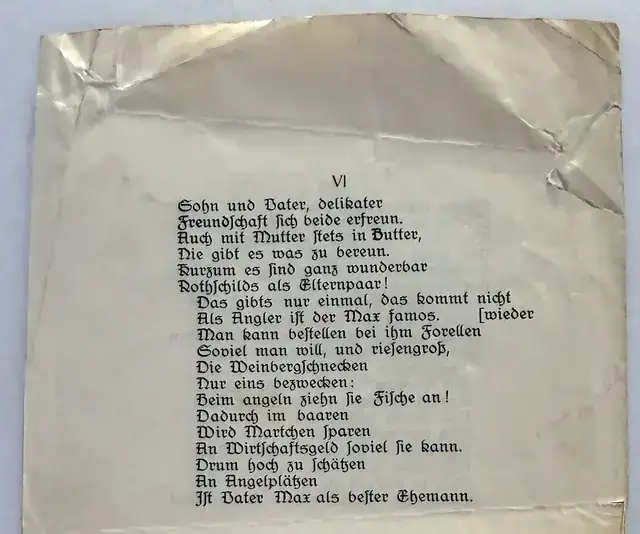 Document / objectThe sixth verse of Ruth and Albert’s wedding songThe sixth verse welcomes Albert’s parents into the comic family portrait and jokes about Max Rothschild’s fishing. Dolf wrote the joke for the wedding gathering. The verse tells us how the family spoke to one another, not whether every comic detail was literal.
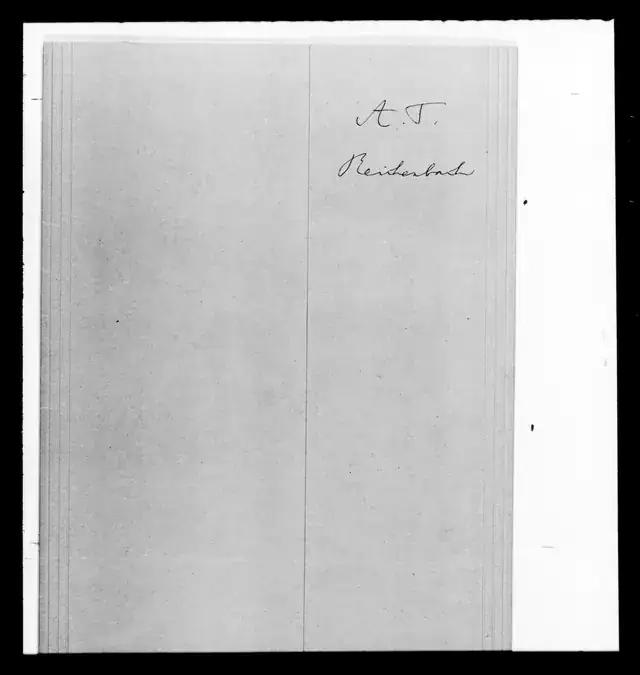 Document / objectThis cover belongs with Ernst Reichenbach’s compiled ancestry chartThis institutional access image shows the cover kept with Ernst Reichenbach’s pedigree. An earlier genealogist assembled the chart, and the Leo Baeck Institute now holds the record. The cover joins the file but does not itself prove any family relationship.